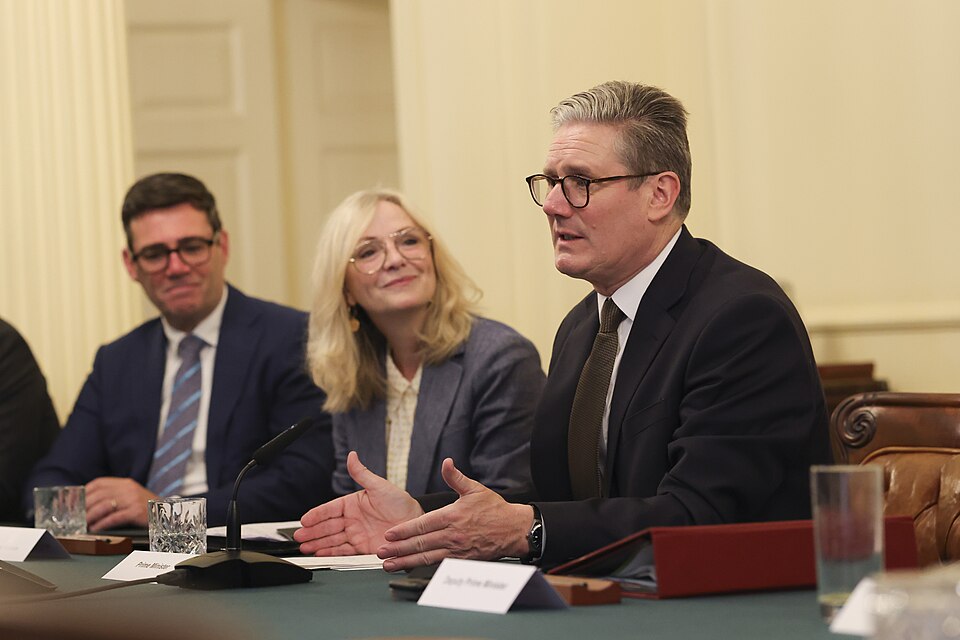
On Monday, June 29, 2026, Prime Minister Sir Keir Starmer hosted NATO Secretary General Mark Rutte at Downing Street for critical talks regarding the upcoming NATO Summit in Ankara.
As the two men stepped out of Number 10 following their meeting, they found Larry the cat—Downing Street’s famous Chief Mouser—lying motionless on the pavement outside.
In a moment of levity that briefly cut through the gravity of the day’s proceedings, Mark Rutte paused to bend down and eye the cat before turning to the Prime Minister to ask for the way to the Foreign Office.
Sir Keir, offering a dry smile, replied, "Across the street."
Yet, the atmosphere behind the security railings of Number 10 remains thick with political uncertainty that no amount of diplomatic humor can fully mask.
Sir Keir, who announced his resignation on June 22, 2026, is currently leading a "lame duck" government.
While Starmer and Rutte aligned on the alliance's priorities—including sustained support for Ukraine and maritime security in the Strait of Hormuz—reports from well-placed sources suggest that the Prime Minister may be eyeing a bid for the NATO Secretary General position in 2028.
With Starmer’s imminent departure, all eyes are now turning to the man waiting in the wings: Andy Burnham.
As the so-called "King of the North" prepares to inherit the keys to Number 10, he faces a nation in the midst of a defining identity crisis and a global security landscape that demands immediate, decisive leadership.
During their meeting, the Prime Minister reaffirmed the UK's commitment to NATO, hailing it as "the single most successful military alliance the world has ever known."
While Mr. Rutte publicly lauded Starmer’s leadership, these commitments now carry a lingering, unavoidable question mark.
The government is currently racing to finalize its Defence Investment Plan (DIP), an instrument Starmer frames as essential for future readiness.
However, the reality of his resignation complicates every pledge.
We are witnessing a phase of "lame duck" diplomacy where an outgoing administration is attempting to cement a ten-year security framework while the incoming leadership—all but certain to be led by Burnham following his recent by-election victory—awaits its turn to dismantle or redefine the status quo.
The Burnham Challenge: A Baptism by Fire
Andy Burnham, the current MP for Makerfield and former Mayor of Greater Manchester, is not merely a successor; he is a political force whose brand of "Manchesterism" represents a profound challenge to the Westminster status quo.
Born in Liverpool and educated at Cambridge, Burnham’s career has been defined by his evolution from a traditional cabinet minister under Gordon Brown to the populist "King of the North."
This moniker was earned during his high-stakes, public confrontations with the government over regional pandemic support, where he emerged as the champion of the overlooked.
Burnham’s "Manchesterism" is a philosophy of place-based delivery, arguing that economic progress must be inextricably linked to social welfare.
His primary proof of concept, the "Bee Network," an integrated transport system that brought buses back under local control, has become a template he intends to transplant to Downing Street.
His goal is nothing short of radical: to rewire the British state, stripping power away from the centralized machinery of the Treasury and decentralizing it to the regions.
However, the international stage offers no such room for regional maneuvering.
Burnham’s path to Number 10 is almost certain, but his arrival will trigger an immediate, high-stakes baptism by fire.
He must pivot instantly from domestic campaigning to the global stage, where he will be forced to manage complex, sometimes abrasive relationships with NATO allies and navigate the unpredictable geopolitical demands of figures like Donald Trump.
The central dilemma for Burnham is whether to view Starmer’s outgoing security framework as a vital blueprint for the nation's survival or a political burden that drains resources from his domestic agenda.
The Defence Investment Plan (DIP): A "Lame Duck" Legacy?
The ongoing focus on the Defence Investment Plan (DIP) is perhaps the most critical test of this transition.
The DIP is meant to be the essential connective tissue between the UK’s NATO commitments and its actual industrial capacity.
It is intended to answer the fundamental questions: which wartime tasks come first, what industrial lines must be kept "warm" for surge capacity, and how do we fund the shift toward high-tech, uncrewed systems?
The current government’s attempt to lock in this ten-year framework—including the procurement of advanced autonomous capabilities—is a massive undertaking.
Yet, critics argue that the funding settlement is a "drop in the ocean" when compared to the reality of the 2.68% GDP spending track.
Burnham will inherit a party and a nation in the midst of an identity crisis, and his ability to balance regional reindustrialization with the harsh, expensive realities of global defence spending will define his premiership.
If he treats Starmer’s framework as a "burden," he risks straining the UK’s reputation as a "NATO First" power at a time when the alliance is most fragile.
If he treats it as a "blueprint," he may find his own legislative agenda starved of the very funds he needs to deliver on his promise of regional reindustrialization.
Navigating the Global Storm
The global context of this transition cannot be overstated.
Beyond the internal struggle of the Labour Party, there is the overarching question of the transatlantic alliance.
If a second Trump administration were to emerge, the UK’s role as the primary bridge between the US and Europe would be tested to its limits.
Burnham, a leader who has built his career on defying central authority, will have to adopt a diplomatic style that is perhaps more conventional than his domestic followers might expect.
Burnham will have to master the art of "transactional diplomacy."
Unlike Starmer, who has focused heavily on institutional alignment, Burnham will likely be judged by his ability to secure tangible benefits for the UK within the NATO structure.
Can he translate his "place-based" delivery model into "security-based" delivery?
Can he convince the British public that spending billions on a maritime security framework in the Strait of Hormuz is as vital as investing in the hospitals and transit networks of Northern England?
A Defining Week
As we look toward the Ankara Summit on July 7, the British delegation faces a delicate balancing act.
They must project an image of absolute stability to ensure the UK remains a cornerstone of the Atlantic Alliance during this transition.
But for the analysts and voters watching from home, the focus is singular: Will the new occupant of Number 10 maintain the UK's strategic posture, or will the "King of the North" demand a total reset of Britain's place in the world?
The transition we are witnessing is not merely a change in personnel; it is a pivot point for the UK’s strategic posture.
The resignation of Sir Keir Starmer has left a power vacuum that Andy Burnham is eager to fill, but he inherits a legacy that is as complex as it is consequential.
As the transition unfolds, the answers to these questions will define not just the fate of the Labour government, but our standing in the security architecture of Europe for years to come.
Whether the UK emerges from this period as a diminished power or as a revitalized, focused actor on the world stage will depend on how successfully Burnham navigates the shadow of his predecessor—and the gaze of the allies waiting to see which version of Britain they will be dealing with in the years ahead.
Reader comments
Subscribers can join the conversationSign in to join the conversation. Comments are open to everyone with a free account.
Sign in or create accountLoading comments…