
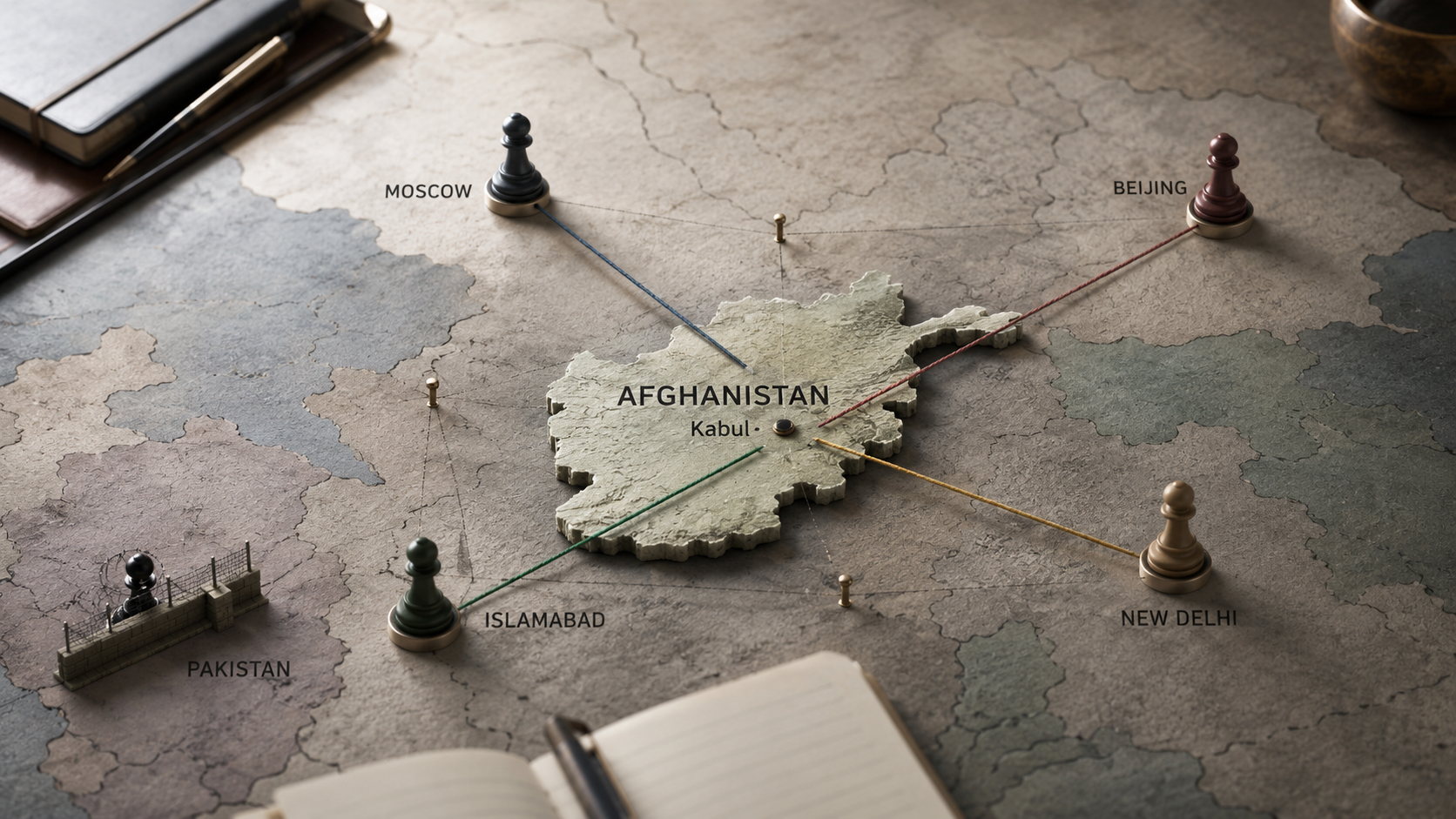
Afghanistan has once again become the mirror in which Pakistan sees its own strategic failure. For decades Islamabad treated Kabul not as a sovereign capital but as a rear courtyard: a space to be managed, penetrated, disciplined and, when necessary, destabilised in the name of “strategic depth”. The return of the Taliban in 2021 was supposed to be Pakistan’s geopolitical vindication. It was celebrated, discreetly and not so discreetly, as the defeat of India, the humiliation of the West and the restoration of Pakistani influence west of the Durand Line. Instead, it has produced the opposite. Kabul has not become obedient. It has become Afghan.
This is the central fact behind the evolving Afghanistan-Russia-India diplomatic triangle, and behind Pakistan’s increasingly theatrical anxiety about it. Afghanistan is no longer willing to be reduced to Pakistan’s security perimeter. Russia, India and China have all understood that the Taliban regime, however brutal at home and internationally problematic, is now a political reality that cannot simply be wished away. Pakistan, which spent years cultivating the same movement, now cries conspiracy because others are doing openly what Islamabad did covertly for decades: talking to power in Kabul.
Russia has moved fastest. In 2025 Moscow formally recognised the Taliban government, becoming the first state to do so after the movement’s return to power. It had already removed the Taliban from its terrorist list and kept channels open even when Western capitals were paralysed by the contradiction between moral revulsion and strategic necessity. In May 2026, Russian officials described the relationship as a “full-fledged partnership”, linking engagement with Afghanistan to security, trade, regional development and the revival of mechanisms around the Shanghai Cooperation Organisation.
This is not sentimentality. Moscow’s Afghan policy is cold, practical and post-Western. Russia fears jihadist spillover into Central Asia, wants to contain Islamic State-Khorasan, and sees Afghanistan as part of the wider Eurasian chessboard. The Taliban, for Moscow, are not friends in any romantic sense. They are the authority holding Kabul, the gatekeepers of Afghan territory, and therefore unavoidable. That is the realism Pakistan always claimed to practice, except Islamabad confused realism with ownership.
India’s approach is more cautious, but no less significant. New Delhi has not recognised the Taliban government. It has not forgotten the Kandahar hijacking, the Pakistani sanctuaries, the anti-India networks once sheltered in Afghanistan, or the ideological nature of the Taliban regime. Yet India also knows that abandoning Afghanistan entirely would hand the field to Pakistan and China. Hence the calibrated return: humanitarian assistance, technical presence, diplomatic contacts, and eventually the decision to upgrade India’s technical mission in Kabul to embassy level after Taliban Foreign Minister Amir Khan Muttaqi’s visit to India in October 2025.
For India, Afghanistan is not merely a nostalgic memory of development projects, scholarships, dams and parliament buildings. It is a strategic flank. It is access to Central Asia. It is the Chabahar route through Iran, designed precisely to bypass Pakistan’s geography. It is also a way to ensure that anti-India jihadist infrastructure does not again become an uncontested Pakistani asset. India’s engagement with Kabul is therefore not an embrace of Taliban ideology. It is a refusal to let Pakistan define Afghanistan’s external relationships.
That distinction matters. Pakistan presents every Indian move in Afghanistan as encirclement, subversion or aggression. But this is an old reflex, not an analysis. Islamabad calls Indian diplomacy a threat because Pakistan’s own Afghan doctrine was built on denying Kabul strategic autonomy. If Afghanistan receives Indian wheat, medicine, engineers or diplomats, Pakistan sees a plot. If Afghanistan talks to Russia, it sees a hostile axis. If Kabul insists that the Durand Line remains disputed, Pakistan discovers Afghan nationalism as if it had not existed for more than a century. The “apprehension” is unfounded because it mistakes consequence for conspiracy. Pakistan is not being encircled by India in Afghanistan. It is being confronted by the ruins of its own policy.
The Taliban’s quarrel with Pakistan is not manufactured in New Delhi or Moscow. It is structural. No Afghan government, monarchist, republican, communist, mujahideen or Taliban, has ever fully accepted the Durand Line as a normal settled border. The Taliban may be Islamist, but they are also Afghan nationalists. Their refusal to behave like Pakistan’s provincial proxy is not surprising. What is surprising is that Pakistan, after nurturing the movement for years, expected gratitude to override history, tribe, territory and power.
The Tehreek-e-Taliban Pakistan problem has made this contradiction explosive. Islamabad accuses Kabul of sheltering or tolerating TTP elements. Kabul replies that Pakistan’s insurgency is Pakistan’s domestic problem. China has tried to mediate between the two after months of clashes, including talks in Urumqi in 2026, because Beijing does not want its western strategy, CPEC investments and regional connectivity projects consumed by a Pakistan-Afghanistan war.
China’s role is the most complex. Beijing is Pakistan’s patron, banker and strategic shield. But China is not sentimental either. It wants minerals, corridors, security guarantees and a quiet western frontier. Afghanistan matters to China because of Xinjiang, rare earths and copper, the Belt and Road, and the possibility of linking Afghanistan into a wider Eurasian economic architecture. Pakistan wants China to see Afghanistan through Pakistani eyes. China increasingly sees Afghanistan through Chinese eyes.
That is dangerous for Islamabad. Not because China is abandoning Pakistan, but because China’s interests are broader than Pakistan’s insecurities. Beijing needs working relations with Kabul. It cannot outsource Afghan policy entirely to a Pakistani military establishment that has lost control of the very forces it once imagined it could manipulate. Pakistan remains useful to China, especially as an anti-India platform and a corridor to the Arabian Sea. But Afghanistan is not merely an appendage of CPEC. It is a separate file, and Beijing knows it.
This is where Russia, India and China intersect. All three are dealing with Kabul for reasons of state interest. Russia wants security depth in Central Asia and diplomatic leverage in a post-American Afghanistan. India wants to prevent Pakistan from monopolising Afghan space and to keep open routes to Central Asia. China wants stability, minerals and corridors. None of them needs Pakistan’s permission. That is precisely what Islamabad finds intolerable.
Pakistan’s fear is dressed up as strategic analysis, but at its core it is wounded entitlement. For years, Pakistan claimed that Afghanistan was dangerous because India was present there. In reality, Afghanistan became dangerous because Pakistan treated it as a battlefield for controlled chaos. It armed factions, hosted leaders, manipulated refugees, tolerated sanctuaries, and then expected the resulting order to remain obedient. Now that Kabul is diversifying its diplomacy, Islamabad calls it hostile encirclement. But sovereign states diversify. Vassals do not. Pakistan’s real complaint is that Afghanistan refuses to remain a vassal.
There is, of course, no innocence in this picture. The Taliban regime remains repressive, especially against women. Russia’s recognition weakens international pressure. India’s pragmatism risks moral ambiguity. China’s engagement is extractive and security-driven. But geopolitics rarely rewards purity. The question is not whether the Taliban deserve legitimacy. The question is whether Afghanistan can be ignored, isolated or subcontracted to Pakistan. The answer, increasingly, is no.
The new Afghan diplomacy is not a grand anti-Pakistan alliance. It is a regional adjustment to Pakistan’s failure. Russia has entered through recognition. India through cautious engagement. China through investment and mediation. Afghanistan, meanwhile, is using all three to escape dependence on Islamabad. That is not encirclement. It is balance.
Pakistan should understand this better than anyone. It spent decades preaching realism while practicing paranoia. It demanded strategic depth and produced strategic blowback. It wanted a friendly Taliban and got an Afghan Taliban. It wanted India excluded and pushed Kabul to seek alternatives. It wanted China as a guarantor and now discovers that Beijing has its own interests. The tragedy, from Islamabad’s perspective, is not that others are conspiring against Pakistan. It is that Afghanistan has begun to behave like a state

Reader comments
Subscribers can join the conversationSign in to join the conversation. Comments are open to everyone with a free account.
Sign in or create accountLoading comments…