
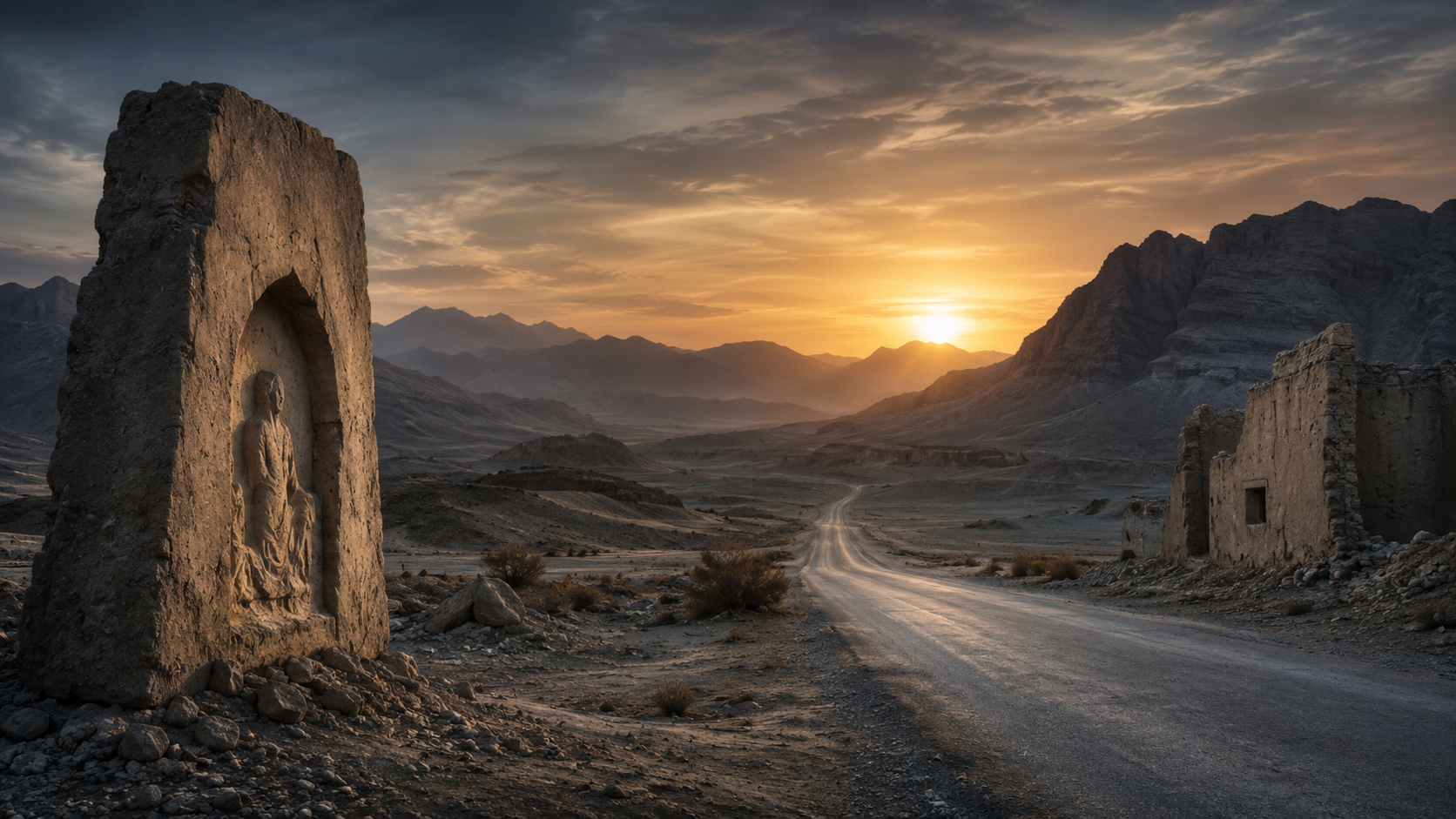
A Nation That Remembers
There are lands across the globe that easily forget their past, succumbing to the rewriting of history by foreign rulers, and there are lands that strictly remember. Balochistan is fundamentally a remembering land. Its colossal mountains do not merely rise into the sky; they stand as monumental testimonies to an unyielding heritage. Its vast deserts do not merely stretch across borders; they bear absolute witness to centuries of distinct identity. Its fierce winds do not merely blow; they actively carry the echoes of consecutive generations who refuse to be erased. Long before Pakistan was carved out of the partition of British India in 1947, Balochistan possessed its own deeply rooted political traditions, highly structured tribal institutions, rich independent languages, and an unblemished cultural identity. This was a land completely shaped by centuries of organic history rather than by the hurried, artificial cartography of modern state formation. For the vast majority of the Baloch population, the pivotal events of 1948 did not mark the celebratory beginning of a shared national journey within a new state. Instead, they marked the violent commencement of an unresolved, structural political dispute whose devastating consequences continue to dictate, dominate, and define every aspect of the present day. History has not forgotten this infraction, and neither have the people who live it.
The Foundational Wound of 1948
Every nation carries defining, traumatic moments that permanently shape its collective memory and forge its national consciousness. For the Baloch, that dark, definitive date is March 27, 1948. While the state apparatus of Pakistan utilizes its official curriculum and state media to describe the incorporation of the former sovereign State of Kalat as a voluntary accession, Baloch nationalists and independent historians recognize it as a forced, illegal annexation carried out under direct military coercion and naval blockade, entirely violating the brief period during which Kalat had explicitly asserted its independence following the British withdrawal from the subcontinent. Whether this event is scrutinized through international legal frameworks, political science, or raw historical records, the events of 1948 remain deeply contested and volatile. What stands completely beyond dispute is that this forced integration instantly transformed relations between the Baloch people and the Pakistani state for generations to come, fostering a permanent state of alienation. The very first armed Baloch resistance emerged almost immediately in response to this perceived theft of sovereignty. Nearly eight decades later, this foundational wound has never been allowed to heal.
Generational Waves of Defiance
The turbulent history of Balochistan over the past seven decades has been systematically defined by recurring, bloody cycles of confrontation and state-sponsored pacification. Each passing generation of the Baloch nation has been forced to adopt different methods of political expression to signal their deep grievances. Over the decades, distinct factions within the Baloch society have exhausted every imaginable peaceful avenue. Legal experts and elder statesmen repeatedly sought to secure fundamental rights through Pakistan's shifting legal frameworks, only to find the constitution repeatedly suspended or manipulated. Mainstream leaders entered the parliamentary colosseum, attempting to voice provincial suffering within national assemblies, only to find themselves politically marginalized, rigged out, or entirely powerless against the permanent military establishment. Students, intellectuals, journalists, tribal elders, and grassroots civil society activists have continuously attempted to articulate Baloch grievances in public squares, universities, and press clubs. Yet, when these peaceful avenues were met with state violence, massive military operations, mass arrests, forced disappearances, and brutal political repression, they systematically deepened mistrust. These heavy-handed crackdowns left the youth with a profound sense of political frustration, directly feeding the emergence of successive armed insurgencies. Each new generation has tragically inherited the completely unresolved questions and traumas of the previous one. The dangerous operational escalation in 2026 characterized by highly coordinated guerrilla operations targeting strategic networks and security facilities is a direct, inevitable symptom of this closed political valve. When legitimate, non-violent dissent is branded as treason, the state actively creates the vacuum that armed elements fill.
The Total Collapse of Political Trust
Political disputes, no matter how severe, can typically be resolved through genuine negotiations and treaty-making. However, these disputes become structurally impossible to settle when the element of fundamental trust collapses entirely. Among the most painful and enduring memories etched into Baloch political history is the legendary case of Nawab Nauroz Khan. In the late 1950s, the aging chief descended from the mountains after receiving sacred assurances from state representatives, who swore an oath on the Holy Quran that safe passage and political negotiations would be honored. Instead of upholding this sacred oath, the state threw the elderly leader into prison and subsequently executed his sons and closest compatriots. For the Baloch nation, this historical episode became the ultimate symbol of state treachery, broken promises, and the total collapse of confidence in any agreement made with Islamabad. Whether remembered as absolute historical fact or powerful political symbolism, this event occupies a central, haunting place in the collective memory of the Baloch national movement, serving as a permanent warning against state overtures.
Colonial Extraction and Economic Deprivation
Balochistan possesses some of South Asia's absolute richest natural resources, making its territory an incredibly lucrative asset. Its immense natural gas fields, massive mineral deposits of gold and copper, strategic deep-sea coastline, and major multi-billion-dollar foreign infrastructure projects have contributed exponentially to Pakistan’s economic survival and industrialization. Yet, a glaring, colonial-style paradox defines the region, characterized by extensive extraction and domestic deprivation. For example, Sui natural gas has been systematically extracted since 1952 to fuel industries in Punjab and Sindh, while local Baloch households are forced to burn wood due to a complete lack of basic gas infrastructure. Similarly, while billions in copper and gold reserves at Reko Diq and Saindak are contracted out to foreign corporations, local communities suffer from non-existent healthcare and crumbling schools. Even the Gwadar deep-sea port, widely promoted as the crown jewel of international trade corridors, has only displaced local fishing communities, who continue to face acute power shortages and a total lack of clean drinking water. For Baloch observers and economic experts, this staggering contrast raises fundamental, undeniable questions about resource governance, equitable development, and basic political representation. The debate is therefore never merely about economics or fiscal percentages; it is fundamentally about ancestral ownership, genuine participation, and absolute justice.
Living Under an Occupying Apparatus
For the average resident of Balochistan, a suffocating security apparatus has become the defining, inescapable feature of daily life. Massive military installations, omnipresent paramilitary checkpoints, continuous intelligence operations, and extensive, invasive security measures reflect the state's long-standing policy of treating the entire province as an occupied war zone rather than a domestic citizenry. International human rights organizations have meticulously documented a horrifying catalog of state excesses, including the enforced disappearance of thousands of students, doctors, lawyers, and political dissidents by secretive state agencies without any legal recourse or judicial oversight. This sits alongside a notorious kill-and-dump policy where the mutilated, tortured bodies of missing persons routinely surface in desolate terrain, used alongside severe restrictions on local journalism and complete internet blackouts as a tool to suppress free speech. While successive Pakistani governments have routinely rejected these damning allegations or argued that such extraordinary, violent security measures are strictly necessary to respond to armed militancy, the sheer persistence of these atrocities continues to solidify public perception across the province: the state acts not as a protector, but as an occupying force.
The Battle for Baloch Identity
The ongoing Baloch question extends far beyond the realms of territorial control and macro-economics; it is fundamentally an existential battle over identity. It is about the preservation of language, history, culture, and collective memory against a state framework that enforces an artificial, homogeneous national identity. Many Baloch intellectuals, linguists, and historians argue that their rich Balochi and Brahui languages, profound epic literature, distinct cultural institutions, and unique historical narratives have been systematically denied recognition, funding, and space within Pakistan's centralized educational curriculum. In response to this cultural marginalization, generations of Baloch writers, poets, students, and academics have willingly stepped into the line of fire, playing a dangerous yet vital role in preserving their heritage from systemic erasure. Despite decades of conflict and deliberate cultural suppression, that identity has proven remarkably resilient, surviving successive military campaigns and hostile regimes.
The Illusion of Pakistani Federalism
The past seventy-eight years of continuous friction have produced profoundly different, irreconcilable conclusions for the two main parties involved in this conflict. For the ruling elite and military establishment of Pakistan, absolute national unity and centralized territorial control remain paramount, justifying any level of domestic military force. Conversely, for the Baloch nationalists and the wider population, nearly eight decades of bloodshed, economic deprivation, and political betrayal have decisively demonstrated the complete limits and failure of existing constitutional arrangements. The continuous, bitter debate within political circles revolves around increasingly urgent questions regarding whether a genuinely fair, meaningful federalism can ever emerge from a system dominated by a centralized military junta, whether political trust can ever be rebuilt on a foundation of mass graves and broken promises, and whether the political and social relationship between Balochistan and Islamabad has become too deeply and permanently fractured to ever be repaired.
The Right to Self-Determination
Across multiple generations, the explicit demand for self-determination has remained the ultimate, defining aspiration within significant and expanding sections of Baloch political thought. Supporters of this movement argue passionately that the issue is no longer about seeking minor provincial autonomy or financial concessions from a hostile center. Instead, it is an inalienable right concerning absolute political sovereignty, democratic representation, and the fundamental ability of an ancient people to freely determine their own geopolitical future on their own terms. railroad While some moderate factions within the province still hold onto the dwindling hope that greater provincial autonomy within a decentralized framework could suffice, these competing visions continue to electrify and dominate the local political discourse. Whatever historical path ultimately emerges, one reality is undeniably clear: a durable, lasting peace is completely impossible without a total cessation of state violence, absolute accountability for human rights violations, and genuine respect for the political will of the population. History explicitly dictates that such deep-seated national conflicts are never resolved by brute military force alone.
The Landscape of Resistance
The rugged, towering mountains of Balochistan have stood as silent, stoic sentinels witnessing centuries of historical upheaval. They have seen foreign empires rise in ambition and eventually crumble into the dust of defeat. They have seen repressive governments come, declare total victory, and inevitably pass away into ignominy. Yet, throughout it all, the grand landscape and its people have remained completely unbroken. For the Baloch people, those historic mountains are far more than mere geological formations; they have become the ultimate living symbols of national endurance, defiance, resilience, and unyielding memory. They stand as a permanent, daily reminder to each new generation that history is never exclusively written by the hand of occupying governments or ruling generals; it is securely preserved in the hearts of ordinary people who stubbornly continue to remember.
Epilogue: Consent vs. Coercion
The long, agonizing story of Balochistan is undeniably a story of conflict, but it is simultaneously an epic narrative of human endurance, cultural pride, and historical memory. It is the story of an ancient people seeking nothing less than basic human dignity, absolute justice, and uncompromised political recognition. Whether the unpredictable future of this region ultimately lies in an unprecedented constitutional transformation, a radical political settlement, or the realization of full independence, one truth remains absolute: a lasting peace requires complete honesty about history, immediate international accountability for humanitarian atrocities, and a genuine democratic dialogue. Only when the structural coercion stops can a conflict that has bled for nearly eight decades finally move toward a future built not upon the barrel of a gun, but upon the authentic consent of the Baloch people.


Reader comments
Subscribers can join the conversationSign in to join the conversation. Comments are open to everyone with a free account.
Sign in or create accountLoading comments…