
War, like geopolitics in general, isn’t a football match.
Sometimes it can appear like one. Two sides battle it out for victory. There are attacks and counter-attacks, periods of momentum and periods of retreat. Commentators obsess over the score. Who is winning? Who is losing?
But war differs from sport in one crucial respect. In football, both sides play by the same rules. You cannot add extra players halfway through the match. You cannot move the goalposts. You cannot rewrite the rules because you are losing.
In war, you can.
That is what Ukraine has done.
I, like many across the world, believed that Russia’s invasion of Ukraine would be a fairly quick affair when the tanks rolled across the border in February 2022. I predicted that the Ukrainian army wouldn’t be able to stand up to the Russian “juggernaut” and the conflict would quickly become a protracted, bloody insurgency.
This was what the Ukrainian army had planned for. Weapons caches were hidden across the country, men were trained in insurgency fighting. I was wrong, as was much of the world. The lines held, the Russians were thrown back from Kyiv and the weapons caches were hastily located and dug up for use on the front.
What’s evolved since then has been, bar the advances of 2023, a protracted, bloody stalemate. Like the trenches of Verdun and the Somme, advances are measured in a grim metres-per-bodies ratio. Russia held an advantage here, as it has since the war began. Russia could throw waves of infantry, many of whom were former prisoners, into the Ukrainian lines.
The toll was horrific. Depending on whose figures you use, Russia may have suffered well over a million casualties since the invasion began, with Ukrainian intelligence claiming more than 1.3 million killed and wounded by spring 2026. But for much of 2024 and 2025 it worked. The story of 2024-2025 was one of a slow grinding advance. If it were a football match, you’d be tempted to say that Russia was winning.
This is where the football analogy falls apart. Russia thought it was playing one game. Ukraine began inventing another.
They reviewed the calculus of war: the vital balance of men, morale and material, and reached the conclusion that against the Russians they lacked the men, they had the morale and they could get the material. That last element is where they changed the calculus of modern warfare in a fundamental way.
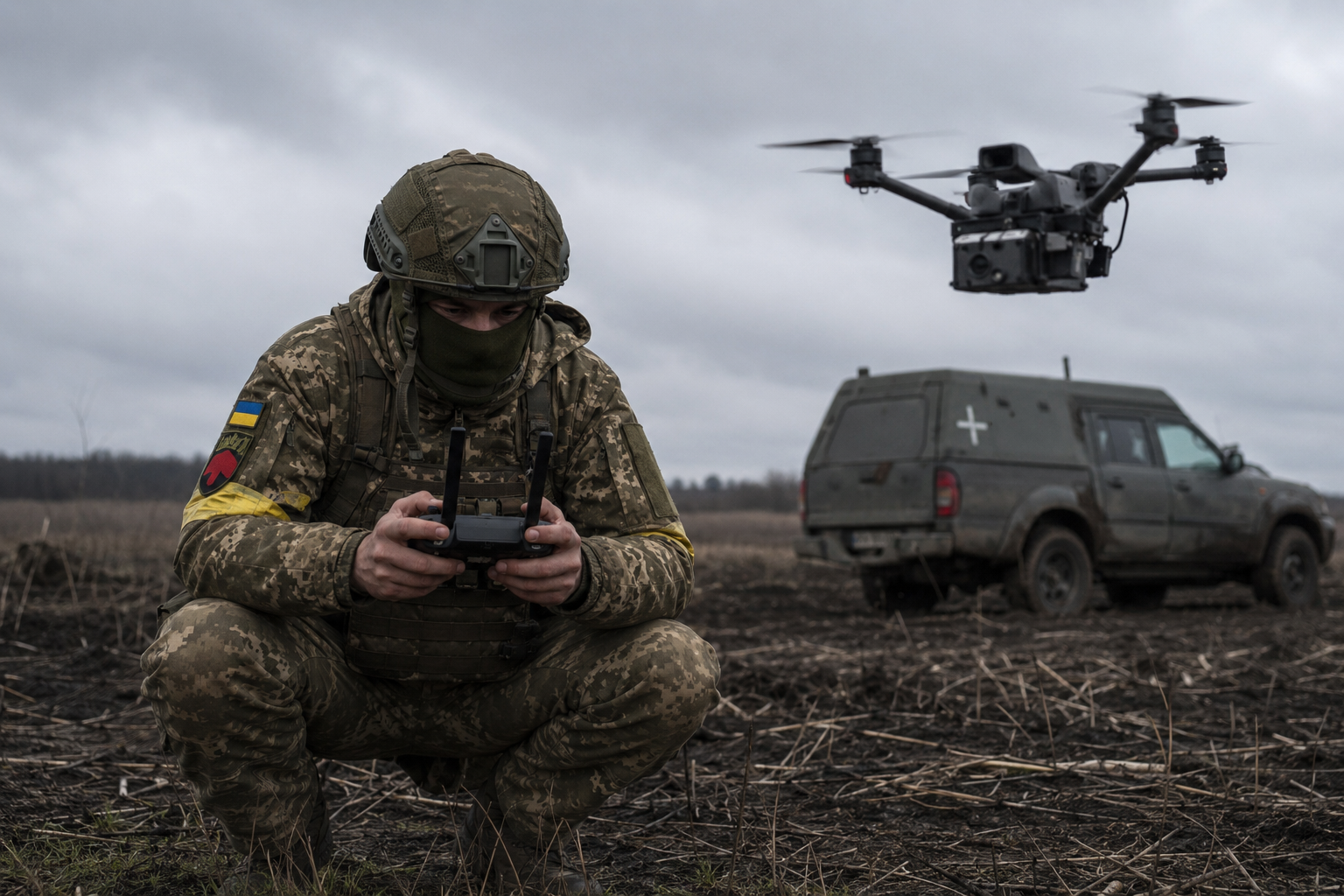
Twenty-first century drone technology had proven itself on the frontlines by 2024 and the Ukrainians doubled down on its use and development. They created the Unmanned Systems Forces as a new military branch, invested heavily in research and development and applied this across the front. They changed the rules, moved the goalposts, added 11 extra autonomous robotic players to their team.
These new players are active in every area of the war. Ubiquitous FPV drones strike targets on the frontline with unmatched efficiency. I recall a story told to me by a Ukrainian drone unit commander on the frontlines last year, who will remain anonymous for operational security. Weeks prior to our meeting, the Russians had mounted an assault on his area of the line with 37 armoured vehicles of varying types. A formidable scratch force of tanks, APCs and IFVs moving at battalion level. This kind of assault is a major local offensive.
They were all destroyed before reaching the Ukrainian lines. A combination of FPV reconnaissance, kamikaze strike drones and artillery wiped the field of a force that in previous wars could be expected to easily punch through the thin Ukrainian lines.
That is one story of many. Drones now evacuate casualties, carry water, ammunition and medicine, and carry out longer range strikes on Russian logistics. Ukraine has also begun investing heavily in ground robots, with 25,000 unmanned ground vehicles contracted in the first half of 2026 and a target of 50,000 by the end of the year.
The longest-range drones, more adequately thought of as slow, cheap cruise missiles, have been reaping a toll on Russia’s vital and vulnerable oil sector. Ukrainian strikes have disrupted Russian refining capacity and fuel distribution networks. In occupied Crimea, Russian-installed authorities halted fuel sales to individuals and businesses after Ukrainian attacks squeezed supply routes. Reuters reported that Russian gasoline production had fallen by 25 per cent compared with June 2025 levels.
The war is no longer something that exists only at the front. Increasingly, Russians are feeling its effects at home.
The changing balance can be seen on the map. Russian forces captured around 319 square kilometres in January 2026. By March, that figure had fallen to just 23 square kilometres, the smallest monthly gain since 2023. Meanwhile, Ukraine claims to have recaptured more than 600 square kilometres during the first five months of 2026. In May alone, Ukraine’s Commander-in-Chief Oleksandr Syrskyi said Ukraine regained roughly 100 square kilometres more than it lost.
That’s not to say that this conflict is all going Ukraine’s way. The winter of 2025-2026 was terribly hard for many Ukrainians as Russian strikes destroyed vital power infrastructure that heated their homes. Russia maintains an advantage in manpower, long-range strike drones and missiles which continue to reap their toll. They advance, albeit slowly, in areas of the line.
Russia has also learned the lessons of the drone war. Russian FPVs are, by and large, worse made. I’ve held one; it was aluminium rather than the polymer or carbon fibre I have seen in Ukrainian designs. But their pilots can be very effective. Rubicon, Russia’s elite drone team, is easily one of the best sets of pilots in the war.
Where does this leave the rest of the world? Russia’s invasion of Ukraine was meant and expected to be a short, victorious war. The intent was to take the capital, topple the government and subsume Ukraine as a colony of Russia. If you want to see where this leaves a country, look to Belarus. This hasn’t happened. Now, in 2026 many are wondering how this war ends.
US President Donald Trump has made his scepticism towards support for Ukraine clear. He has often spoken more favourably about Vladimir Putin than previous American presidents and has repeatedly questioned the value of backing Kyiv. His instincts tend towards personal relationships rather than long-term strategic commitments. In 2025, his administration paused military aid and intelligence sharing with Ukraine, proving itself unreliable.
So, Ukraine and her European, and other allies such as Japan and South Korea, stopped relying on him. He still attempts to drive negotiations when his capricious tempers turn to the subject, but he has very few cards to play over Ukraine. In 2026 Ukraine manufactures vast quantities of its own drones, has its own cruise missile programme and leads the world in the tactics and technology of drone warfare.
During Trump’s and Netanyahu’s confrontation with Iran, it was Ukraine, not the United States that found itself exporting some of the most innovative drone-defence solutions to the Middle East. While the US was shooting million-dollar Patriot missiles at Iranian Shahed drones, the Ukrainians were training partners in how to use cheap interceptor drones at a fraction of the cost. Ukrainian officials say P1-Sun-type interceptors cost up to $3,000, compared with Shaheds costing many times more.
Now, Trump could go the other way and start putting pressure on Putin, coming to him as a fellow traveller of sorts to try to get him to seek a peace more favourable to Ukraine. This, though, goes against his nature. He is a man to whom personal relationships are king, and he deeply dislikes Ukraine’s President Zelenskyy.
As for Ukraine’s economy, that’s one major area where Europe has, more or less, replaced the United States. After Hungary lifted its veto, the EU approved a €90 billion loan for Ukraine. Europe is also providing arms: German tanks, British anti-air systems and Swedish Gripen jets, of which up to 16 have been pledged, to name a few.
Combined with significant reinvestment in critical defence, Europe’s defence industrial base is expanding after decades of neglect. Rheinmetall says it aims to produce around 1.5 million 155mm artillery shells per year by 2027. Much of this will be headed to Ukraine.
Meanwhile Russia’s economic outlook is bleak. While Russia has always had a much larger economy than Ukraine’s, it is not being propped up by anyone on the same scale. It isn’t likely to collapse, but there are significant questions about how much more strain it can take.
War manufacturing may look excellent on a GDP analysis: if you build a shell, you create jobs, money flows and something is produced. But that end product, the shell, doesn’t do anything productive. Compare it to a car which moves people and encourages further economic activity, a hospital which heals the sick so that they can further contribute, or a school to educate the next generation. There is no return on investment in artillery.
Russia’s military expenditure in the 2025 budget has been estimated at 7.2 per cent of GDP, roughly double its pre-invasion level. Couple this with a vanishing male workforce, internet shutdowns and the slow death caused by sanctions, and the medium to long-term outlook is bleak.
Even a politically dangerous full mobilisation is unlikely to tip the balance in a war where men simply mean a lot less than they once did and Russia has a lot less to equip them with. A wave of infantrymen will be met not with their human antagonists, but death from the sky.
I don’t think that anyone in 2022 could have imagined that Ukraine would be in the position it is now. That is a failure of imagination and recognition of what Ukraine is. Many could not imagine that Ukraine could hold their own against their much larger neighbour, but history is replete with small nations beating larger ones: the US and Vietnam, Imperial Russia and Japan, NATO and Afghanistan and very recently the US and Iran.
Ukrainians have a clear reason to fight. Many Ukrainians understand this as an anti-colonial struggle against centuries of Russian domination. They are fighting on their land, for their people.
Russia is not.
That is how a small nation defeats a large one. They play by different rules, and Ukraine is playing very well.

Reader comments
Subscribers can join the conversationSign in to join the conversation. Comments are open to everyone with a free account.
Sign in or create accountLoading comments…