
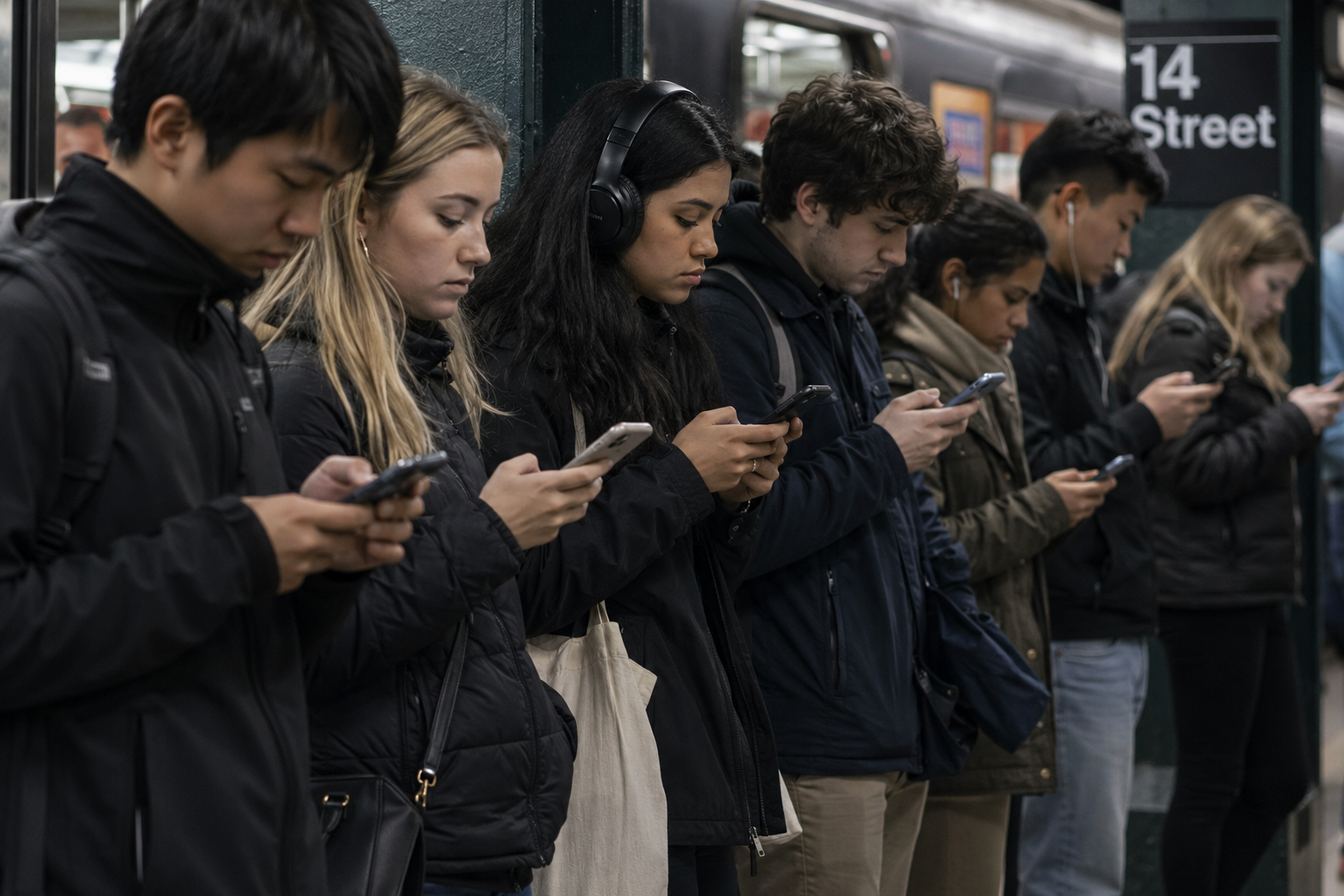
Social media has flipped the world upside down. Overnight, unknown individuals can explode into global fame, and people who once struggled to make ends meet can turn a simple idea into a million-pound empire.
A phone camera has replaced traditional gatekeepers, giving anyone the power to entertain, influence, and sell to the world. Viral moments can change lives in hours, not years.
For many, it has become a fast track out of financial hardship and into opportunity, luxury, and independence. In the process, it has raised living standards and rewritten what success looks like in a world driven by attention.
However, its downsides are often overlooked or rarely discussed, despite their significant impact on mental health, privacy, and social pressure.
Recently, Greece announced plans to introduce stricter social media regulations for children under the age of fifteen.
And honestly, does Greece have a point?
These concerns are no longer being raised only by critics of technology, but increasingly by psychologists, researchers, and even millions of ordinary people beginning to question what constant digital life is doing to our modern society.
One of the most influential voices in this conversation is Jonathan Haidt — a social psychologist and professor at the New York Stern School of Business whose work focuses on moral psychology, human behaviour, and moral emotions.
He explored many of these issues in his blockbuster best-selling book The Anxious Generation.
Haidt argues that the rise of smartphones and social media has fundamentally reshaped childhood and adolescence, contributing to serious problems surrounding anxiety, social development, attention spans, and mental health — all issues, which he believes are linked to modern day technological change.
The extraordinary success of the book reflects something much larger than a publishing phenomenon — it reflects a growing belief that people today can sense that something is off.
That modern life no longer feels psychologically healthy.
What we once thought was technological progress now often resembles a form of self-inflicted harm—a slow erosion of our capacity to rest, focus, and feel at ease in our own minds—to live life normally.
Haidt argues that an entire generation has been raised inside toxic digital environments built around algorithms, performance, comparison, and endless stimulation, contributing to rising levels of anxiety, loneliness, social isolation, and declining mental well-being.
These billion-dollar social media platforms, which are installed on our devices, are no longer merely tools. They essentially become the environments in which people grow up. They shape us as human beings at the start of our adult lives, and the instant connections social media offers can feel powerful initially – but can also create something far more dangerous.
For example, opening Instagram for only a few moments quickly becomes overwhelming: endless advertisements, influencer marketing, fake, curated lifestyles, aggressive self-promotion, and an algorithmically engineered stream of content designed to constantly capture attention.
So how did we get here? How did we arrive at a world where millions of people willingly transform themselves into personal brands and display their private lives online?
A world where every moment of human life — every meal, breakup, holiday, achievement, struggle, or private thought — is converted into content, commodified and packaged for strangers, and consumed for attention.
And perhaps the strangest part of all is this:
People we have never met begin to feel deeply familiar, while the real relationships in our lives — the friends we grew up with, the people we shared genuine experiences with — slowly fade into the background.
Because when we seriously consider how social media is reshaping behaviour—how we think, how we relate to others, and how we experience everyday life—
It becomes difficult to ignore the seriousness and scale of what’s changing, and how little of it feels like it’s moving in a good direction.
Society is being controlled by a handful of powerful technology companies – who have access to your data, your habits and frankly your entire life.
This would ultimately mean that people – and society at large would slowly lose the ability to think, connect, and even live without the constant influence of algorithms shaping their behaviour, thoughts and lifestyle.
We post, before we think. We document whilst forgetting to live, we scroll endlessly, whilst ignoring our relationships, responsibilities, and the world unfolding around us.
A New Global Consensus Emerges
We exist more online than in reality.
In response, several countries have begun to wake up to the realities of social media’s dangers. Here are several examples that clearly signal a new trend, which Jonathan Haidt himself called in a recent article a “new global political movement”.
China: The country recently introduced stringent controls over social media platforms, citing concerns over political influence, censorship, national security, and the broader societal harm these networks may cause.
Australia: the country has passed legislation to restrict access to major social media platforms for users under 16, with enforcement set to roll out over the coming years.
The aim is to reduce harm to young people, particularly in relation to mental health concerns, social media addiction, and online safety.
Despite several world governments introducing new regulations against social media — the question ultimately arises whether or not our society can truly keep up with modern technology — which grows at a pace that runs ahead of legal frameworks.
And in that distance between technological growth and regulation, the future of human behaviour is already being reshaped.
Despite certain world governments enforcing vague social media regulations — they are an attempt to respond to a shift in human behaviour that is already well underway.
These multi-million-dollar social media companies continue to evolve, develop, and grow in ways that dominate our modern-day society.
Platforms such as TikTok already command millions of daily users, embedding themselves into the fabric of everyday life.
Other major platforms, including Facebook, Snapchat, and X, operate on highly powerful algorithm-driven systems that actively curate, influence, and shape what users see, engage with, and ultimately consume online.
The truth is, modern social media continues to operate and grow in ways that make it increasingly difficult to control or contain.
Algorithms are still designed to maximise attention, not wellbeing or happiness.
Therefore as a result, users are continuously pulled back into patterns of constant doom scrolling, comparison, and consumption — to the extent our entire society becomes commodified
The impact of this extends far beyond individual users, shaping the wider fabric of society and modern civilisation itself.
We once lived as normal human beings, we once enjoyed simple, everyday things, like spending time outdoors, having uninterrupted conversations, reading for pleasure, and experiencing life without constant digital interruption — much like life in the 1990s, when attention was not fragmented by screens and connection was more often face-to-face than filtered through devices.
Just picture a New Yorker in the 1990s: walking through busy streets lined with yellow taxis and corner newsstands, picking up a newspaper, grabbing a coffee from a small diner, and sitting on a park bench in Central Park, watching the world move around them without feeling the need to document it.
Life was more grounded and communal, shaped by shared physical spaces, real encounters, and meaningful moments that were lived, understood and experienced fully.
I think that’s a world worth fighting for.
Modern social media has become socially dangerous, not only in how it dominates our attention, but in how it quietly reshapes human behaviour, relationships, and the very way we experience our existence — and what it has done to our world is both profound and irreversible in ways we are only just beginning to understand.
We have a right to live our life offline.



Reader comments
Subscribers can join the conversationSign in to join the conversation. Comments are open to everyone with a free account.
Sign in or create accountLoading comments…