For most of its short history, Pakistan's official national narrative pushed by the military led establishment rested on a simple proposition: the country's story began with the arrival of Muhammad bin Qasim in Sindh in 712 CE. School textbooks, state institutions, and official discourse largely framed Pakistan as the culmination of a distinct Islamic political identity, while the region's pre-Islamic civilizations often received little more than passing mention.
Today, however, something remarkable appears to be happening.
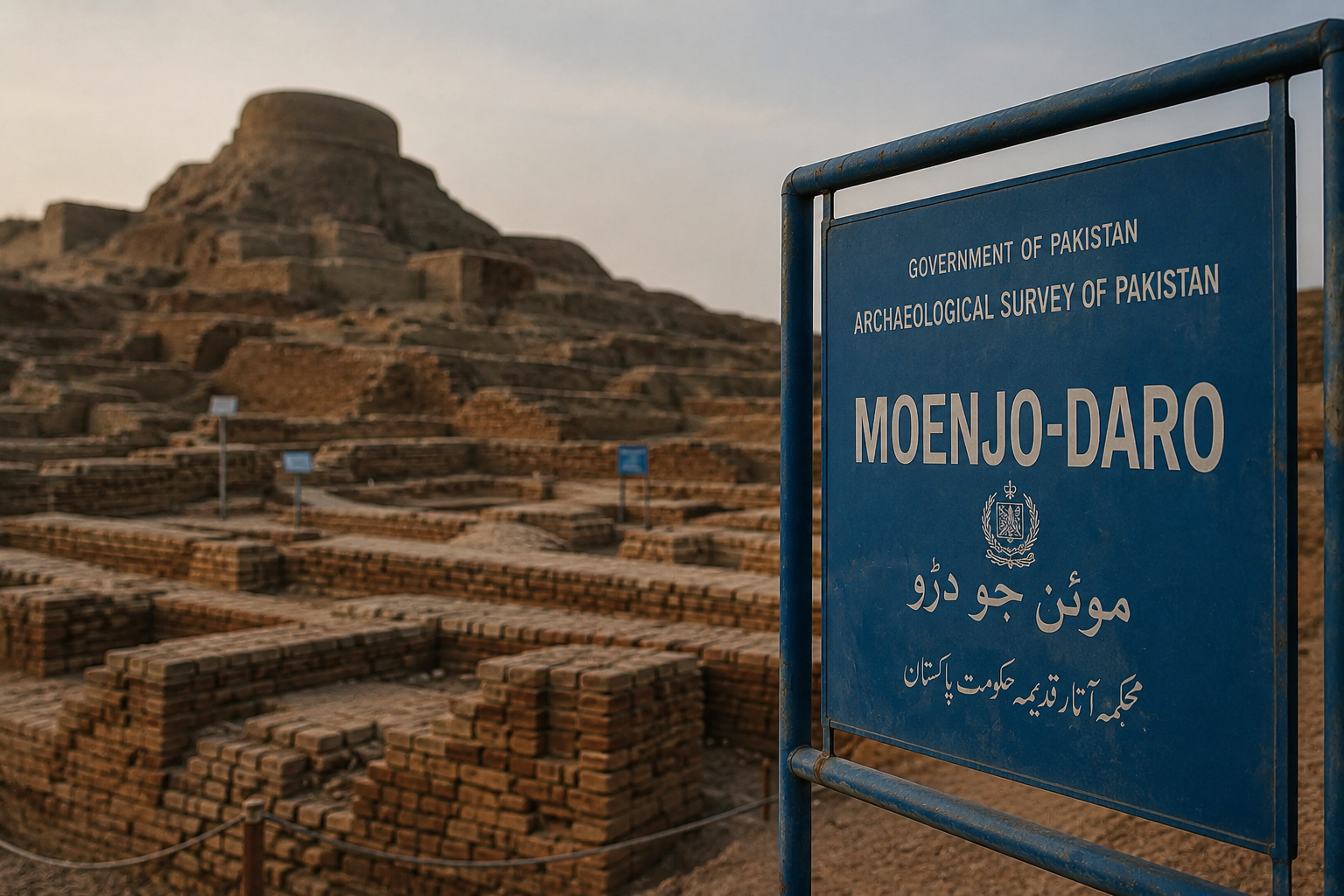
Pakistan's political and military establishment has suddenly discovered a profound interest in Mohenjo-Daro, Harappa, Taxila, Gandhara, and the broader Indus Valley Civilization. Government-backed documentaries, academic seminars, tourism campaigns, and official speeches increasingly present these ancient civilizations as central to Pakistan's national identity.
The question is obvious: Why now?
Many observers, particularly in India, have linked this shift to the ongoing dispute over the Indus Waters Treaty. Following India's decision to place the treaty in abeyance, some argue that Pakistan is invoking the Indus Valley Civilization to strengthen its historical and moral claim to the Indus River system. There may be some truth to that argument. But focusing exclusively on the water dispute risks missing a far more significant development.
The real story is not about water. It is about legitimacy.
The Old Formula
For decades, Pakistan's establishment derived much of its political legitimacy from two recurring narratives.
The first was external threat.
The second was religious identity.
Whenever democratic demands intensified, economic performance faltered, or questions emerged regarding political legitimacy, the state often reverted to security-driven or ideological narratives. The formula was effective for a long time, particularly during the Cold War and the post-Afghan Jihad era.
But the world has changed.
The geopolitical environment that once rewarded ideological militancy and strategic ambiguity no longer exists in the same form. The post-9/11 international order transformed the global conversation around extremism, political Islam, and state-sponsored proxies. Pakistan's traditional ideological model has become increasingly difficult to sustain.
A Changing International Environment
The shift is particularly visible in the Gulf.
For decades, Saudi Arabia provided significant ideological and financial support to religious institutions across the Muslim world, including Pakistan. Under Crown Prince Mohammed bin Salman, however, Riyadh has fundamentally altered its priorities.
The Kingdom now speaks the language of technology, artificial intelligence, tourism, investment, and economic modernization. Religious activism no longer occupies the same central place in Saudi foreign policy.
As a result, one of the traditional pillars supporting Pakistan's ideological infrastructure has weakened considerably. At the same time, both China and the United States have consistently encouraged Islamabad to pursue greater internal stability and moderation.
China's concerns are primarily economic and security-driven. Beijing has invested billions of dollars through the China-Pakistan Economic Corridor (CPEC) and has little tolerance for militant instability that threatens its investments.
The United States, despite its fluctuating relationship with Pakistan, has long advocated policies that reduce extremism and improve regional stability. For both powers, stability is preferable to ideological confrontation.
The Return of Civilizational Identity
Against this backdrop, Pakistan's renewed embrace of the Indus Valley Civilization begins to make more sense.
Mohenjo-Daro, Harappa, Taxila, Gandhara, and Mehrgarh are undeniably part of Pakistan's historical landscape. The issue is not whether these civilizations belong to Pakistan's heritage. They do.
The more important question is why they were largely marginalized for decades and why they are now being promoted so aggressively. The answer appears to be a search for a broader and more inclusive national identity. A civilizational narrative offers something that a narrowly ideological narrative cannot. It provides a shared historical foundation that transcends sectarian, ethnic, and linguistic divisions. Punjabis, Sindhis, Baloch, Pashtuns, and other communities can all find a place within the story of an ancient civilization that predates modern political and religious divisions.
It is also a narrative that resonates internationally. Ancient civilizations command global respect and cultural prestige in ways that ideological narratives often do not.
Enlightened Moderation Revisited?
Observers may recall former President Pervez Musharraf's concept of "Enlightened Moderation."
Two decades ago, the Pakistani establishment attempted to soften the country's international image by emphasizing moderation and reform. The initiative achieved limited success, partly because domestic political conditions were not conducive to a genuine transformation.
Today, however, circumstances are different. Pakistan faces severe economic challenges. International expectations have changed. Public frustration with political instability and poor governance continues to grow.
The population is increasingly concerned with employment, inflation, public services, and economic opportunity rather than ideological grandstanding. Under these conditions, the promotion of the Indus Valley Civilization can be viewed as a modernized version of the same project: an attempt to repackage national identity in a way that is more compatible with contemporary realities.
Beyond the Water Dispute
Indian commentators who interpret Pakistan's Indus Valley narrative exclusively through the lens of the Indus Waters Treaty may be overlooking the larger picture. The water dispute may have accelerated the trend, but it is unlikely to be its primary cause.
Pakistan is facing an identity challenge. It requires a national story that can unite diverse populations, improve its international image, and provide an alternative source of legitimacy as older ideological frameworks lose their effectiveness. The Indus Valley Civilization offers precisely such a story.
Whether this transformation is genuine remains an open question.
The Real Test
The true measure of this shift will not be the number of documentaries produced, conferences organized, or archaeological excavations launched.
The real test is whether the state is prepared to embrace its history honestly and comprehensively. If Pakistan wishes to reclaim the legacy of the Indus Valley Civilization, it must also acknowledge the broader principles associated with a confident and mature nation-state: democratic accountability, rule of law, intellectual openness, and respect for pluralism.
Civilizational pride alone cannot solve governance failures.
Ancient heritage cannot substitute for democratic legitimacy.
And historical symbolism cannot replace meaningful reform.
Pakistan's newfound affection for Mohenjo-Daro may reflect a genuine rediscovery of a rich and ancient past. It may also represent a pragmatic attempt to navigate a changing geopolitical environment and a growing crisis of legitimacy.
Most likely, it is a combination of both.
The coming years will reveal whether this is merely another exercise in narrative management—or the beginning of a more profound reimagining of Pakistan's national identity.



Reader comments
Subscribers can join the conversationSign in to join the conversation. Comments are open to everyone with a free account.
Sign in or create accountLoading comments…