Totality returns to Europe
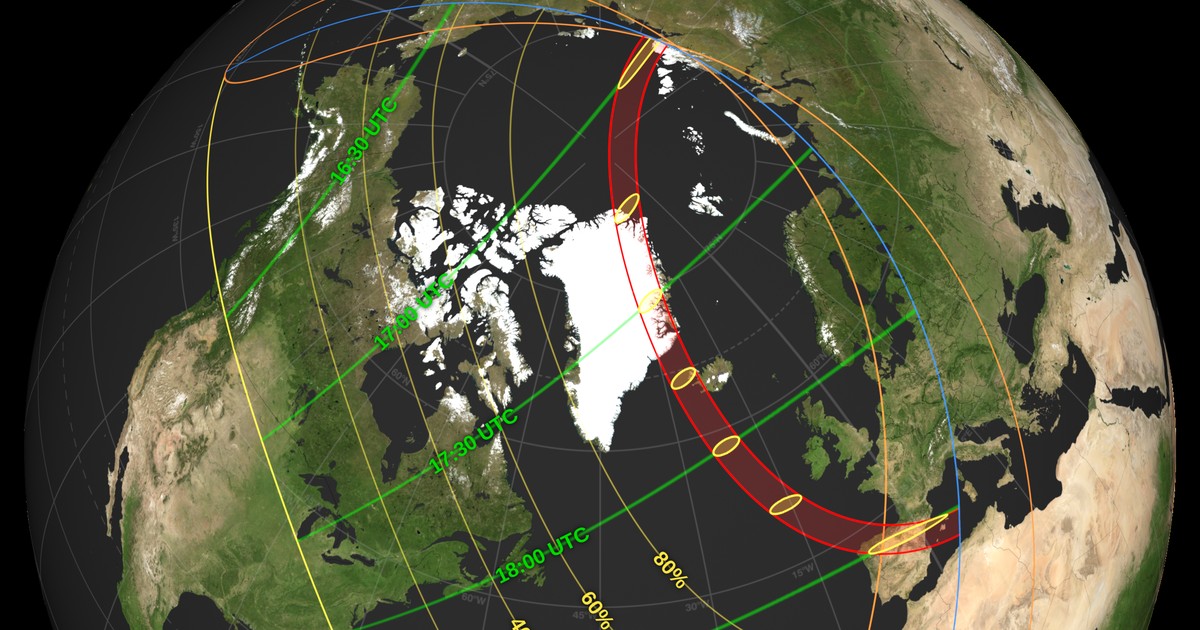
A total solar eclipse will sweep across parts of the Northern Hemisphere on Wednesday 12 August, bringing totality to Greenland, Iceland, northern Russia, Spain and a small corner of Portugal.
The path of the Moon's darkest shadow crosses the Arctic and North Atlantic before reaching Europe. Outside that narrow band, a much larger area will see a partial eclipse, including most of Europe and parts of North America and north-west Africa.
London: 91% at maximum eclipse
NASA calculates that the eclipse will begin in London at about 6:17pm, reach maximum at around 7:13pm and end at about 8:06pm. At maximum, roughly 91% of the Sun's visible area will be covered by the Moon.
The effect will be deeper in parts of Ireland and western Britain and close to total in parts of the Iberian Peninsula. Madrid is expected to reach about 99% coverage, while locations inside the path of totality in northern Spain and Iceland will briefly see the Sun's bright face completely blocked.
For the UK, the Sun will never be fully covered - which makes eye protection necessary throughout the entire event, even at maximum eclipse.
A sunset eclipse for much of western Europe
The timing makes this eclipse especially unusual for many European observers. The Sun will be low in the western sky, and in some places it will set while still partially eclipsed.
That can create a dramatic horizon view, but it also means buildings, hills and cloud near the horizon can easily block the event. The geometry is fixed; the weather is not.
How to watch safely
The UK will not experience totality, so viewers must use proper solar eye protection throughout the entire event. Ordinary sunglasses are not safe. NASA advises using eclipse glasses or handheld solar viewers that comply with the ISO 12312-2 international standard.
Cameras, binoculars and telescopes need a purpose-built solar filter attached to the front of the optics. Looking through an unfiltered optical device can cause severe eye injury even when eclipse glasses are being worn.
For those inside the path of totality, eye protection can be removed only during the brief interval when the Moon completely covers the Sun's bright face, and must go back on as soon as the Sun begins to reappear.
The eclipse is both a public spectacle and a scientific opportunity. NASA teams will use observations from the ground and high-altitude aircraft to study the solar corona and the effects of the Moon's moving shadow. For millions of people across Europe, however, the first task is simpler: find an unobstructed western view and watch the Sun safely.



Reader comments
Subscribers can join the conversationSign in to join the conversation. Comments are open to everyone with a free account.
Sign in or create accountLoading comments…