
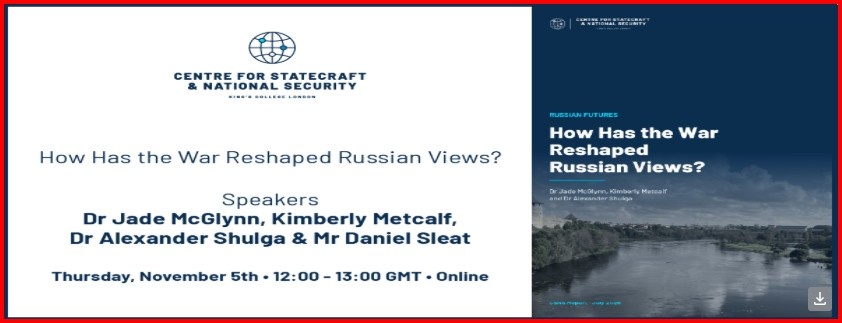
A population can grow exhausted by war without becoming a political force capable of ending it. That was the most troubling lesson I took from a discussion hosted on 5 November by the Centre for Statecraft and National Security at King’s College London. It also raises a difficult question about propaganda: how much enthusiasm does a government actually need, if it can preserve enough acquiescence?
The online discussion examined How Has the War Reshaped Russian Views?, a report by Dr Jade McGlynn, Kimberly Metcalf and Dr Alexander Shulga. Chaired by Daniel Sleat, it drew on ten waves of telephone polling between December 2022 and May 2026 and interviews with 31 non-elite Russians. The discussion challenged the assumption that mounting costs will necessarily turn Russian society against the invasion of Ukraine.
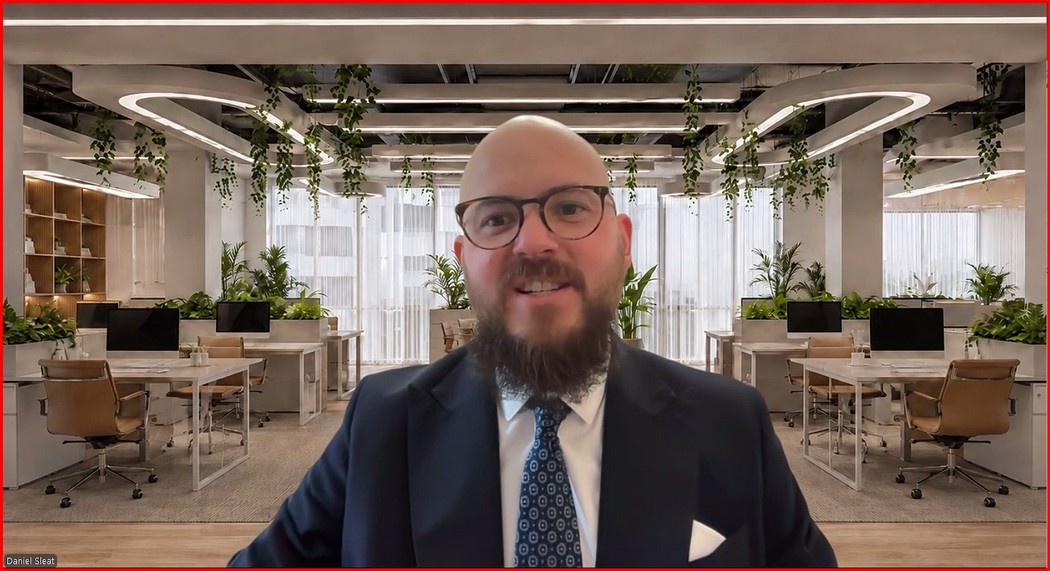
My question, read out by the chair, asked how Russia’s management of information operations should be assessed: what had been its principal strengths and weaknesses in shaping domestic opinion, influencing international narratives and sustaining support for the war?
McGlynn’s answer challenged the premise. Individual information operations were part of the picture, she argued, but the more consequential process was the construction of an information environment in which people participate in narratives about themselves and their country. That distinction deserves far more attention.
Exhaustion without rejection
McGlynn set out the apparent contradiction. In the May 2026 polling, 81 per cent of respondents would welcome an end to the war, while only 11 per cent supported another mobilisation. Yet the underlying interpretation of the conflict had proved much more durable: across the series, between 75 and 88 per cent saw the West as the real adversary.
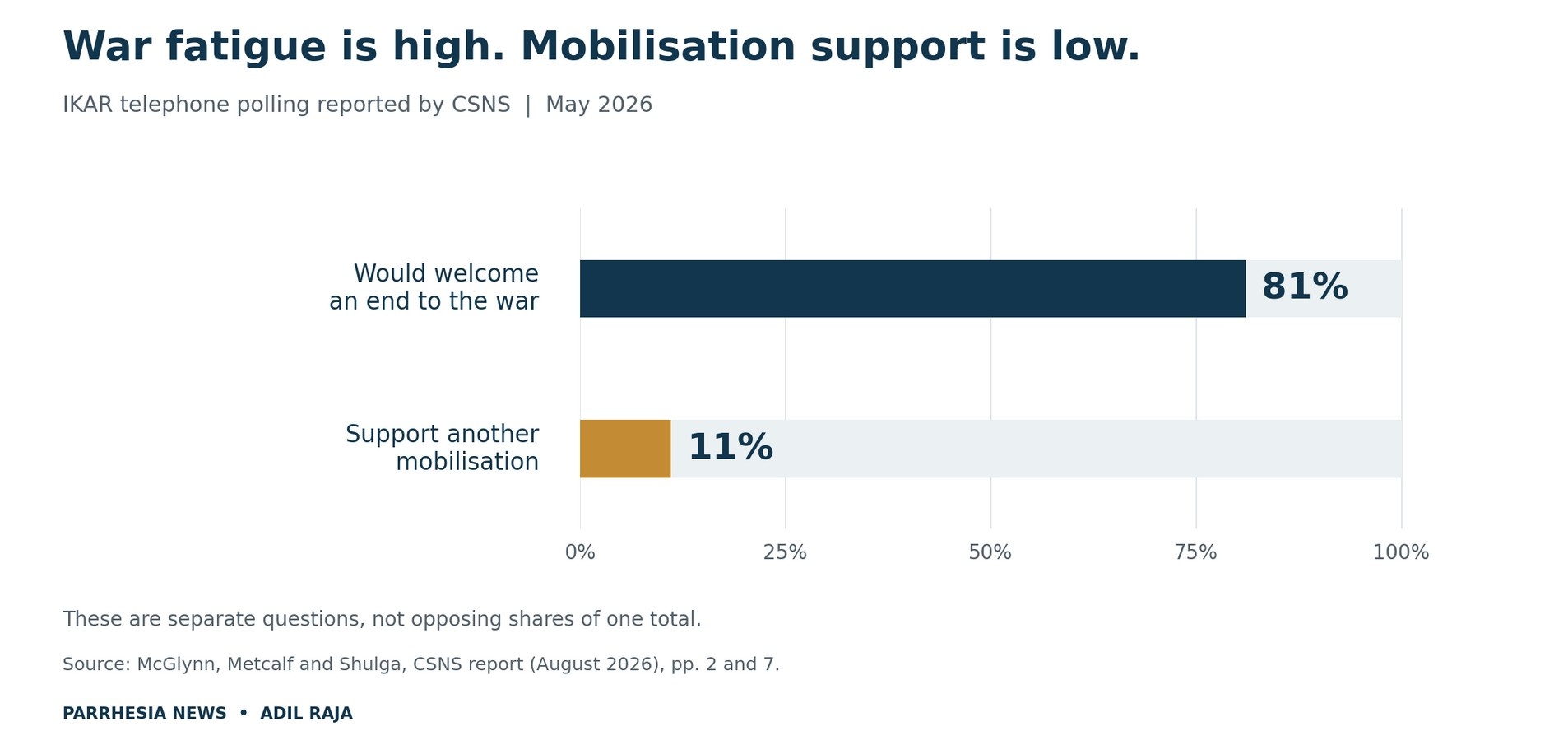
Wanting the suffering and disruption to stop does not necessarily mean accepting that the war was wrong. Nor does it necessarily imply a willingness to challenge the authorities responsible. Shulga, who heads the Kyiv-based Institute for Conflict Studies and Analysis of Russia, argued that many Russians wanted the war to end with Putin declaring victory.
That leaves considerable political room for the Kremlin. A person may dislike the costs, avoid military service and hope for a settlement while continuing to accept the government’s explanation of why the conflict exists. My reading is that the distinction between enthusiasm and acquiescence is essential to understanding how a prolonged war becomes politically sustainable.
An information environment larger than the lie
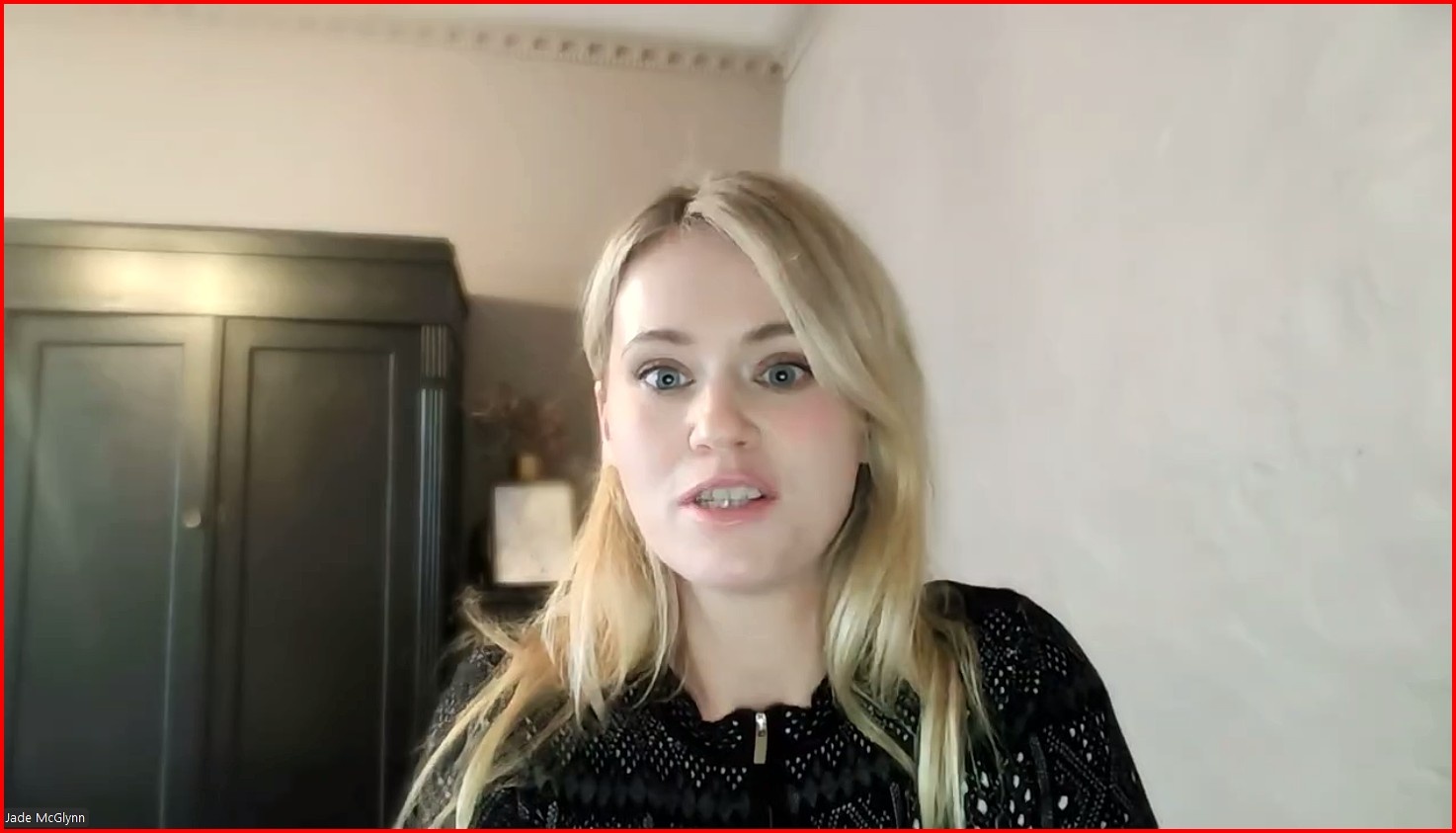
McGlynn described a process extending well beyond the production of false statements. In her account, the state has encouraged, incentivised and sometimes coerced participation in narratives about Russian identity. These narratives draw on beliefs already present in parts of society and adapt them to the Kremlin’s purposes.
The audience is therefore more than a passive recipient of official messaging. People can repeat, personalise and help reproduce a national story because it offers something they wish to believe about themselves. The emotional appeal can survive disagreement with particular policies or distrust of particular officials.
McGlynn also argued that Russia understands information as an ecosystem: the channels through which it travels, the people who deliver it and the relationships through which it acquires authority. Her criticism of Western approaches was that they too often concentrate on whether an individual output is reliable, while neglecting the conditions that make a message persuasive.
For me, this was the strongest answer to my question. Exposing a fabricated claim remains necessary. But a correction has a harder task when accepting it would also require someone to reconsider national belonging, personal responsibility or the judgement of people they trust.
Confusion can serve power
McGlynn used Russian messaging about Bucha to illustrate a more recognisable disinformation technique: the proliferation of competing accounts, associated with what RAND researchers Christopher Paul and Miriam Matthews called the “firehose of falsehood”. The object need not be universal belief in one alternative version. It can be uncertainty sufficient to make an audience retreat to its existing loyalties.
The evidence of civilian killings in Bucha is not merely one competing narrative. The UN Human Rights Monitoring Mission documented killings there during Russian occupation. McGlynn’s example concerned how propaganda can blur responsibility despite documented evidence.
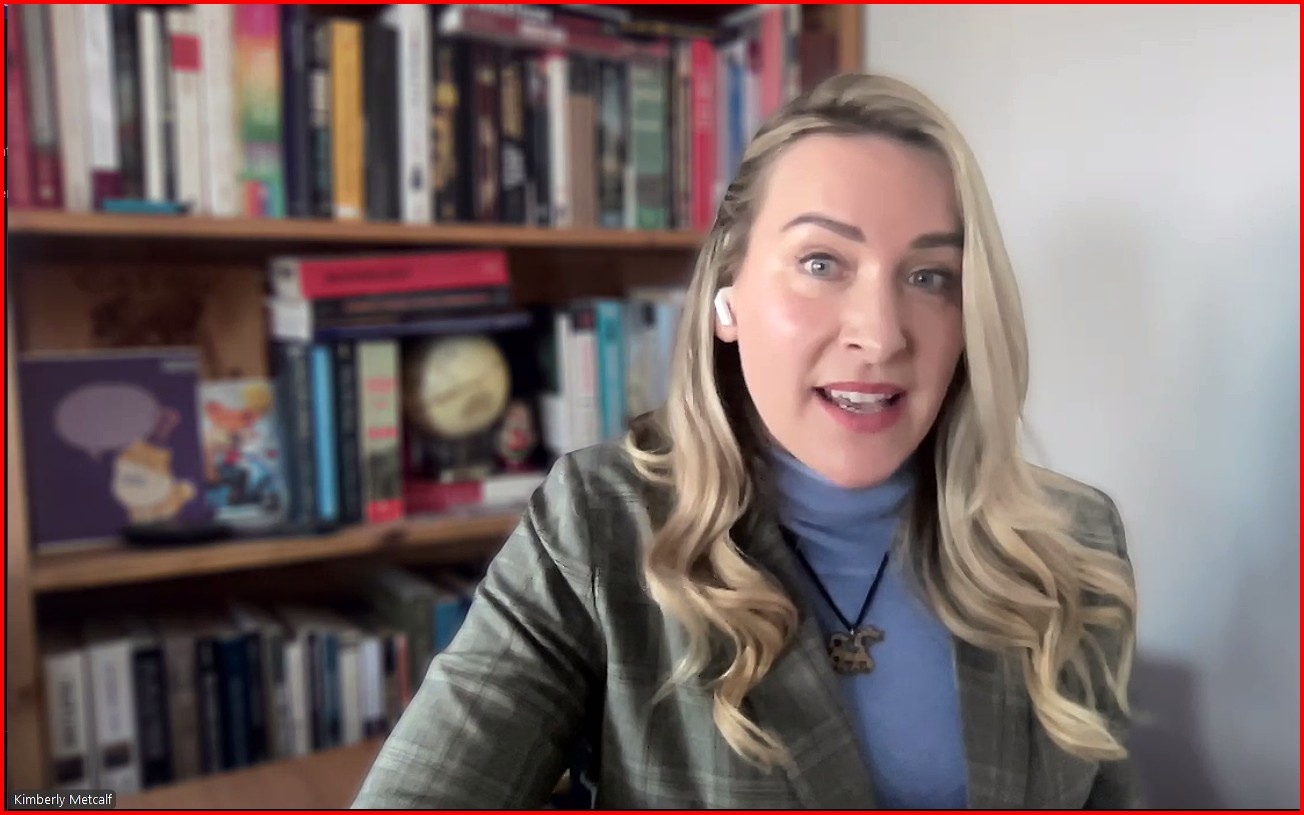
Metcalf’s interviews added a revealing dimension. Some interviewees described themselves as opposed to the war or unwilling to fight, yet still reproduced accounts of confrontation with the collective West. She also described narratives of Russian victimhood and a recurring tendency to redirect discussion towards Western wrongdoing.
Criticism of Western governments can be entirely legitimate. In this context, however, the analytical question is what that criticism is being used to explain or evade. Other states’ failures do not remove Russia’s responsibility for invading Ukraine. Treating every claim as equally suspect can leave the government’s preferred account intact, because no competing explanation is allowed to become convincing.
The limits of information control
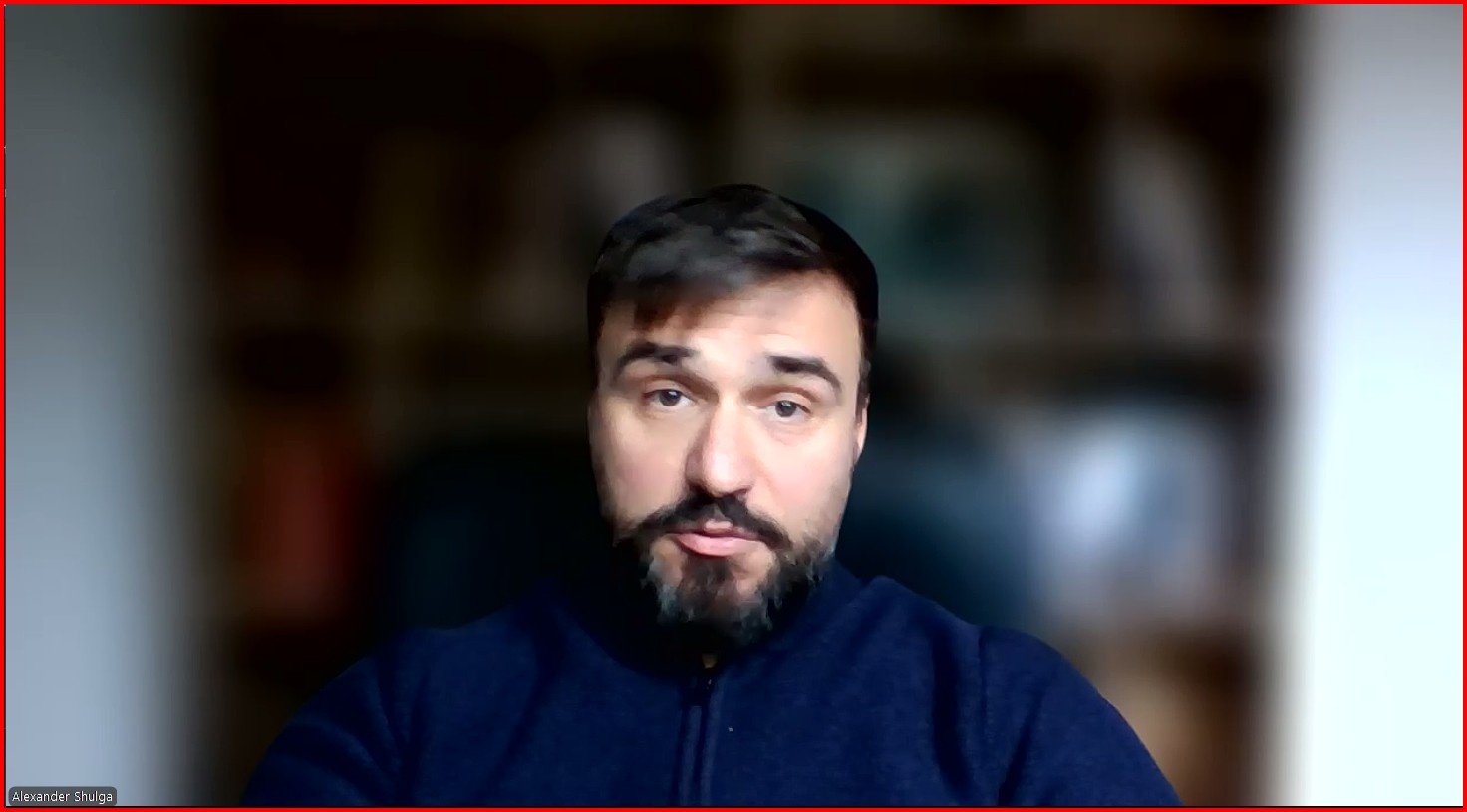
The discussion did not describe an all-powerful propaganda machine. Resistance to further mobilisation provides a clear limit. McGlynn argued that the Kremlin pays attention to public sentiment and has devoted substantial resources to avoiding another formal mobilisation call. Persuasion about national purpose does not automatically produce willingness to bear the personal costs of war.
Metcalf’s account of people who left Russia and later returned also complicated any simple division between supporters and opponents. Residency difficulties, work prospects and the practical burdens of living abroad affected their decisions. These were individual calculations about security and livelihood, rather than straightforward declarations of ideological allegiance.
I would therefore assess Russian information control as effective but constrained. It can help preserve explanations that accommodate the war, while failing to generate an equivalent appetite for sacrifice. Its success must be judged against the behaviour it seeks to sustain. Continued acquiescence and enthusiastic mobilisation are different outcomes.
The international part of my question requires a separate assessment. Russian domestic opinion cannot establish how successfully Moscow has influenced audiences abroad. Shulga nevertheless offered a forceful warning: he sees the Russian state as treating information warfare as a serious instrument of conflict and using culture, history, religion and other fields within that effort. He argued that a response confined to defensive fact-checking was inadequate. That is his strategic assessment, rather than a result measured by this polling.
The counterargument is that silence may conceal dissent
There is a serious objection to treating public compliance as evidence of successful persuasion. In an authoritarian system, people may repeat an official account because it feels safer, avoid political discussion because it seems futile, and remain silent because collective action carries a high cost. None of those behaviours necessarily demonstrates private belief. A lack of protest cannot settle the question of consent.
Research by Philipp Chapkovski and Max Schaub illustrates the problem. In their April 2022 online study, 71 per cent reported support for Russian military actions in Ukraine when asked directly. An indirect list experiment, which let respondents answer without identifying their position individually, estimated support at 61 per cent. The gap indicates that some respondents concealed their opposition.
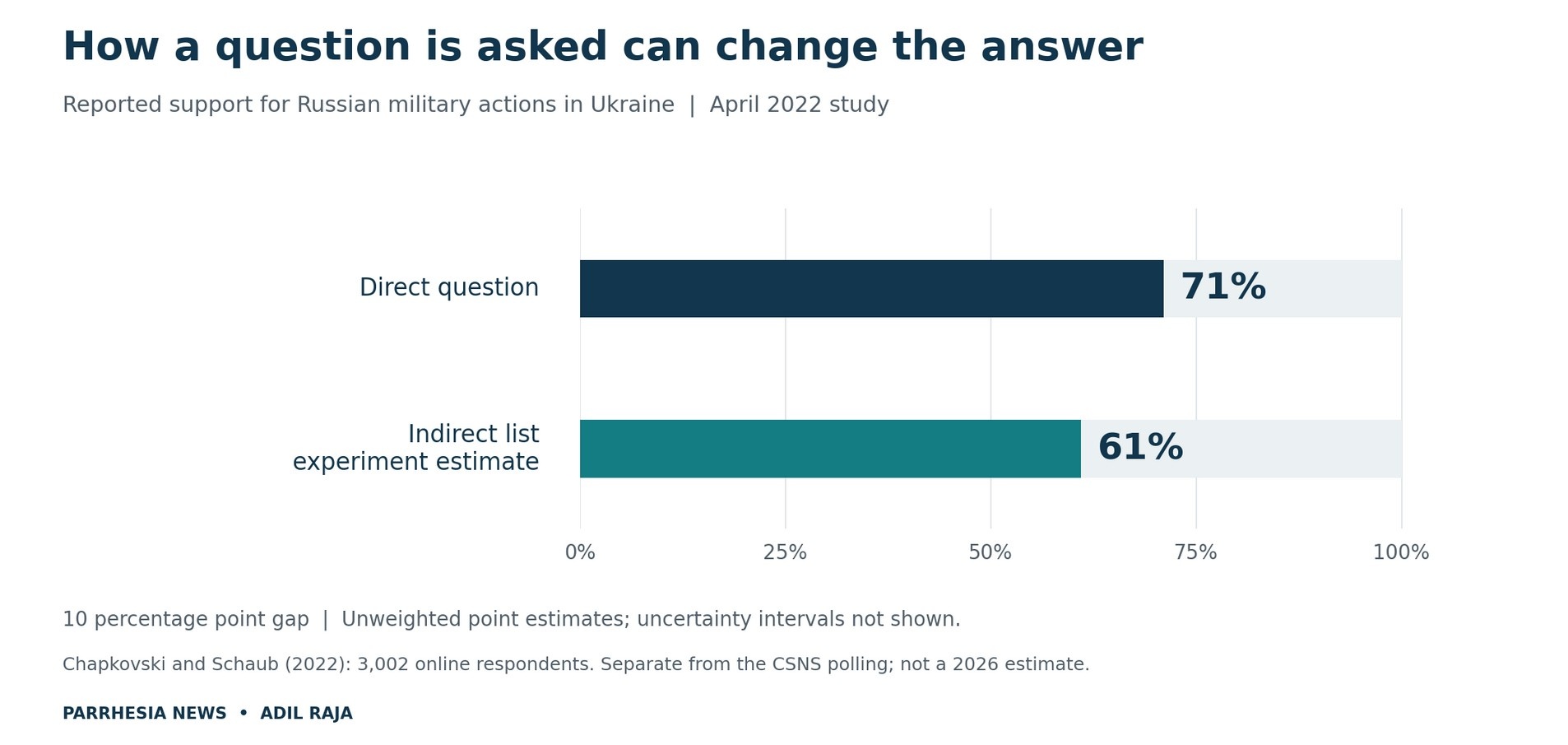
The results cut both ways. They demonstrate concealed dissent, yet also show substantial support within that sample. A study from 2022 cannot tell us the scale of misreporting in 2026. It challenges confidence about what public answers reveal without establishing that most Russians secretly oppose the war.
My objection to an overly confident reading is broader. The Kremlin may preserve compliance through a combination of persuasion, coercion and the absence of credible alternatives. Propaganda may help produce the impression that everyone else agrees. That can isolate opponents without converting them. The evidence supports a conclusion about the state’s continuing room to act more securely than it supports a claim about what every citizen believes.
What the evidence can tell us
There are limits to the evidence itself. Shulga explained that his researchers emphasised everyday experience and questions respondents could answer without directly declaring political allegiance. McGlynn stressed the value of polling for identifying trends, rather than treating percentages as a complete inventory of private belief.
Shulga also disclosed that callers did not identify the study’s Ukrainian origin and introduced themselves as Russian sociologists, acknowledging an ethical compromise. Readers should weigh that disclosure alongside the practical barriers to research under wartime repression.
Fear, conformity and weakly held preferences complicate interpretation. Metcalf also described the practical constraints on her interview sample, much of which comprised people abroad. Those interviews illuminate how individuals reason; they cannot establish how common every view is across Russia.
Nor does the research isolate propaganda’s causal effect from repression, material incentives, existing beliefs or the absence of effective political organisation. That distinction matters. The findings help explain accommodation; they do not prove that messaging alone produced it.
Credibility and political agency
My conclusion is that a credible response must begin by understanding the audience rather than imagining that everyone is waiting to embrace the same political alternative. It must explain responsibility clearly, recognise the grievances propaganda exploits and preserve the distinction between a government and the people living under it.
Independent journalism has an essential role here. It can document decisions and their consequences, test official claims and give people access to evidence they can examine. Its authority depends on applying those standards consistently, including when scrutiny is uncomfortable for Western governments.
My question began with the strengths and weaknesses of Russian information operations. The answers pointed to a wider problem: a state can retain room for war even when enthusiasm diminishes. But continued compliance should not be mistaken for unlimited consent. The task is to understand where belief ends, where fear begins, and whether private exhaustion can become an effective constraint on power. The evidence discussed at King’s offers little reason to assume that transition will happen by itself.
Sources and image credits
Primary reporting: the author’s recording of the CSNS online seminar, 5 November 2026. Seminar screenshots supplied by Adil Raja; original seminar material and speakers are credited in captions. Infographics by Parrhesia News, with data sources and limitations stated.
CSNS event and speaker details, 5 November 2026
McGlynn, Metcalf and Shulga, How Has the War Reshaped Russian Views?, August 2026
Paul and Matthews, The Russian “Firehose of Falsehood” Propaganda Model, RAND, 2016
UN Human Rights Monitoring Mission in Ukraine, report on civilian killings, 7 December 2022
Chapkovski and Schaub, Solid support or secret dissent?, Research & Politics, 2022

Reader comments
Subscribers can join the conversationSign in to join the conversation. Comments are open to everyone with a free account.
Sign in or create accountLoading comments…