
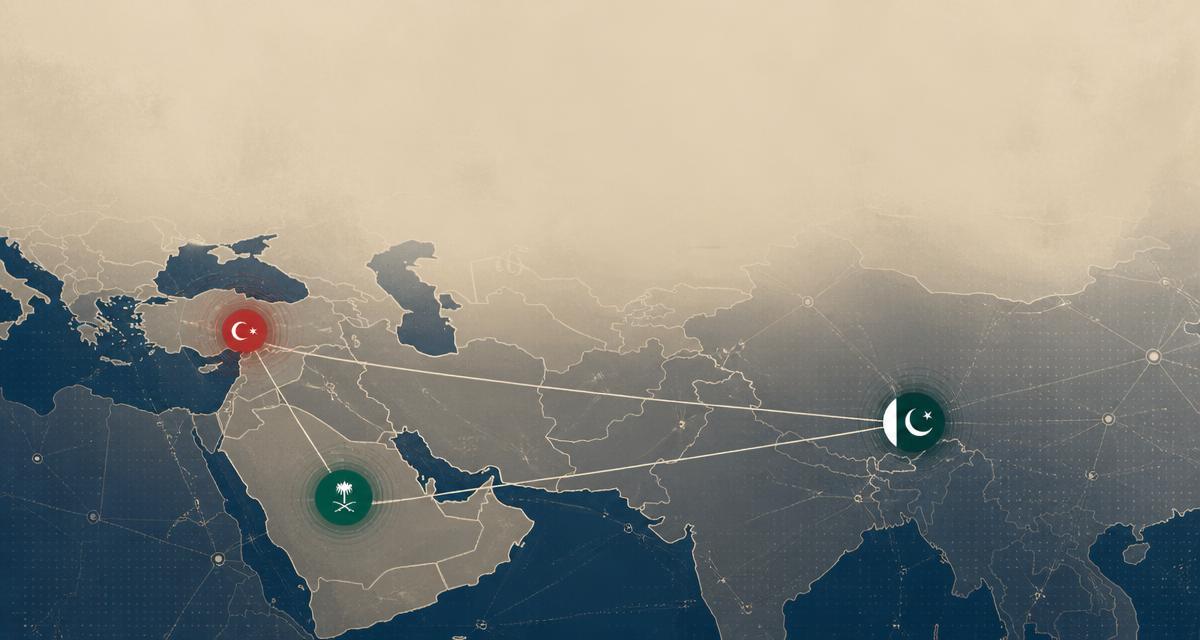
There was something almost theatrical about the choreography in Mecca. Pakistan's prime minister and army chief performed Umrah before Recep Tayyip Erdogan had even landed in Saudi Arabia; a few hours later, Shehbaz Sharif, Erdogan and Mohammed bin Salman signed a defence agreement declaring that an armed attack against one of their countries would be considered an attack against all three.
The symbolism required no explanation. Islam's holiest city, the Muslim world's only nuclear power, NATO's second-largest army and the Gulf's deepest strategic purse had gathered around language that inevitably invited comparisons with Article 5.
The comparisons began immediately, and so did the fantasies. In Pakistan, where geopolitical importance is often measured less by what the country can afford to do than by the enthusiasm with which television commentators imagine it doing it, the agreement was rapidly promoted into another resurrection of the "Islamic bomb", an embryonic Muslim NATO, a collective shield against Israel, India, Iran and, depending on the hour and the television channel, perhaps most of the known universe. Turkey added its familiar mixture of neo-Ottoman rhetoric and strategic ambiguity, while in parts of the Arab commentariat the pact became evidence that the Muslim world was finally learning to defend itself without asking Washington for permission.
It is an appealing story but, unfortunately for Islamabad's media, it is also largely the wrong one. The Mecca agreement is indeed important, but not because Saudi Arabia, Turkey and Pakistan have suddenly created a military bloc prepared to fight one another's wars. Quite the opposite: its significance lies in the fact that three states with remarkably different interests, vulnerabilities and relationships with the United States have concluded that the regional order has become unreliable enough to require additional insurance, while remaining equally determined not to surrender the freedom to decide when that insurance actually applies.
What the pact actually changes
The distinction matters. Saudi Arabia already had a mutual defence agreement with Pakistan when Iranian missiles and drones struck Saudi energy infrastructure. Pakistan condemned the attacks in the strongest possible terms, reaffirmed its "unwavering" support and did precisely what states generally do when the language of fraternity meets the possibility of an actual war with Iran: it issued statements. No Pakistani aircraft attacked Iranian targets. No divisions crossed the Gulf. The Islamic bomb remained exactly where it was.
Later, when the Houthis threatened Saudi Arabia and commercial shipping in the Red Sea, Islamabad again invoked international law, solidarity and the security of the kingdom, while drawing a considerably more precise red line around Pakistani-flagged vessels and Pakistani maritime interests. An attack on those, the Foreign Ministry warned, could trigger the lawful use of force in self-defence. The difference in wording was instructive. Pakistan is willing to defend Pakistan, but the rest remains negotiable.
Pakistan is willing to defend Pakistan, but the rest remains negotiable.
Turkey is unlikely to behave differently. Ankara has no interest in fighting Iran on behalf of Saudi Arabia, just as Islamabad has no interest in opening another front along a border running through an already volatile Balochistan. Both countries maintain complicated but indispensable relationships with Tehran.
This is why describing the Mecca pact as a Sunni NATO obscures more than it explains. NATO is valuable because Article 5 is embedded inside an integrated military structure, decades of interoperability, permanent commands, common planning and, above all, the strategic guarantee of the United States. A sentence declaring that an attack on one is an attack on all does not reproduce any of that merely because three leaders sign it in an impressive location.
The mechanisms behind the Mecca agreement remain largely undefined. There is no published integrated command structure, no automatic military response mechanism and no evidence that any of the three signatories has surrendered sovereign discretion over when or how it would intervene. And they would be extremely unwise to do so.
Riyadh buys options
Saudi Arabia has just spent months discovering how vulnerable a wealthy state can remain despite buying some of the most sophisticated weapons systems in the world. Riyadh possesses equipment, but it still depends upon external actors for strategic depth, intelligence, maintenance, technology and, in extremis, the security umbrella that only Washington can presently provide.
The kingdom's answer is not to replace the United States but to stop depending exclusively upon it.
Mohammed bin Salman has spent years diversifying almost every element of Saudi foreign policy. China is an indispensable economic partner and energy customer. Russia remains useful. India has become central to trade, investment and Asian strategy. Israel, despite the catastrophe in Gaza and the impossibility for now of formal normalisation, remains a potential technological and security partner. The United States remains irreplaceable militarily while becoming progressively less predictable politically.
Pakistan and Turkey enter this architecture not as substitutes for Washington but as additional layers around it. Riyadh is buying options.
The relationship between Saudi Arabia and Pakistan has always been far less romantic than Pakistani rhetoric suggests. It has never been one between equals, and nothing in Mecca has changed that. Pakistan needs Saudi Arabia financially far more than Saudi Arabia needs Pakistan strategically. The new agreement merely expands the transaction without abolishing the asymmetry.
An ecosystem, not an alliance
Turkey, however, adds an increasingly capable defence industry with genuine ambitions to become one of the principal suppliers of the non-Western military market. That may prove to be the most important element of the entire pact. Saudi Arabia has capital and demand. Turkey has rapidly expanding aerospace, drone, missile and naval industries. Pakistan has military experience, engineering capacity, lower production costs and a defence establishment desperate to turn its supposed recent performance against India into export contracts and political relevance.
Mecca can institutionalise that ecosystem. This is where India should pay attention, although not for the reasons causing such excitement in Pakistani drawing rooms. Saudi Arabia is not going to war with India over Kashmir. Riyadh's relationship with New Delhi is now far too important to sacrifice on the altar of Pakistani national mythology. The idea that Saudi Arabia has signed up to Pakistan's next war against India belongs largely to the realm of Pakistani wish fulfilment.
The defence-industrial consequences, however, are real. Saudi capital financing Turkish and Pakistani research, production and weapons development would strengthen precisely the military-industrial base from which Pakistan acquires systems useful against India. This is the difference between an alliance and an ecosystem. The former may never fight. The latter can alter the balance anyway.
This is the difference between an alliance and an ecosystem. The former may never fight. The latter can alter the balance anyway.
Turkey's strategic ambition
For Ankara, this is almost ideal. Turkey has spent the Erdogan years attempting to transform itself from an important NATO member into an autonomous middle power capable of operating simultaneously inside the Western alliance and beyond it. It sells drones to countries that may dislike one another, negotiates with Russia while arming its opponents, speaks to Iran while competing with it, champions Palestine while preserving relationships indispensable to its own economy and uses defence exports as the industrial arm of foreign policy.
The Mecca pact enlarges the market and the political space for exactly that strategy. Ankara gains Saudi capital, Pakistani cooperation and an institutional role in Gulf security without having to assume responsibility for defending the Gulf in the way Washington does. It can sell weapons, train forces, participate in exercises, deepen intelligence cooperation and advertise itself as one of the architects of a more autonomous regional order.
Whether it would actually send Turkish forces into a war against Iran is another matter entirely. Almost certainly not.
Iran and Washington
Iran understands this perfectly well, which is why Tehran's response should not be read as fear of a Sunni military bloc. The real Iranian concern is subtler. Greater coordination among Riyadh, Ankara and Islamabad reduces Iran's ability to deal with each neighbour separately and gradually constructs military and industrial capacity around its borders that could become relevant during a future crisis even if nobody presently intends to use it against Tehran.
The pact does not have to be anti-Iranian to complicate Iran's strategic environment. And that is precisely what Mecca potentially represents: not encirclement, but insurance against coercion.
The distinction may prove equally important for Washington. Every regional attempt at greater strategic autonomy is now routinely described as evidence of American decline, and there is certainly no shortage of reasons for Middle Eastern governments to doubt Washington's reliability. But diversification away from exclusive dependence upon the United States is not the same as strategic divorce.
The Saudi military remains deeply dependent on American systems. Turkey remains inside NATO. Pakistan has spent the past year rediscovering the attractions of Washington after periods of mutual hostility. None can reproduce the American combination of intelligence, logistics, airpower, naval power, satellite capabilities and extended deterrence.
The United States may therefore decide that the Mecca arrangement is a useful form of burden-sharing, provided it remains compatible with American interests and does not develop into an explicitly anti-Israeli structure. On that point, Saudi Arabia will be extremely careful, despite Pakistan's rhetoric.
Portfolios, not camps
This is no longer the Cold War: states are not choosing camps, they are assembling portfolios. Saudi Arabia can remain dependent on American security while buying Chinese technology, courting Indian investment, exploring Israeli cooperation, financing Turkish defence production and acquiring Pakistani strategic depth. Turkey can remain in NATO while building military relationships designed explicitly to increase its autonomy from NATO. Pakistan can call China its iron brother, rediscover Washington, depend on Saudi money, work with Turkey and simultaneously insist that none of these relationships restricts its sovereignty. Iran can negotiate with Washington while depending increasingly on China and Russia. India can belong to the Quad, buy Russian oil and weapons, deepen its partnership with Israel, court Saudi Arabia and refuse to become anybody's formal ally.
And the Mecca agreement belongs to that world. Its "attack on one, attack on all" language will attract headlines because treaties are easier to describe than networks of overlapping interests. But the real importance of the pact will probably emerge far from the battlefield: in joint ventures, production lines, intelligence sharing, training programmes, naval deployments, financing mechanisms and the slow construction of an industrial base capable of giving three very different states more options than they possess today.
Whether they would fight for one another remains doubtful. Whether they can make one another stronger is a much more serious question.
Redundancy over trust
And this is where the irony becomes difficult to avoid. Pakistan will celebrate the pact as evidence that it has finally been recognised as a great Islamic power. Turkey will present it as another confirmation that the post-Western world requires Turkish leadership. Saudi Arabia will say considerably less and write the cheques.
Riyadh, as usual, may understand the transaction best. It has not bought an Islamic NATO; it has purchased redundancy: Pakistani manpower and deterrent ambiguity, Turkish industry and technology, and some additional diplomatic weight.
Pakistan and Turkey have purchased access to Saudi capital, political prestige and a potentially enormous defence market. Nobody has promised to die for anybody else. The alliances of the new Middle East are not built upon trust. They are built upon the recognition that trust has become too expensive.
The alliances of the new Middle East are not built upon trust. They are built upon the recognition that trust has become too expensive.
And in the geopolitical disorder now stretching from the Mediterranean to the Indus, the strongest states may not be those with the most faithful allies, but those capable of surviving the moment when every ally discovers that its interests lie somewhere else.
Source manuscript: Francesca Marino, "The Mecca Pact: An Alliance for a World Nobody Trusts" (10 August 2026). This article is presented as opinion and geopolitical analysis.
Reader comments
Subscribers can join the conversationSign in to join the conversation. Comments are open to everyone with a free account.
Sign in or create accountLoading comments…