

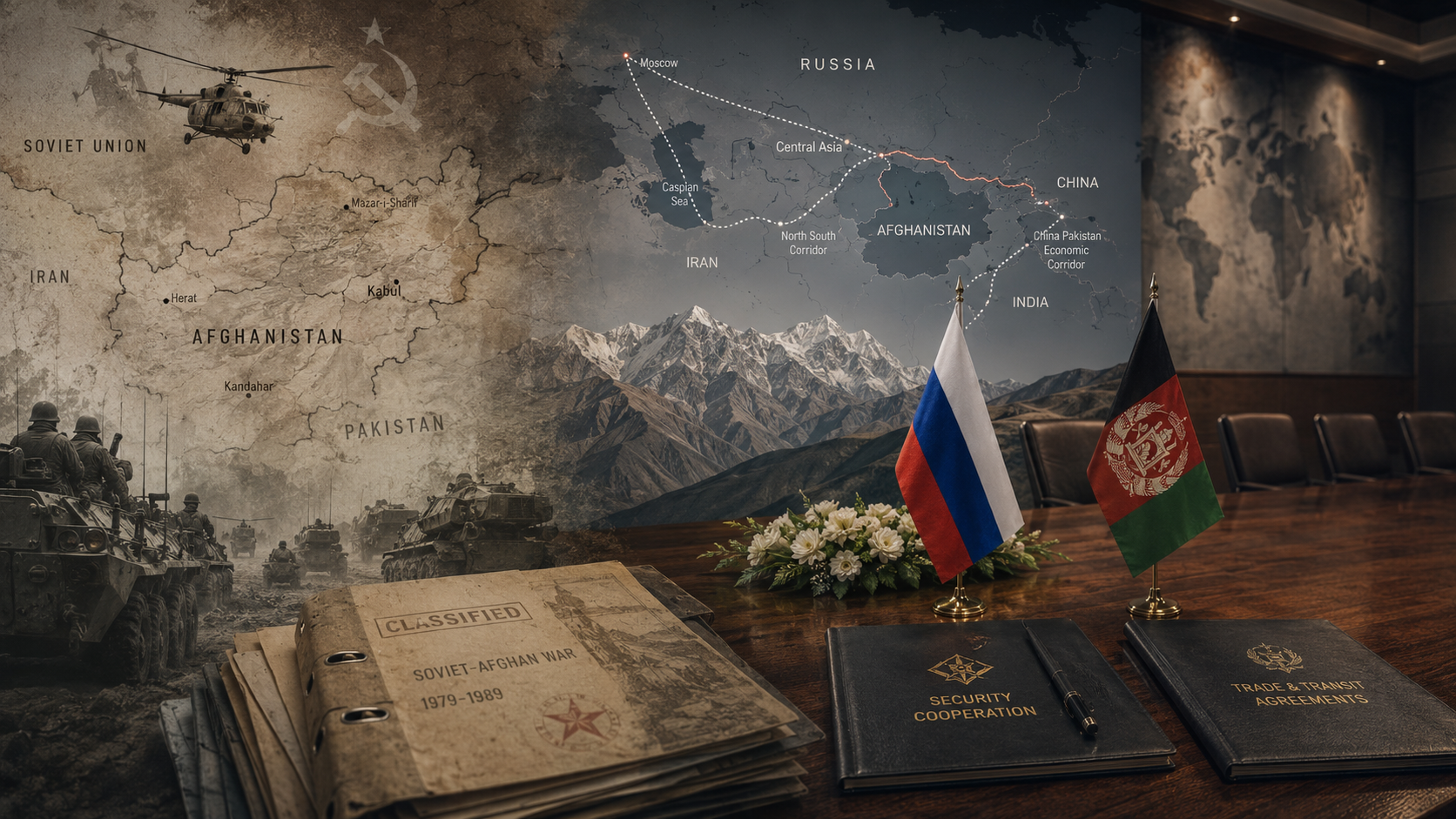
The emerging relationship between Russia and Afghanistan represents one of the most striking geopolitical reversals of the twenty-first century.
Four decades ago, Afghanistan was the graveyard of Soviet ambitions. Today, Moscow and Kabul are moving toward security cooperation, signalling a broader realignment across Eurasia.
Russia became the first country to formally recognise the Taliban-led government in July 2025. Less than a year later, Russian and Afghan officials reportedly signed a military-technical cooperation agreement, although the details remain undisclosed.
Taken together, these developments suggest that both countries now see strategic value in partnership despite a history marked by war and mutual hostility.
The obvious question is: how did former enemies become potential security partners?
Beyond the Legacy of the Soviet-Afghan War
Many observers continue to view Afghanistan primarily through the lens of the Soviet invasion and the anti-Soviet resistance of the 1980s.
That conflict undoubtedly played a major role in weakening Soviet influence and damaging Moscow's international prestige.
However, reducing the collapse of the Soviet Union solely to the Afghan war oversimplifies history.
The Soviet decline emerged from a combination of military overreach, economic strain, ideological competition, intelligence operations, and sustained geopolitical pressure from the West.
Afghanistan was an important theatre within a much larger Cold War struggle. It became a battleground where global powers tested strategies, financed proxies, and pursued long-term geopolitical objectives.
Understanding this broader context helps explain why today's developments should not be viewed simply as an ironic historical footnote.
Rather, they are part of a larger transformation in international politics.
The Legacy of Proxy Warfare
The Soviet-Afghan conflict also demonstrated the effectiveness and dangers of proxy warfare.
Operation Cyclone, the covert programme through which the United States supported Afghan resistance forces, remains one of the most significant intelligence operations of the Cold War era.
Through regional partners and intelligence networks, resources flowed into Afghanistan to undermine Soviet power without direct confrontation between the superpowers.
The consequences extended far beyond the battlefield.
Foreign powers discovered that local movements could be leveraged to achieve strategic goals, but the long-term effects often proved difficult to control.
The Afghan conflict became a case study in how external intervention can reshape societies for generations.
The networks, ideologies, and security dynamics created during that period continued to influence regional politics long after the Soviet withdrawal.
Today, many states are reassessing the legacy of those policies and the instability they helped create.
Why Russia and Afghanistan Are Moving Closer
The answer lies not in friendship but in interests.
Modern geopolitics rarely operates according to historical grievances alone. States cooperate when their strategic calculations align.
Both Moscow and Kabul have reasons to seek closer ties.
Russia wants to strengthen its position in Central Asia, counter extremist threats, and expand its regional influence.
Afghanistan seeks international recognition, security assistance, investment opportunities, and alternatives to dependence on Western diplomatic channels.
Both governments also share concerns about the reliability of Western-led security frameworks and the use of external pressure to influence domestic political outcomes.
From this perspective, the emerging Russia-Afghanistan partnership is not surprising.
It reflects a pragmatic assessment of mutual interests in a rapidly changing international environment.
A Changing Regional Order
The significance of this development extends far beyond bilateral relations.
Afghanistan occupies a strategic crossroads connecting South Asia, Central Asia, China, Iran, and the wider Eurasian region.
Any shift in Kabul's external relationships inevitably affects neighbouring powers.
Russia's engagement with Afghanistan will be closely watched in Islamabad, Tehran, Beijing, and the Central Asian republics.
Each actor has its own interests in regional stability, trade corridors, security cooperation, and counterterrorism efforts.
For Pakistan in particular, the implications are substantial.
Afghanistan's external partnerships influence border security, refugee movements, economic connectivity, and regional diplomacy.
Russia's growing role could provide Kabul with additional strategic options while simultaneously reshaping traditional power relationships in the region.
Whether this contributes to greater stability or generates new strategic competition remains an open question.
Afghanistan and the Multipolar Future
For more than a century, Afghanistan has served as a focal point of great-power competition.
It played a central role during the imperial rivalries of the nineteenth century, became a Cold War battleground during the twentieth century, and stood at the centre of America's longest war after 2001.
Today, Afghanistan may once again be emerging as a test case, this time for the transition from a unipolar world order to a more multipolar international system.
The symbolism is powerful.
The country that once contributed to the weakening of Soviet influence is now engaging with Russia as a security partner.
This does not mean history has been forgotten.
It demonstrates that national interests, rather than historical sentiment, continue to drive international relations.
The emerging Russia-Afghanistan relationship should therefore be viewed as more than a bilateral agreement.
It reflects deeper shifts in global power structures and growing efforts by regional states to pursue alternatives to Western-led frameworks.
Conclusion
The developing Russia-Afghanistan partnership highlights an enduring reality of geopolitics: there are no permanent friends or enemies, only permanent interests.
Russia seeks influence, security cooperation, and strategic depth.
Afghanistan seeks recognition, stability, and broader diplomatic options.
These overlapping objectives have created the conditions for cooperation between two countries once separated by war.
Whether this relationship evolves into a long-term strategic alliance remains uncertain.
Significant political, economic, and diplomatic obstacles remain.
What is certain, however, is that Afghanistan continues to occupy a pivotal position in global affairs.
As the international system evolves toward a more complex and multipolar structure, developments in Kabul will remain closely tied to the broader struggle over the future balance of power in Eurasia and beyond.

Reader comments
Subscribers can join the conversationSign in to join the conversation. Comments are open to everyone with a free account.
Sign in or create accountLoading comments…