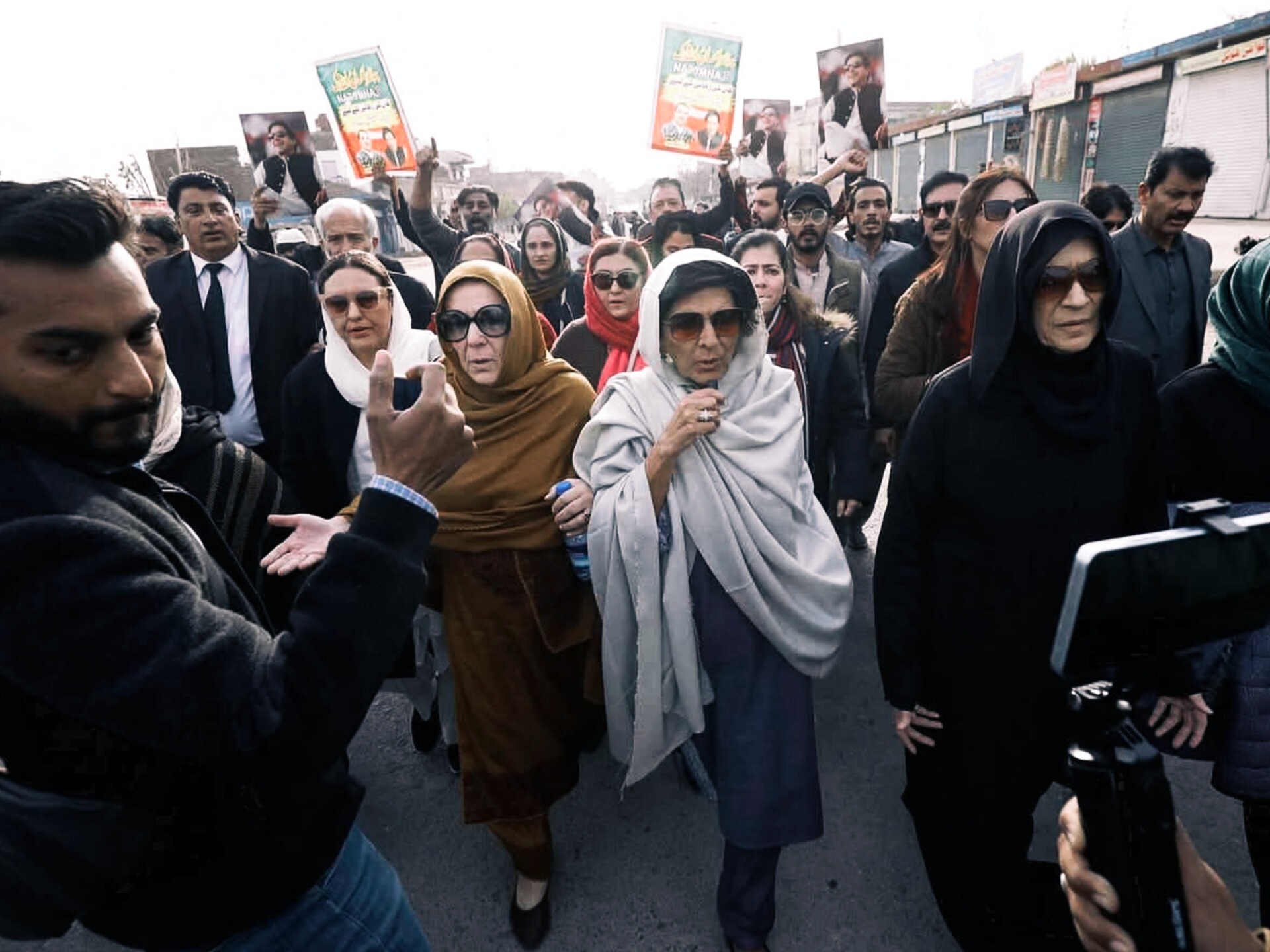
In Pakistan, demanding the release of a political prisoner can be enough to join him behind bars. Imran Khan’s three sisters, Aleema Khan, Uzma Khan and Noreen Niazi, were detained in Lahore ahead of a protest calling for their brother’s freedom. And now, according to their family, they have resorted to a hunger strike: women imprisoned to prevent them from mobilising others are using the one means of protest the authorities have left within their reach.
On September 30, Khan’s cousin, Qasim Zaman, said the sisters had been refusing food for 48 hours in protest against their treatment at Kot Lakhpat jail. He alleged that essential items had not reached them and demanded access for their relatives and lawyers. The Punjab government, meanwhile, had assured the Lahore High Court that Aleema was receiving basic necessities: Pakistan’s administration can apparently account for a prisoner’s toothbrush more readily than it can justify her imprisonment. The conflicting accounts make access to the women all the more necessary: assurances from the administration holding them cannot substitute for allowing their family and legal representatives to establish their condition.
A hunger strike brings the dispute back to the prisoners themselves, whose voices preventive detention was intended to remove from public life.
Aleema was detained in Lahore on September 20; Uzma and Noreen were taken into custody the following day. All three received 30-day detention orders under the Punjab Maintenance of Public Order Ordinance. Their arrests preceded a protest demanding their brother’s release, originally scheduled for September 27 and subsequently postponed to October 4. The march has moved. The women remain behind bars.
The authorities claimed that the women were mobilising supporters and represented a potential danger to “public peace and tranquillity”. The danger, evidently, consisted of three sisters speaking publicly about their brother’s imprisonment and encouraging people to demonstrate.
They were not detained because a court had established that they had committed a crime. They were detained because the government feared what they might persuade others to do in the future.
Preventive detention performs a convenient trick: it transforms political opposition into a security threat before any offence has occurred, allowing the state to punish intention, influence and even kinship.
The political calculation is straightforward. With Khan imprisoned, his sisters have helped keep him present in public life. They speak, relay messages and remind supporters that the removal of their leader has not extinguished their cause. Preventive detention allows the authorities to interrupt that work without first proving a criminal offence.
Influence becomes a prospective disturbance; a prediction about tomorrow supplies the justification for imprisonment today.
There is something revealing about the setting. These arrests took place in Lahore, far from the borderlands where Islamabad habitually invokes insurgency to explain why ordinary legal protections must be suspended. But apparently, no mountain hideout or foreign conspiracy is necessary: three elderly women advocating for a jailed brother are sufficient to activate the machinery of public safety.
The method long associated with and justified by Pakistan’s peripheral conflicts has now an entirely domestic political application.
And those arrests were not an isolated excess. Three days earlier, human-rights lawyer Imaan Zainab Mazari-Hazir and her husband, Hadi Ali Chattha, had been re-arrested only hours after the Supreme Court granted them bail and suspended their 17-year prison sentences in a cybercrime case. The couple had been convicted over social-media posts critical of military operations and state policy in conflict-affected regions. When the country’s highest court ordered their release, the state simply reached for an older case involving a protest and an allegedly blocked road.
The sequence was almost pedagogical. A court may order a prisoner released; the security apparatus will decide whether the order has any practical meaning. The judiciary remains useful as scenery, provided nobody mistakes it for an institution capable of limiting power.
Mazari’s real offence has long been apparent. She has represented Baloch students, families of the forcibly disappeared, journalists and others whom the state prefers to keep outside both public attention and legal protection.
In a functioning system, this is the work of a lawyer. In Pakistan, insisting that intelligence agencies explain what they have done with people can itself be treated as evidence of hostility to the state.
These cases belong to the same political architecture as the campaign now unfolding against Baloch women.
On August 27, the Government of Balochistan published what looked less like a police notice than a licence for collective suspicion. Nine Baloch women from Gwadar, Jiwani and Turbat were declared highly wanted, with rewards of between one and 1.5 million rupees offered for information leading to them. Their alleged offence was affiliation with Fitna al-Hindustan, the term now routinely used by Pakistani authorities to describe the Baloch insurgency while attributing it simultaneously to India.
The women may or may not have links to an armed organisation. The government offered no publicly verifiable evidence, no indication that they had been formally charged and no account of the judicial process through which they had acquired the status of wanted militants.
It supplied photographs, names, cash prizes and assurances that informants would be protected. In a province where people have disappeared for considerably less than a formal accusation, the message required little elaboration.
The timing was convenient.
Four days earlier, 20-year-old student Safia Baloch had allegedly been taken from Quetta during a night operation involving the Counter Terrorism Department and the Inter-Services Intelligence.
On August 5, 17-year-old Aqsa had disappeared with her father, Abdul Qudoos Zarakzai, after security personnel raided their home in Khuzdar.
At the end of July, Rafia Bibi, Tania and Javeria had reportedly been detained at a Frontier Corps checkpoint near Quetta and had not been seen since.
First women vanish; then the state explains why women should be feared.
For decades, enforced disappearance has operated as an unofficial component of Pakistan’s counterinsurgency doctrine. Men are taken from homes, universities, roads and checkpoints, held outside the law and sometimes released months or years later. Others return as bodies; many never return at all. Courts are bypassed because the purpose is not simply to punish an individual. It is to discipline an entire family and community through uncertainty.
Historically, Baloch women experienced disappearance indirectly. When a husband, brother or son was taken, they maintained the household, searched police stations and military camps, petitioned courts and spent years sitting beside photographs of the missing. The violence was directed at men, but its social and economic consequences were transferred to women.
That arrangement produced something Islamabad appears not to have anticipated. Women became the most visible representatives of the Baloch political struggle.
Mahrang Baloch, Sammi Deen Baloch and thousands of others moved enforced disappearance from private homes into streets, protest camps and national debate.
The march from Turbat to Islamabad transformed individual grief into a collective indictment.
It also disrupted the state’s preferred narrative. Indian conspiracies are more easily invoked against gunmen in the mountains than against mothers carrying photographs of their sons.
Pakistan responded to the march with roadblocks, arrests, water cannon and tear gas, revealing that the state did not object only to Baloch militancy. It objected to any form of Baloch political agency it could not control.
The participation of a small number of women in armed organisations has now provided a more useful pretext.
Since Shari Baloch attacked the Confucius Institute in Karachi in April 2022, the Baloch Liberation Army’s Majeed Brigade has deployed several female fidayeen.
Their appearance marked an important evolution in the insurgency and demonstrated the BLA’s ability to recruit educated women for operations carrying enormous symbolic value.
There is no legal or moral immunity conferred by gender. A woman who plans or conducts an armed attack is as much a combatant as a man, and the authorities have the right to investigate her.
What they do not have the right to do, is to seize women without warrants, conceal their whereabouts and produce custodial statements as substitutes for evidence before a court.
Nor can a handful of female attackers justify treating an entire female population as an extension of the insurgency.
Yet this is precisely what the category of Fitna al-Hindustan makes possible.
It collapses the distinctions between combatant, activist, lawyer, relative and suspect. Every protester can become a facilitator, every missing woman a clandestine militant and every demand for due process an act of foreign-sponsored subversion.
The arrests of Imran Khan’s sisters reveal the same method without the Balochistan vocabulary.
Aleema, Uzma and Noreen were not accused of carrying explosives or commanding an armed cell. They were accused, in essence, of possessing political influence and being prepared to use it.
Their relationship to a jailed opposition leader made them useful hostages; their own public voices made them dangerous.
Imaan Mazari occupies the point at which the two campaigns intersect.
She is targeted neither as somebody’s grieving relative nor merely as an opposition supporter, but as a woman who uses the law to expose the distance between Pakistan’s constitutional order and the practices of its security institutions.
Re-arresting her after the Supreme Court ordered her release was therefore not bureaucratic improvisation. It was a declaration of hierarchy.
This is not simply misogyny, although misogyny makes the repression easier to conduct and easier to sell. It is a strategy of political control directed at women because women have become essential to the survival of movements the state has tried to decapitate.
When male leaders are jailed, women carry their messages. When men disappear, women search for them. When activists are silenced, female lawyers take their cases.
And because repression is still imagined as a masculine contest between the state and its armed enemies, women are sometimes able to expose its machinery with particular clarity.
A gunman can be killed and labelled a terrorist. A mother asking where her son has been taken presents a more complicated problem.
A lawyer demanding that intelligence agencies answer to a court is more troublesome still.
By turning both into security threats, the state solves the problem rhetorically. Once peaceful advocacy and armed violence have been placed in the same category, disappearance becomes prevention, preventive detention becomes public safety and defiance of court orders becomes administrative routine.
Pakistan claims that changing security threats have forced it to expand its response.
The sequence suggests something darker.
After decades of imprisoning and disappearing men, the state helped create political movements increasingly sustained by the women left behind.
It is now coming for them too—not because they are weak, but because they have proved that they are not.

Reader comments
Subscribers can join the conversationSign in to join the conversation. Comments are open to everyone with a free account.
Sign in or create accountLoading comments…