
The inter-war period is over.
Ominous words, maybe, but it appears to be the general consensus among those in geopolitical circles. Exactly when it came to an end, and what killed it, is debatable, but it has most certainly shuffled off the mortal coil of ‘now’ and into the dusty realm of ‘then’.
This New Cold War (the jury is out for a name, because that really can’t be it) is in many ways more dangerous than the first. It was simpler, or would appear so to most: East vs West, Red vs Blue, Communist vs Capitalist. The rest of the world, or the unaligned nations, played and were played by both sides. The music and the propaganda were also certainly much better.
The main front of this conflict is undoubtedly Ukraine, with Iran a close second. However, further east the drums of approaching strife are sounding loud.
The Greatest Trial of the Postwar Era
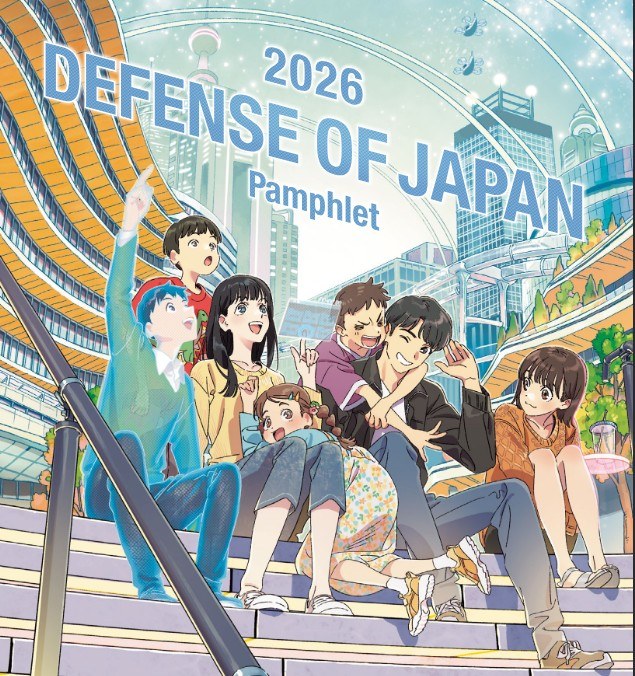
Japan has heard this, made clear in the “2026 Defence of Japan” white paper (DOJ2026), released on the 3rd of August with a typically ‘Kawaii’ front page.
The paper lays out some of the details in Japan’s most significant armament programme since the build-up of WW2. As Europe has, it recognises the growing challenges that it’s likely to face in the future and, interestingly, they align with Europe keenly. Both recognise an authoritarian neighbouring power that threatens them, both recognise the need to jump-start their defence industries and both recognise the need to keep the United States interested and involved.
It gets right into it, describing current geopolitical trends as “the Greatest Trial of the Postwar Era”. Given how close the world came to Armageddon during the old Cold War, that is quite the statement.
“States that do not share universal values or political and economic systems based on such values are expanding their influence. Unilateral changes to the status quo by force and such attempts represent a serious challenge to the existing international order. The international community is facing its greatest trial since World War II and entering a new era of crisis.
“The global balance of power is shifting dramatically and competition among states is growing. In particular, the inter-state competition between the U.S. and China is likely to intensify even further in the future.”
There is little ambiguity here. The document lists key risks: technology, information warfare and grey zone operations. So far, so European. It’s telling that Chapter 2 focuses on “Russia’s Aggression and Ukraine’s Defence”, preceded by: “It cannot be ruled out that a serious situation similar to Russia’s aggression against Ukraine may occur in the Indo-Pacific region in the future, particularly in East Asia.”
Tensions in the region are high. Chinese President Xi Jinping has set 2027 (five months’ time) for his forces to be ready to attack Taiwan and it recognises that growing tensions are not happening in a vacuum. Naturally, China is therefore the main challenge identified in the document. It states: “China’s external posture, military activities, and other activities are a matter of serious concern for Japan and the international community and present an unprecedented and the greatest strategic challenge, which Japan should respond with its comprehensive national power and in cooperation and collaboration with its ally, like-minded countries and others.”
However, if you read again the opening bullet point, it (rather politely) refers to the: “States that do not share universal values or political and economic systems based on such values.”
The dictators, and their partnerships
These can safely be referred to hereafter as the dictators: Russia, China, North Korea and Iran.
All received attention in Japan’s new strategy and they recognise that these actors aren’t working alone. Regarding Russia (which borders Japan and occupies islands Japan claims, ask how a European power does this sans imperialism), it states: “Russia’s military activities in the Indo-Pacific region, including Japan, coupled with its strategic partnership with China, are posing a strong security concern.”
It goes on to mention the “Strong State” model adopted by Russia and the above partnership with China. Without that partnership and the other with North Korea, Russia’s position in its war of conquest against Ukraine would likely be much weaker. China supplies Russia with significant dual-use material, things that can be used for civilian or military purposes. In my interview with Gen. David Petraeus last year, he laid out that relationship, describing how the trade includes “All the elements needed to make weapon systems, without which, Russia could not produce those weapon systems”.
Of course, North Korea has provided troops and ballistic missiles and Iran provided the Shahed drones which have become so effective and copied by all powers.
Japan’s response to all of these interconnected threats is, as with Europe, to rearm and cement the alliance between ‘like-minded countries’ (there, read ‘democracies’). It states: “What should be prioritized the most in protecting the lives and livelihoods of the people of Japan is carrying out active diplomacy. With the Japan-U.S. Alliance as the cornerstone, it is essential to work along with like-minded countries and promote multilateral cooperation.”
As I wrote in Parrhesia News two weeks ago, Europe’s rearmament and increasing assertiveness must not come at the cost of the transatlantic alliance. Japan is in the same position, but is lucky in some regards not to draw as much cultural ire from the Trump administration as does Europe. After all, Trump just bought significant amounts of yen.
Japan is a bit of a special case though. Since its defeat in WW2, it has been effectively a US protectorate, the mighty 7th Fleet of the US Navy is headquartered in Yokosuka and Japan’s own constitution is explicitly pacifist. Its armed forces, the “Japanese Self-Defence Forces”, started as a branch of the police.
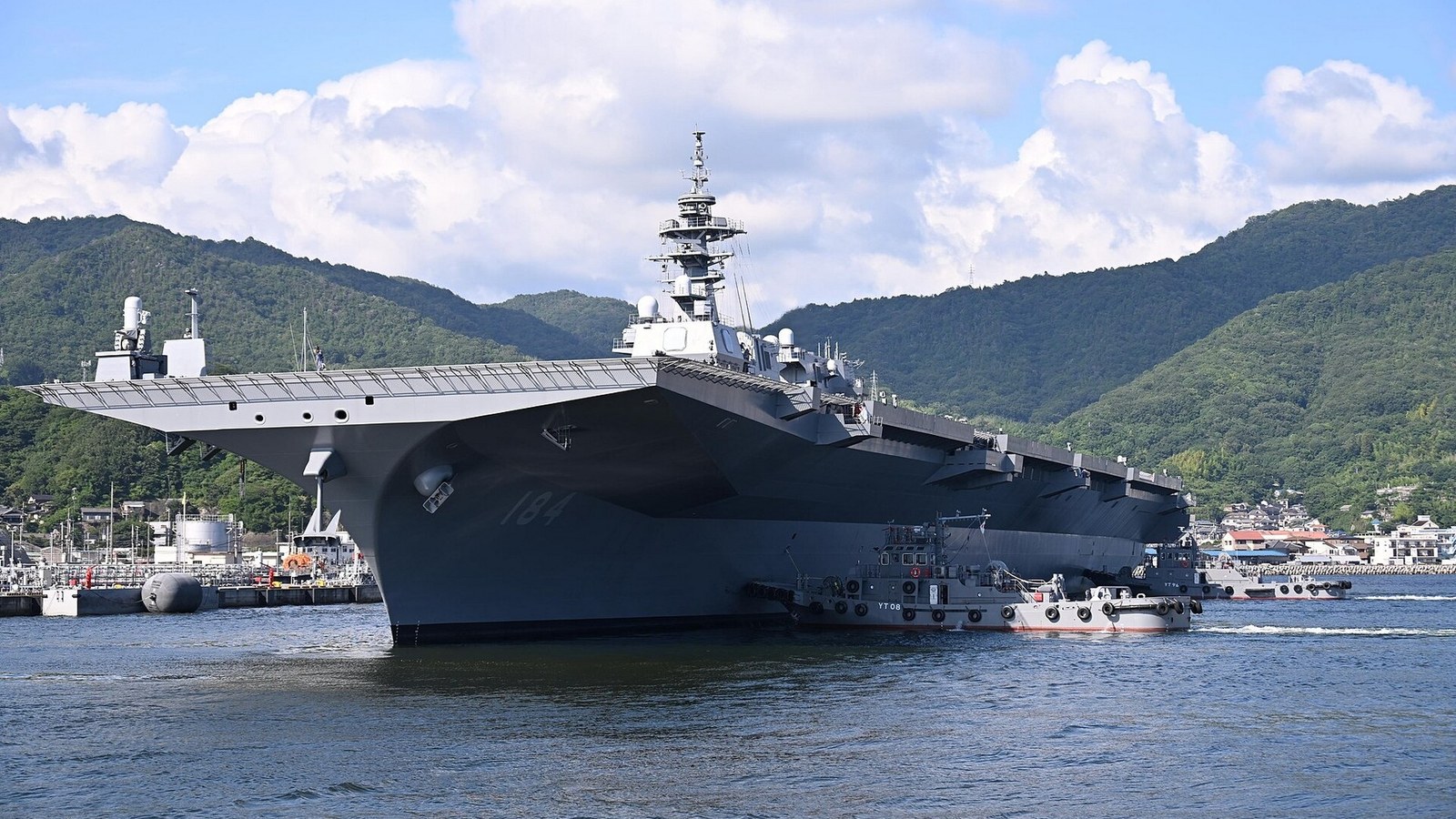
Japan can’t even technically own aircraft carriers.
The amusing legalese of rearmament
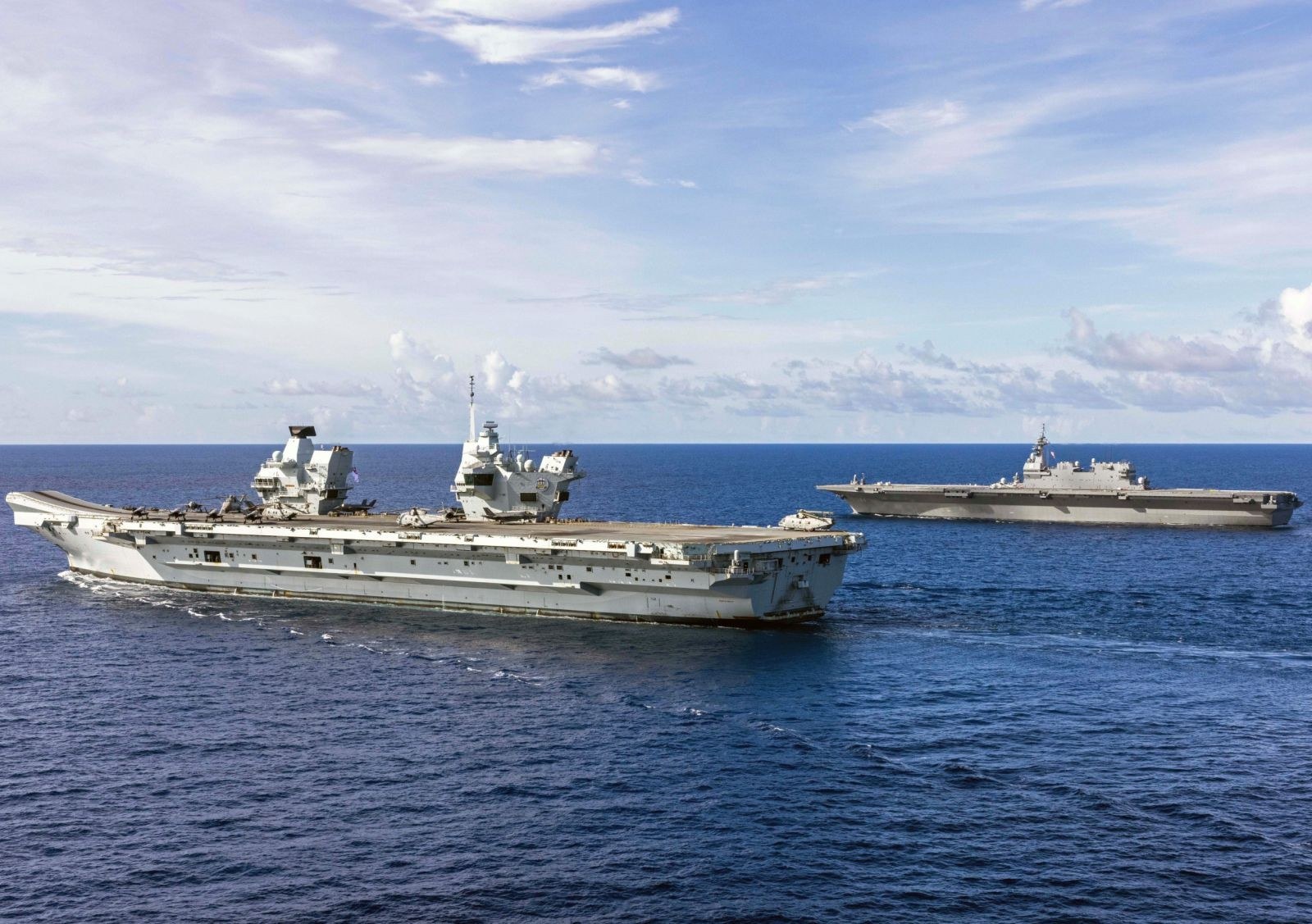
I said ‘technically’. The ship in the foreground is an aircraft carrier, the Royal Navy’s HMS Prince of Wales. The ship in the rear is, despite appearances, not an aircraft carrier. It is the JS Kaga, an Izumo-class aircraft-carrying multi-role cruiser. It is capable of carrying and launching F-35Bs, the same jet that Prince of Wales flies, but despite appearances and the fact that it is named after a WW2-era Japanese aircraft carrier which fought at Pearl Harbor and was sunk at the Battle of Midway, it is not, in fact, an aircraft carrier. Such is the amusing legalese of Japanese rearmament.
What’s shown in the image above is also the cooperation that is discussed. Japan is engaged in military cooperation with many of the democracies and it intends to grow those relationships beyond that which it already has with the US. In April, Japan relaxed restrictions on arms exports. It is developing 6th-gen fighters with the UK and Italy under the GCAP programme, it has donated funds, vehicles and non-lethal supplies to Ukraine and is building 11 new Mogami-class frigates for Australia.
New partners, and an old taboo
A new and interesting branch of relationship building is in Japan’s agreements with India. On August 4th, Japanese Defence Minister Shinjiro Koizumi announced the dispatch of Japanese F-2 fighter jets to India for a joint exercise, the first ever on Indian soil. Japan is also a founding member of ‘The Quad’, an informal partnership between Japan, India, the US and Australia. In May this year, the Quad announced the Indo-Pacific Maritime Surveillance Collaboration (IPMSC). The initiative appears focused on strengthening info-sharing and surveillance coordination amongst the members. Chinese state media came out strongly against it. Unsurprising, given that it appears likely aimed at balancing against China.
There is another Rubicon that Japan may cross. It has the tragic status of being the only nation to have suffered the horrors of atomic war. Since 1967, Japan has formally pledged not to host, manufacture or possess nuclear weapons. This is known as the “three non-nuclear principles” and has been steadily upheld since it was signed. In July, Defence Minister Shinjiro Koizumi pressed for a debate on the matter. He said: “While this is a difficult issue for Japan to discuss, one topic we cannot avoid is nuclear weapons.” Although DOJ2026 maintains adherence to the three principles, a sitting cabinet minister discussing a debate on it is deeply significant for the nation.
Twenty years ago, these kinds of developments in Japan would have been near impossible. Today, they merely are prudent. Japan’s rearmament and its alliance building laid down in DOJ2026 show a clear trend: lines are being drawn. In the Indo-Pacific, just as in Europe, the world is returning to a system of alliances, opposite in ideology, which stand in competition and conflict with one another.
Japan has chosen its side. Many other nations may find that they have to choose in time, or have that choice taken from them.


Reader comments
Subscribers can join the conversationSign in to join the conversation. Comments are open to everyone with a free account.
Sign in or create accountLoading comments…