
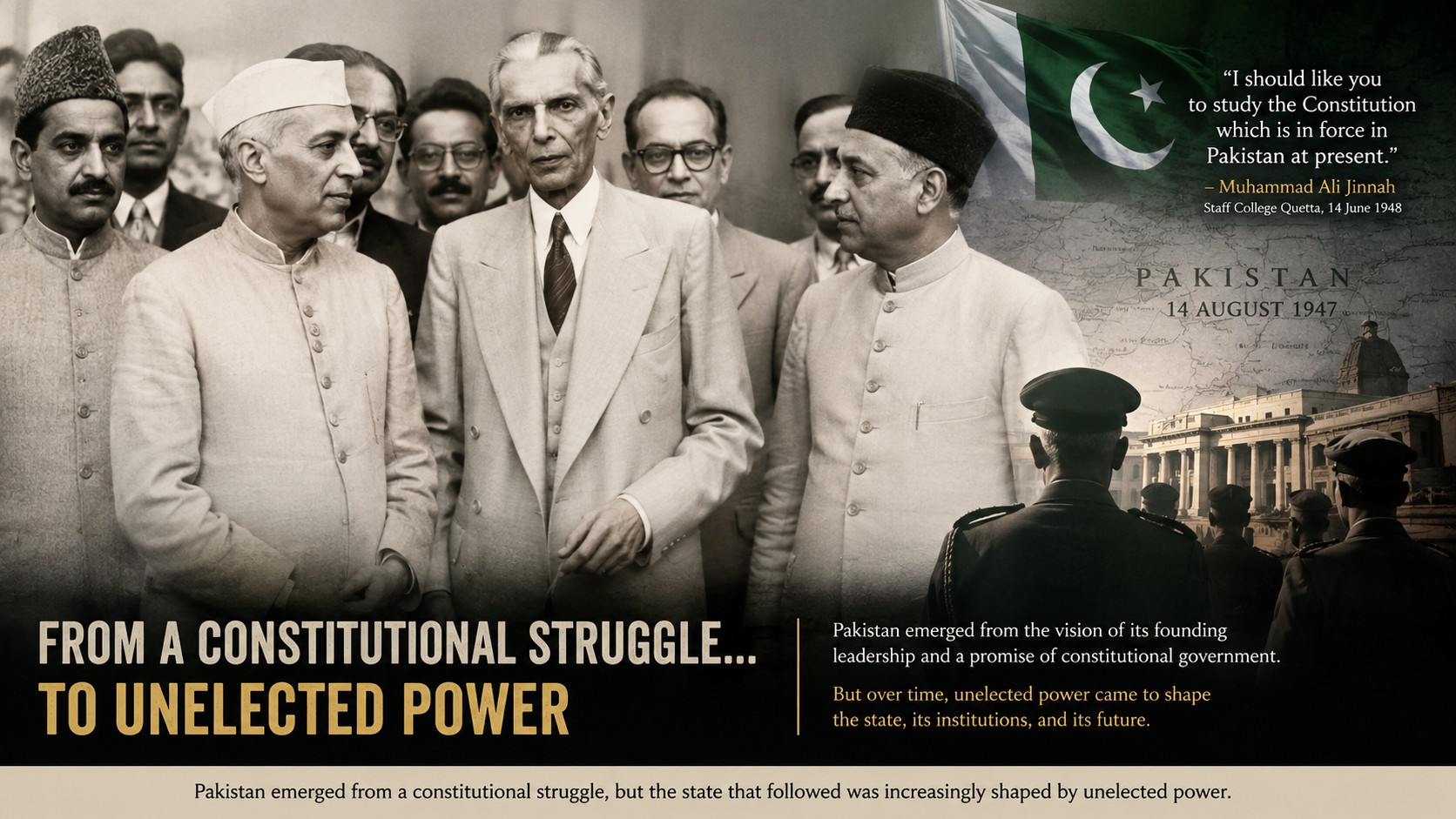
Every 14 August, Pakistan is invited to remember freedom. The flag goes up, old songs return to television, schoolchildren rehearse familiar lines about sacrifice, and political leaders speak of a country born so that the Muslims of South Asia could live with dignity and govern themselves.
The ceremony has its place. So does the pride. But nearly eight decades after independence, there is another question worth asking — one that does not fit easily into the official programme: what became of the political promise that accompanied the creation of Pakistan?
Pakistan was not founded as a military state. It was born in upheaval — Partition massacres, refugee columns, a weak treasury, administrative dislocation and war in Kashmir — but it was still meant to be run through constitutional authority and representative institutions. The Army was one institution of the new state, not its political custodian.
That distinction blurred, then almost disappeared. Over time, the language of emergency, strategic necessity, national interest and ideological discipline came to outweigh the less dramatic business of citizenship, federal compromise, parliamentary authority and institution-building. Pakistan did not simply acquire a strong military. It developed a political order in which the security establishment acquired an enduring say over who could rule, how far they could rule and which areas of national life lay beyond ordinary civilian control.
This is not an argument that every failure in Pakistan can be laid at the door of the Army. Civilian politicians, judges, bureaucrats, business interests and parties all played their part, often willingly. But it is difficult to read the country's history without seeing a recurring pattern: civilian weakness created room for intervention; intervention weakened civilian institutions further; their weakness was then cited as proof that intervention had been necessary in the first place.
The result can be seen in the broken constitutional record, the loss of East Pakistan, repeated bouts of political engineering, chronic dependence on external lenders, unresolved provincial grievances, recurring militancy and a hybrid order in which elections continue to exist while sovereignty is often shared with unelected power.
The founding promise was not military guardianship
Pakistan came into being on 14 August 1947 as the Dominion of Pakistan. The constitutional title 'Islamic Republic of Pakistan' arrived later, under the 1956 Constitution. The founding record contains several strands at once: Muslim political identity, constitutional government, representative politics and, in Jinnah's speeches, an insistence that citizenship could not simply be reduced to communal identity.
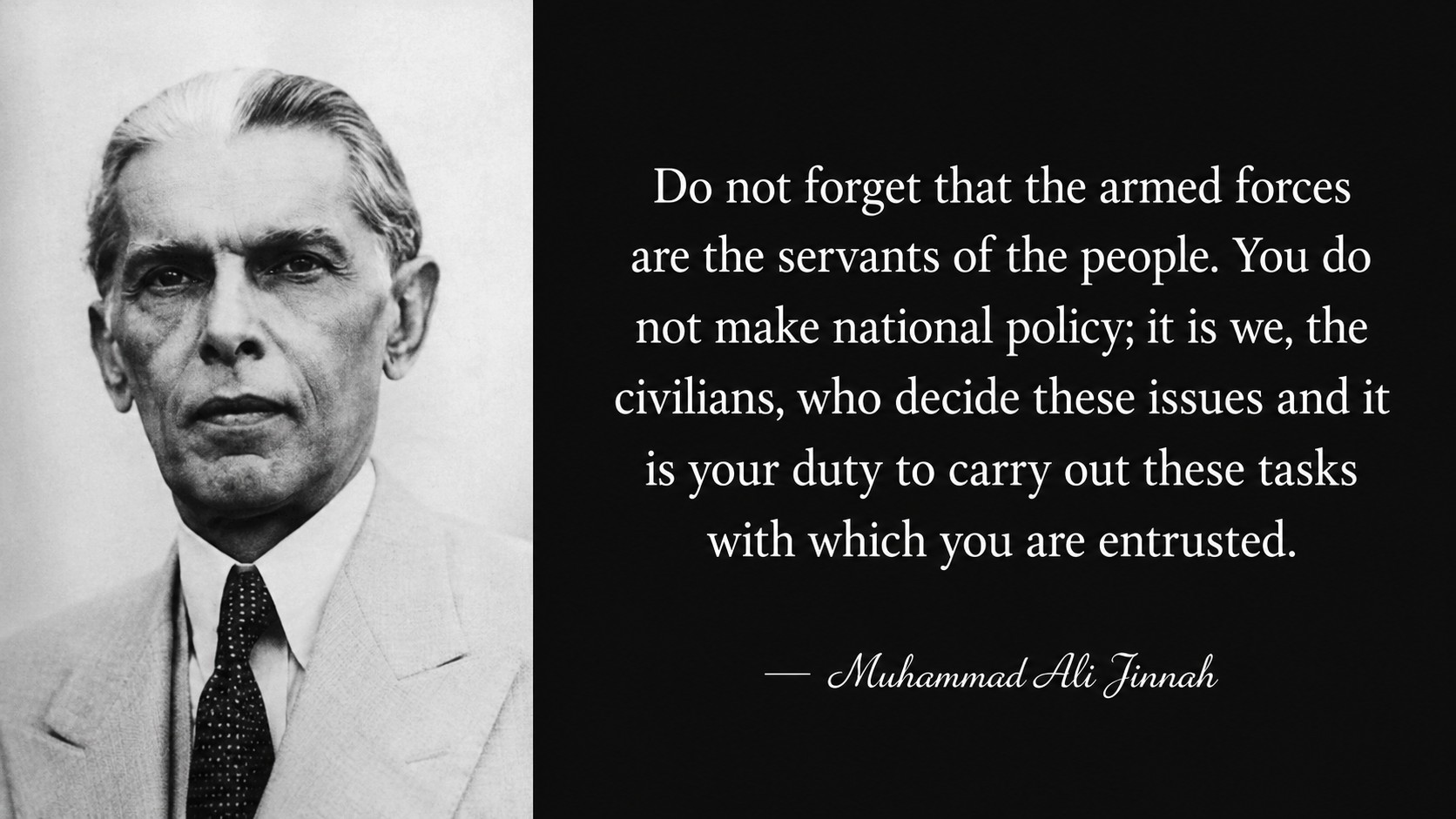
There is a tendency, on all sides of Pakistan's ideological arguments, to conscript Muhammad Ali Jinnah into positions he never neatly occupied. He was not a modern secular liberal in the way that term is now commonly used, but neither was he an advocate of permanent praetorian government. His political method was constitutional. His instinct was legal and representative. And when he addressed military officers at Staff College Quetta in June 1948, he reminded them that they were servants of the state and bound by the Constitution.
That principle should have been unremarkable. In Pakistan, it became revolutionary.
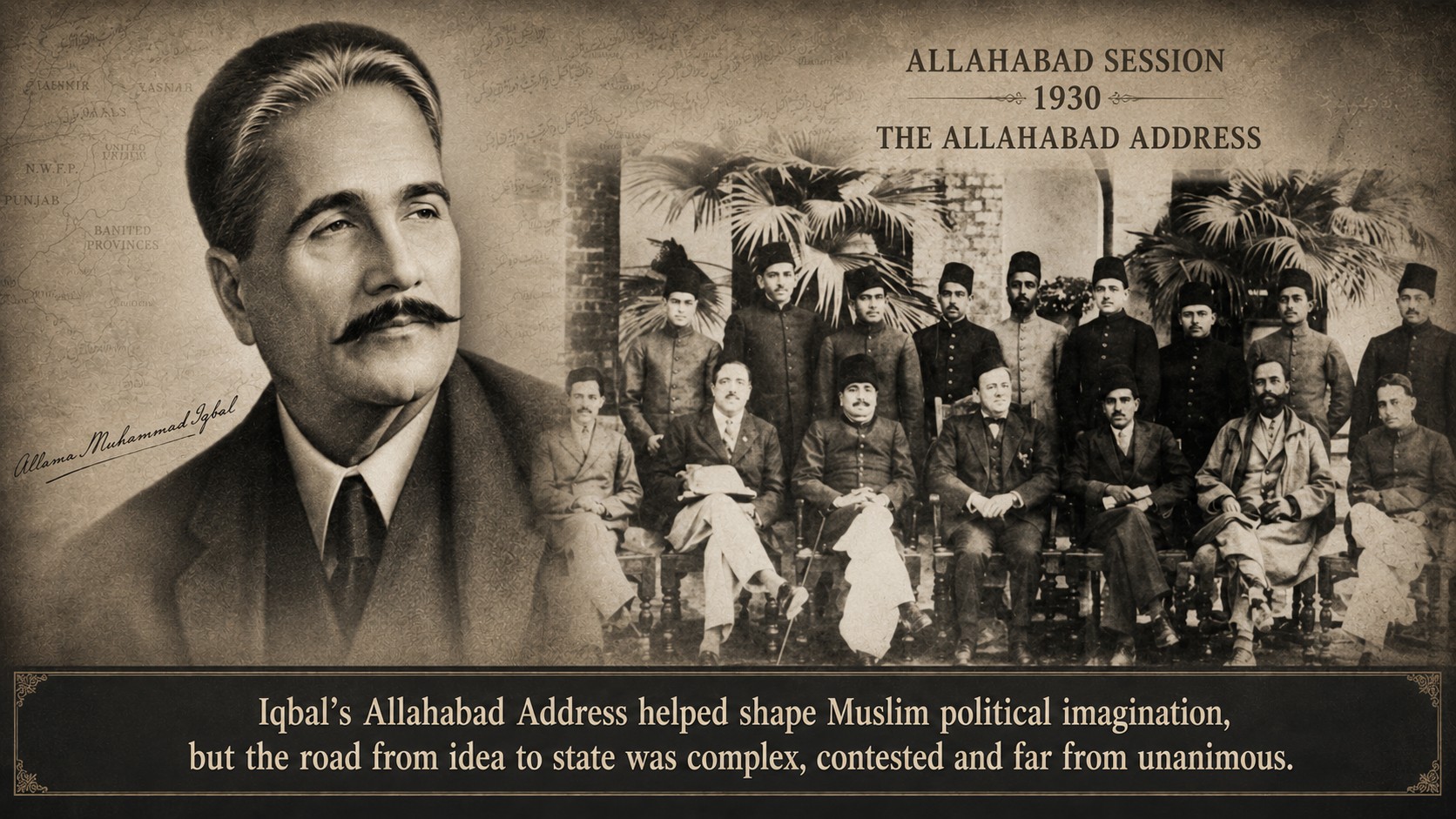
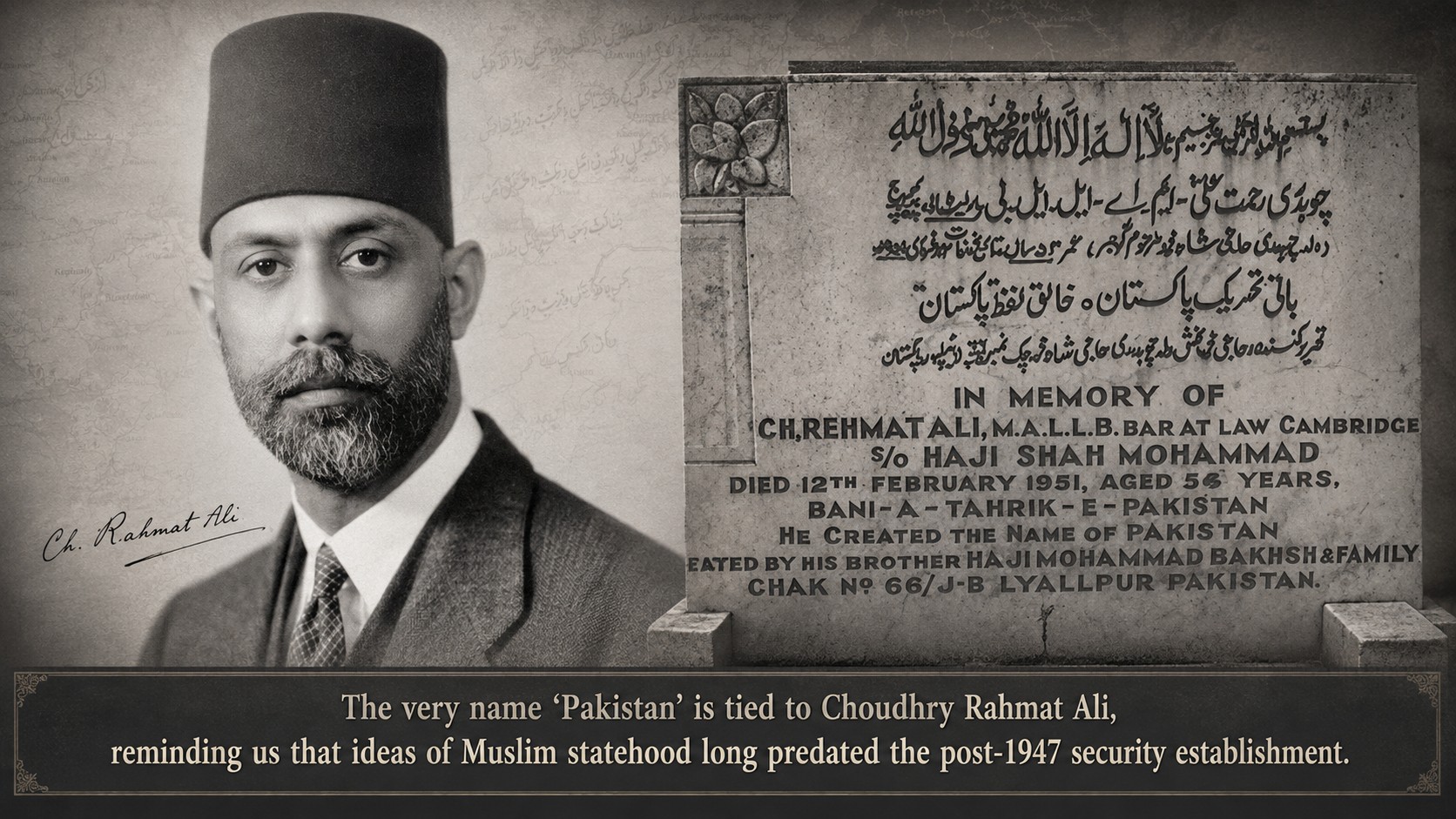
The intellectual road to Pakistan was never as tidy as the textbooks later made it appear. Iqbal's Allahabad Address mattered. Rahmat Ali's coinage mattered. So did the changing politics of Punjab, Bengal, Sindh, the North-West Frontier Province and Balochistan. What eventually gathered behind the Muslim League was a coalition of regional interests, anxieties and aspirations. It was not a plebiscite for authoritarian rule after independence.
Jinnah's 11 August 1947 address to the Constituent Assembly is remembered for its language of religious freedom. Less often remembered in public argument is the consistency of his constitutional instinct: the armed forces were subordinate to lawful civilian authority. The Army was to defend Pakistan; it was not meant to become the final interpreter of Pakistan.
The road to the first coup was partly civilian — but the coup changed the state
It is convenient to tell Pakistan's history as a morality play in which generals suddenly hijacked an otherwise healthy democracy. It is also wrong. By 1958, parliamentary government had already been damaged by civilian governors-general, senior bureaucrats and judicial reasoning that made extra-constitutional action easier to defend. Governments were short-lived. Political parties were weak. Centre-province tensions were acute. And the demographic weight of East Pakistan presented a question that the ruling elite in the western wing was never comfortable answering democratically.
Those failures matter because they explain how military rule became possible. They do not make it inevitable — and they certainly do not make it harmless.
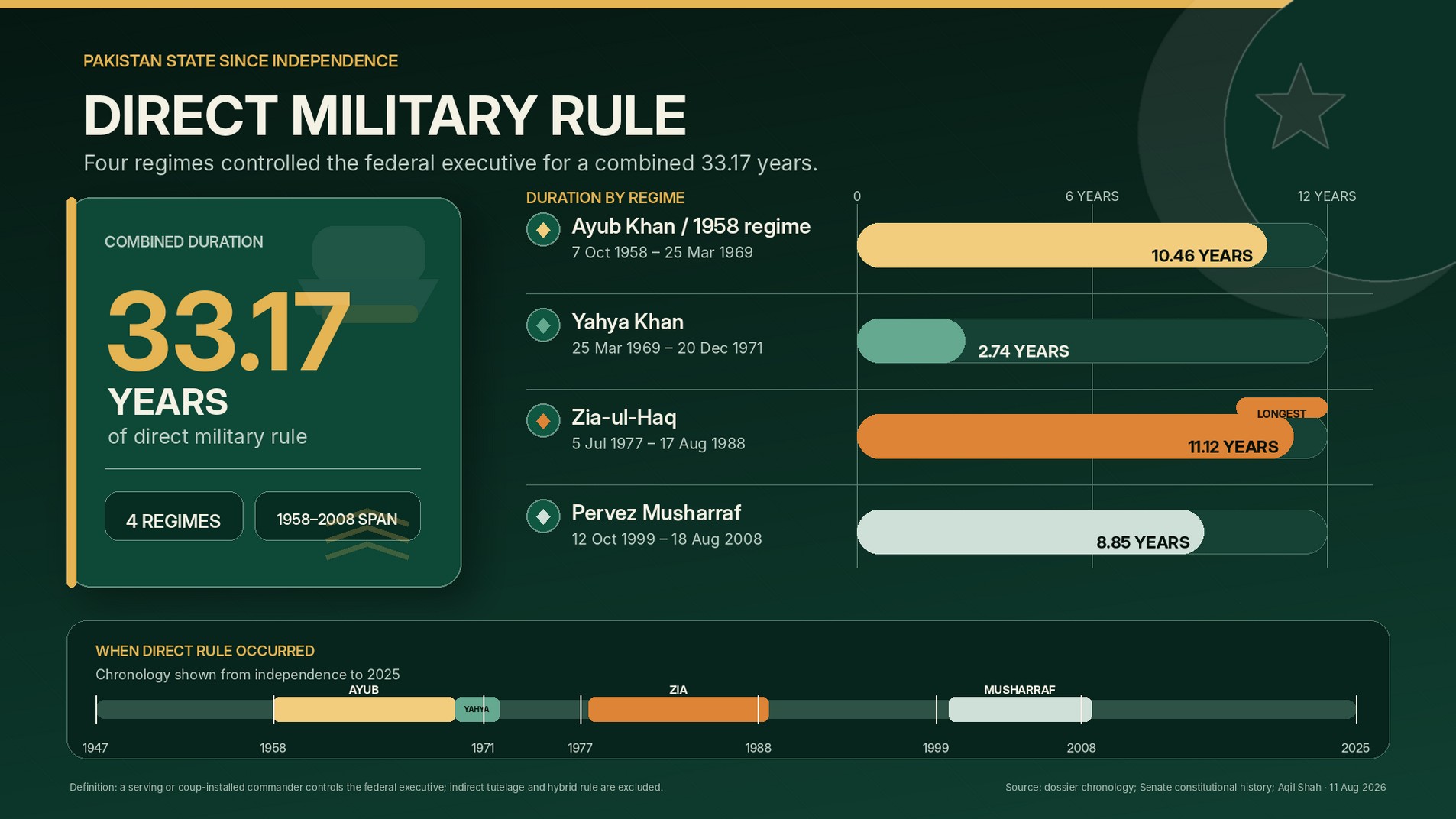
In October 1958, President Iskander Mirza abrogated the 1956 Constitution and imposed martial law, appointing General Ayub Khan as chief martial-law administrator. Within days, Ayub displaced Mirza. A military that had been gaining influence now held sovereign power. The precedent was set: when politics became difficult enough, the constitutional order could be set aside.
Pakistan would live with that precedent for the rest of its history.
Ayub's bargain: growth without democratic depth
Ayub Khan's regime offered a bargain that would be familiar to later generations: less political noise in exchange for order, discipline and development. His defenders still point to infrastructure, industrialisation and strong growth during the 1960s. Those achievements were real enough to leave a lasting constituency for nostalgia.
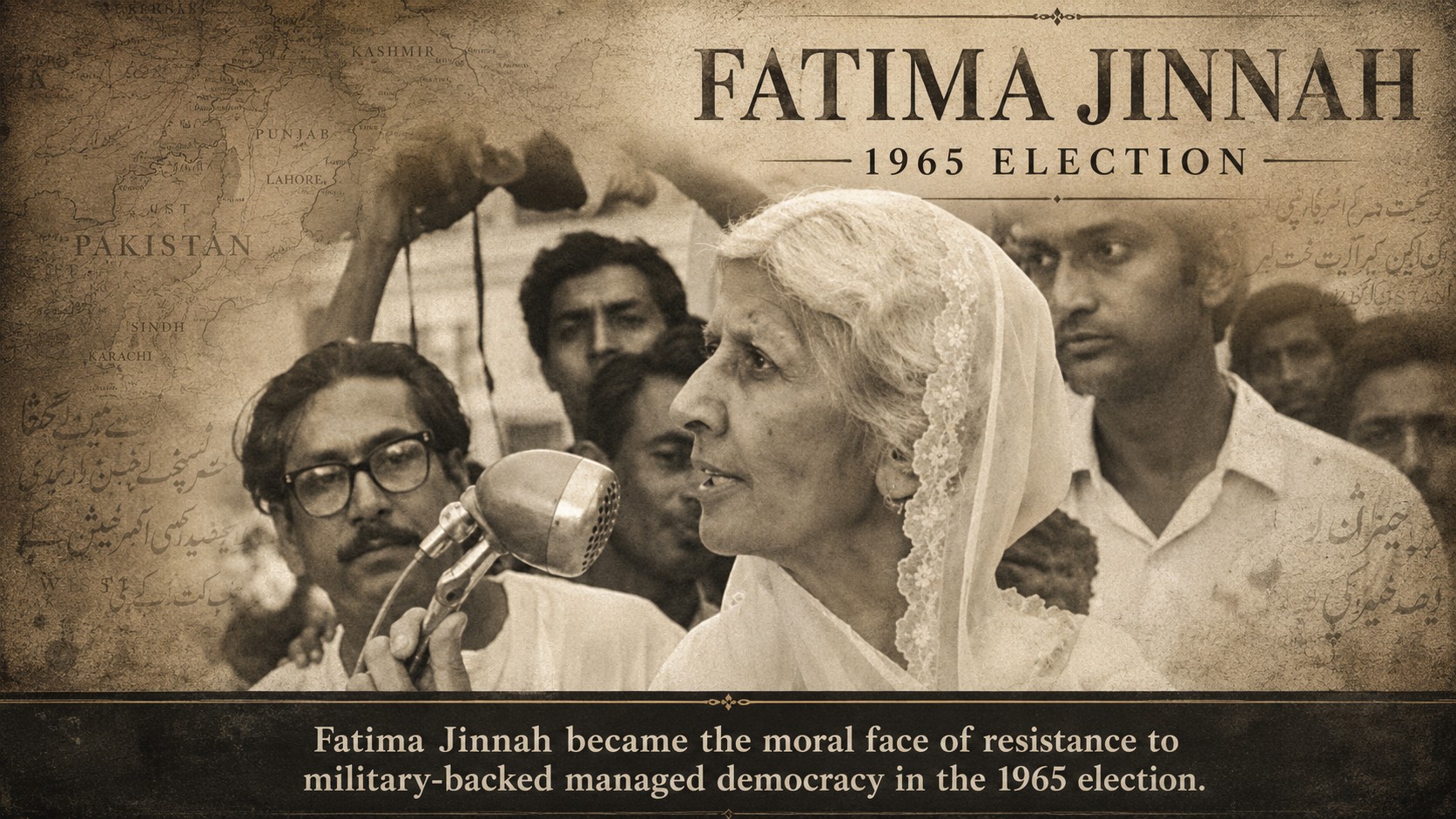
But the political cost was also real. East Pakistan remained aggrieved. Representative institutions never acquired the authority they needed. The press worked within constraints. And the 1965 presidential election against Fatima Jinnah became a lasting symbol of managed political competition.
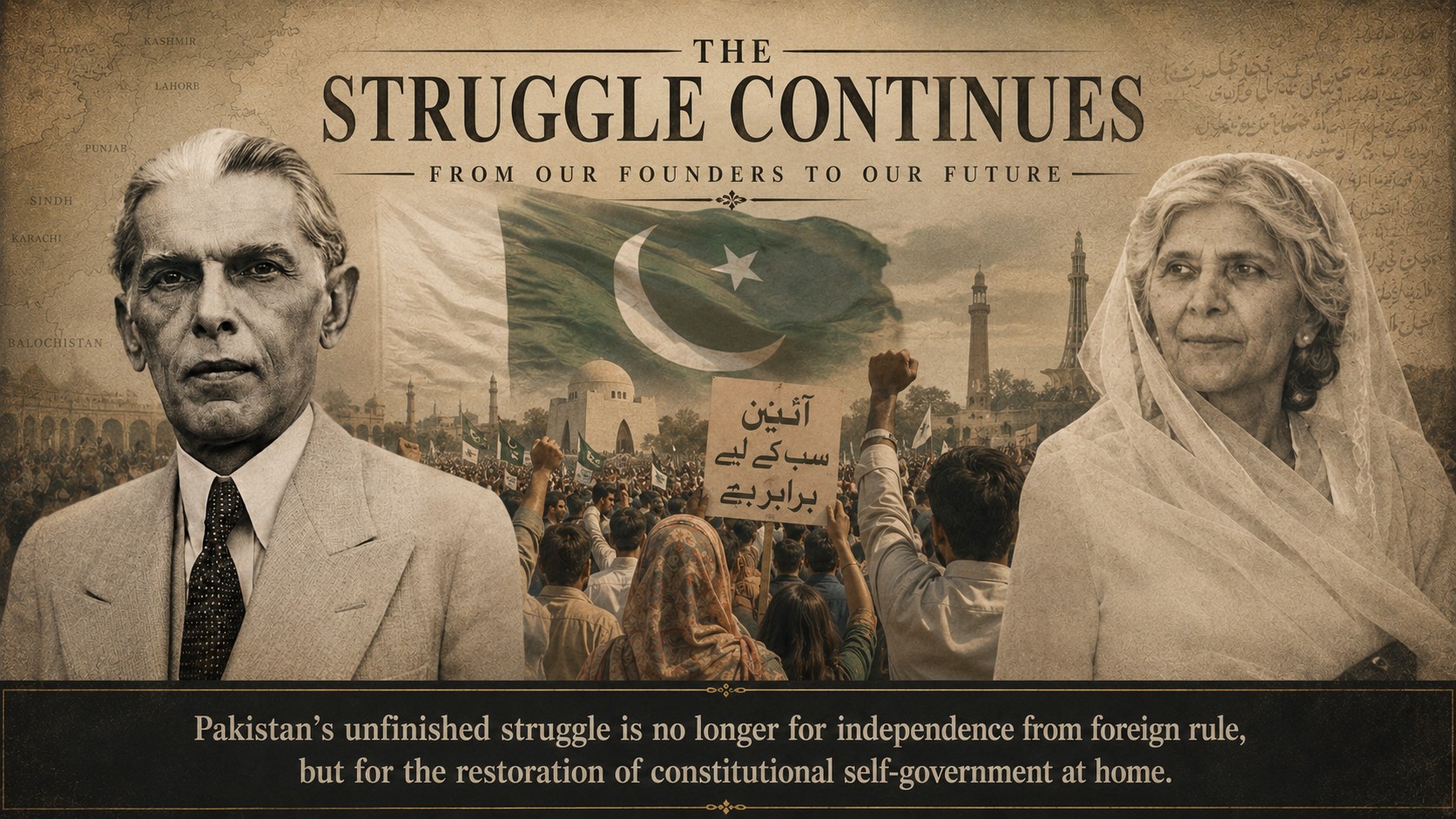
Fatima Jinnah's challenge was particularly awkward for the regime. The sister of Pakistan's founder had become the most recognisable civilian face of resistance to a military-backed order that claimed to speak for national stability. Her campaign exposed an insecurity at the heart of the authoritarian project: the state could invoke the people constantly, but it remained wary of letting them decide freely.
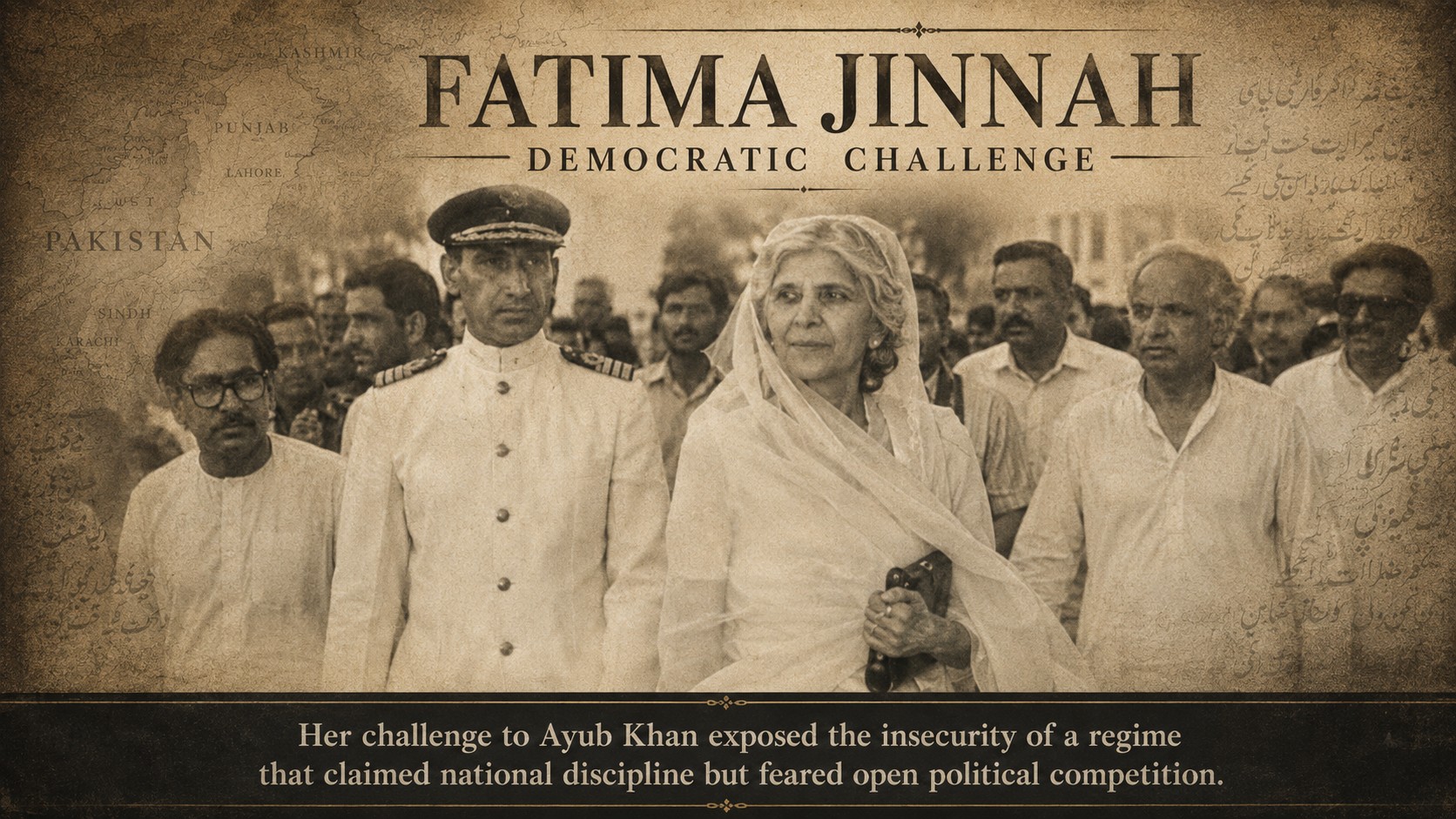
Ayub's system did not depoliticise Pakistan. It merely changed the terms on which politics took place. Once the military entered politics as an arbiter, every later civilian dispute carried the possibility of another intervention.
How the security state reproduced itself
Pakistan's security threats were not invented. Kashmir was a real dispute. India was a rival and often an adversary. The Cold War mattered. Afghanistan became a strategic theatre. After 9/11, another international war reshaped Pakistan's security environment.
The important distinction is not between a threatened state and an unthreatened one. It is between a state that manages security threats through accountable institutions and a state in which security logic gradually becomes the organising principle of political life.
In Pakistan, threat became an institutional resource. The more central national security became, the easier it was to argue for exceptional authority. Western alliances strengthened the coercive state faster than they strengthened representative institutions. Political weakness justified military supervision; military supervision ensured that politics remained weak. Parliament lost ground. Parties became more personalised. Intelligence agencies became more deeply embedded in political life. The media learned that some boundaries were invisible but no less real.
This is how a security state sustains itself: it draws legitimacy from fragility while helping preserve the conditions in which fragility persists.
India took a different institutional road
The comparison with India should not be romanticised. India has experienced emergency rule, communal violence, institutional bias and periods of democratic backsliding. But its Army did not decide who governed New Delhi. That difference is not cosmetic. It shaped the development of the two states.
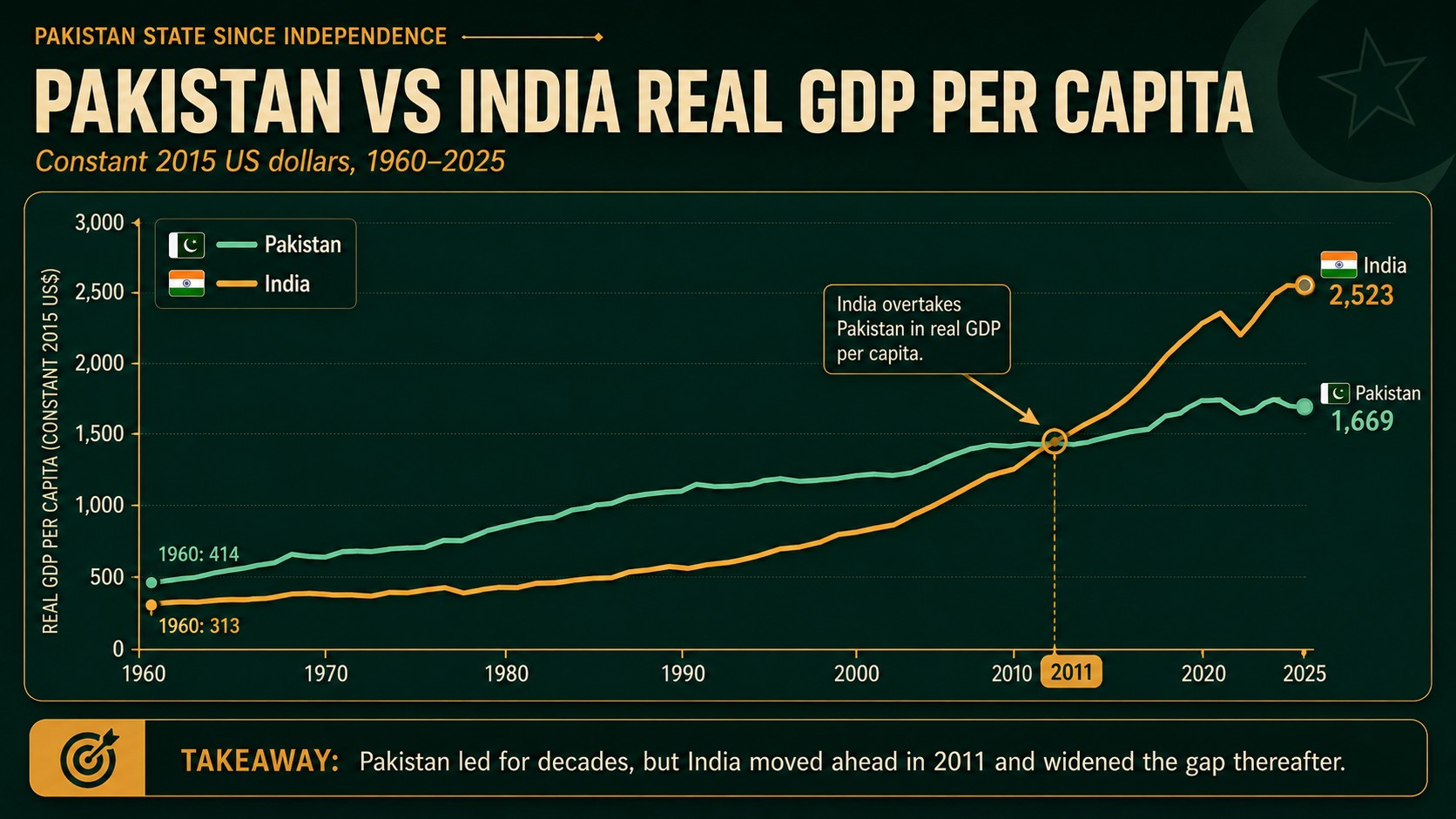
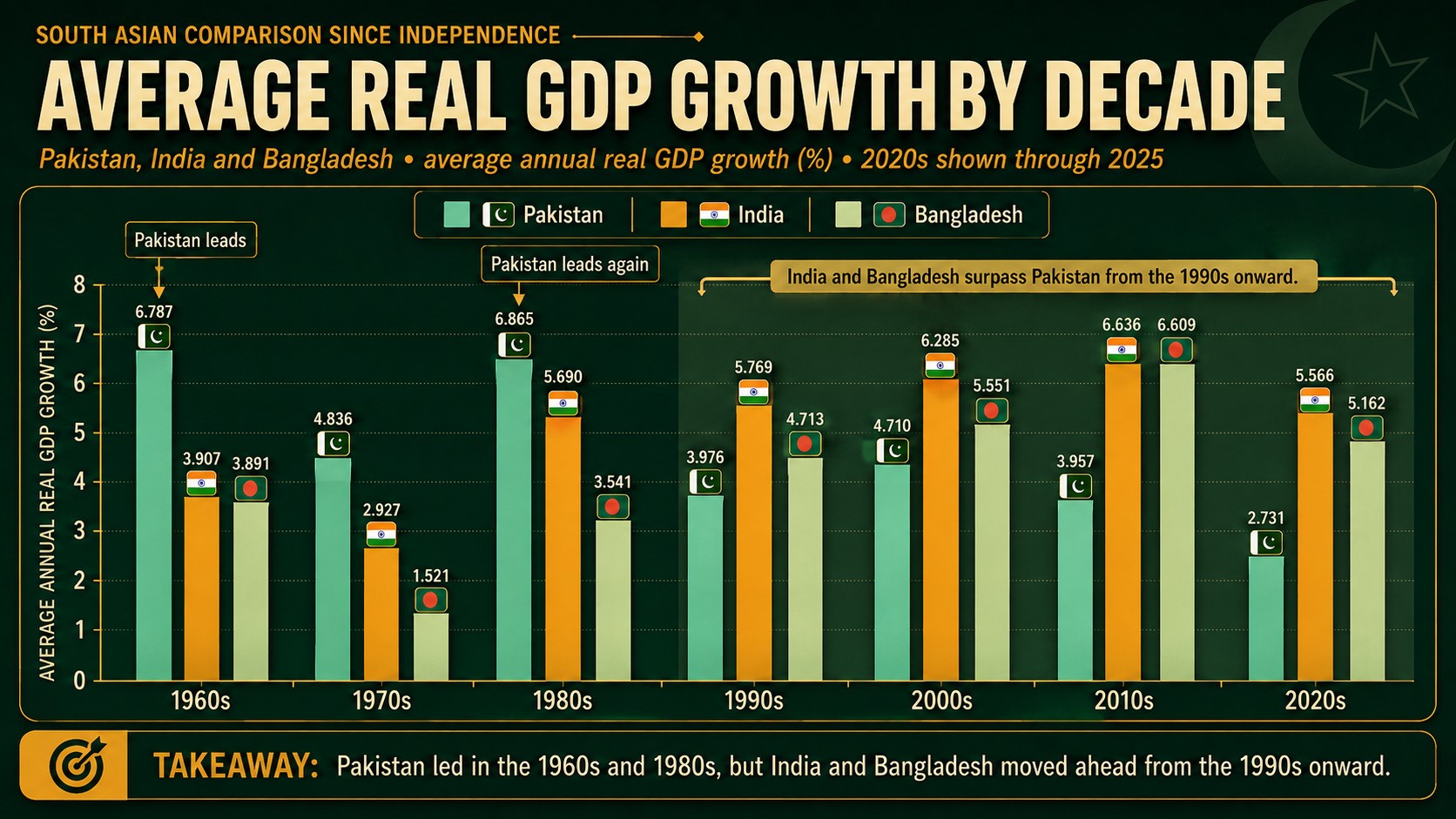
For decades, Pakistan could still point to stronger economic performance. In the World Bank-based series supplied for this report, Pakistan's real GDP per capita remained ahead of India's for much of the post-independence period. The lines crossed in 2011. By 2025, the gap had widened substantially in India's favour.
No single graph can prove that democracy creates prosperity. Nor can it assign every economic disappointment to military influence. What it does show is that the security-first model did not protect Pakistan's earlier advantage.
Wars, strategy and the difference between courage and judgement
Pakistani soldiers have fought and died in Kashmir, along the international border, on the glaciers, in the tribal districts and in years of counterterrorism operations. Their sacrifice does not need to be diminished in order to scrutinise the strategic choices made above them.
Bravery and strategy are different tests. On the second, the record is much harder to celebrate.
1947–48: Kashmir becomes both cause and template
The first Kashmir war began within months of independence. Whatever view one takes of its origins or justice, it established Kashmir as a permanent centre of Pakistan's national-security politics. The dispute became more than territory; it became part of the political vocabulary through which a permanently securitised state could be justified.
1965: the illusion of opportunity
The 1965 war remains wrapped in competing national myths, but Pakistani insiders themselves later acknowledged the miscalculation. The expectation that India could be tested in Kashmir under favourable conditions did not deliver the political result its planners wanted. The conflict intensified militarisation without settling the dispute. Air Marshal Nur Khan would later call it 'a wrong war'.
1971: the failure that no patriotic narrative can erase
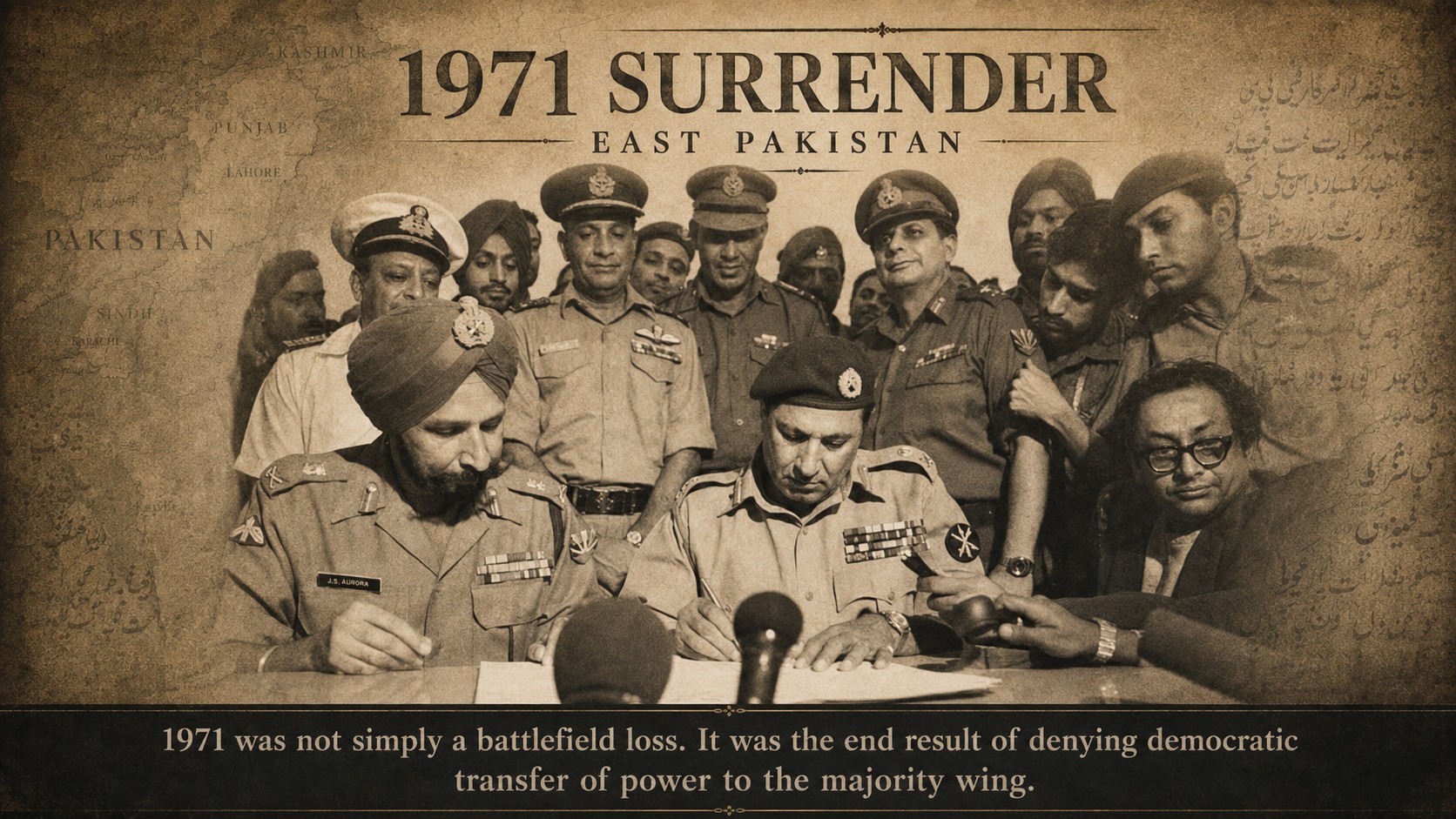
The loss of East Pakistan was not simply a battlefield defeat. It was the greatest failure of the Pakistani state, and of the establishment that claimed a special competence in preserving national unity.
The decisive crisis began before India entered the war. The 1970 election gave Sheikh Mujibur Rahman's Awami League a clear parliamentary majority. Pakistan's constitutional problem was therefore straightforward, however difficult its political consequences: would the state accept the result of its own election?
It did not. Power was withheld. Negotiations broke down. Military repression followed. India eventually entered a conflict that had already been transformed by political denial and violence.
Pakistan did not lose its eastern majority because its soldiers lacked courage. It lost it because the state preferred coercion to democratic legitimacy. The guardians of national unity presided over the break-up of the country.
Siachen and Kargil
India's 1984 occupation of commanding positions on the Siachen Glacier imposed a long-term strategic cost. Kargil in 1999 produced an even sharper lesson. Tactical surprise was followed by diplomatic isolation, international pressure and a civil-military rupture. The episode remains a case study in what can happen when operational secrecy is detached from political accountability.
Counterterrorism: a real achievement, but not a lasting settlement
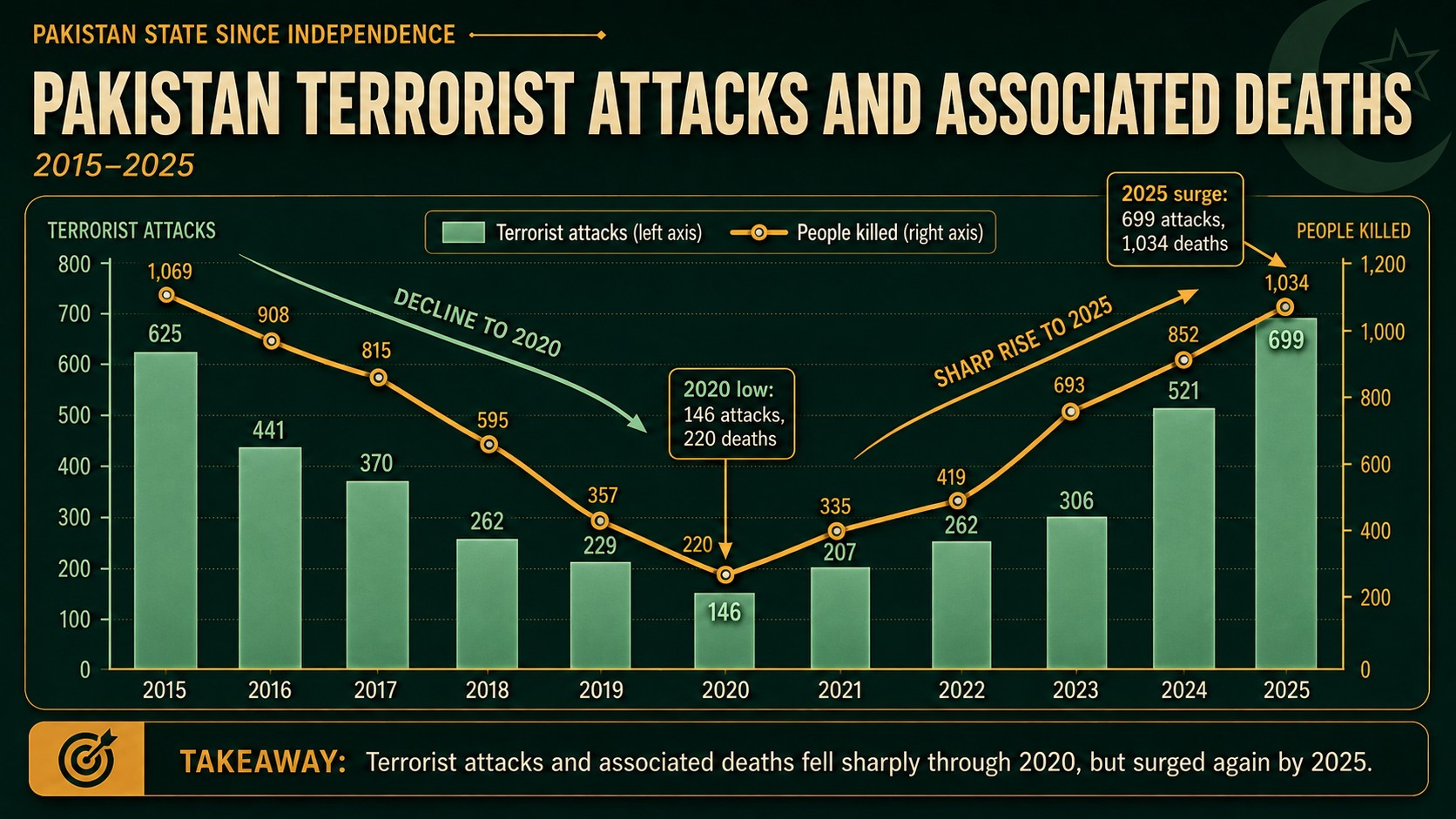
There is one area in which the security establishment can point to a substantial recovery. After the horrific years of militant violence, major operations, intelligence work and enormous sacrifice by security personnel contributed to a sharp decline in attacks after 2014.
But the gains did not hold. The Pakistan Institute for Peace Studies series supplied in the dossier records 146 attacks and 220 associated deaths in 2020. By 2025, it records 699 attacks and 1,034 deaths. The reversal is too large to dismiss as statistical noise.
It suggests a familiar problem: tactical suppression can buy space, but it cannot substitute indefinitely for political settlement, civilian policing, credible administration and a strategy that addresses how militancy regenerates. A state that centralises power in the name of security eventually has to be judged on whether it can produce durable security.
Bangladesh is the comparison Pakistan's ruling elite never wanted
If India is the institutional contrast, Bangladesh is the more painful moral one. For decades, official narratives tended to explain 1971 mainly through Indian intervention and Bengali nationalism. That framing avoids the central political fact: East Pakistan contained Pakistan's majority population, and that majority was denied the ordinary consequences of electoral victory.
Bangladesh's later history is hardly a democratic fairy tale. It endured coups, assassinations, authoritarian rule and serious democratic erosion. Yet the development comparison is now impossible to ignore. In the series supplied with this report, Bangladesh overtook Pakistan in real GDP per capita around 2020 and remained ahead thereafter.
The social comparison is more uncomfortable still. Across the supplied indicators, Bangladesh records better outcomes in life expectancy and infant mortality, while the human-development material places Pakistan behind both Bangladesh and India. The precise figures vary between some of the source charts and the accompanying text, but the direction of the comparison is the same: Pakistan lags.
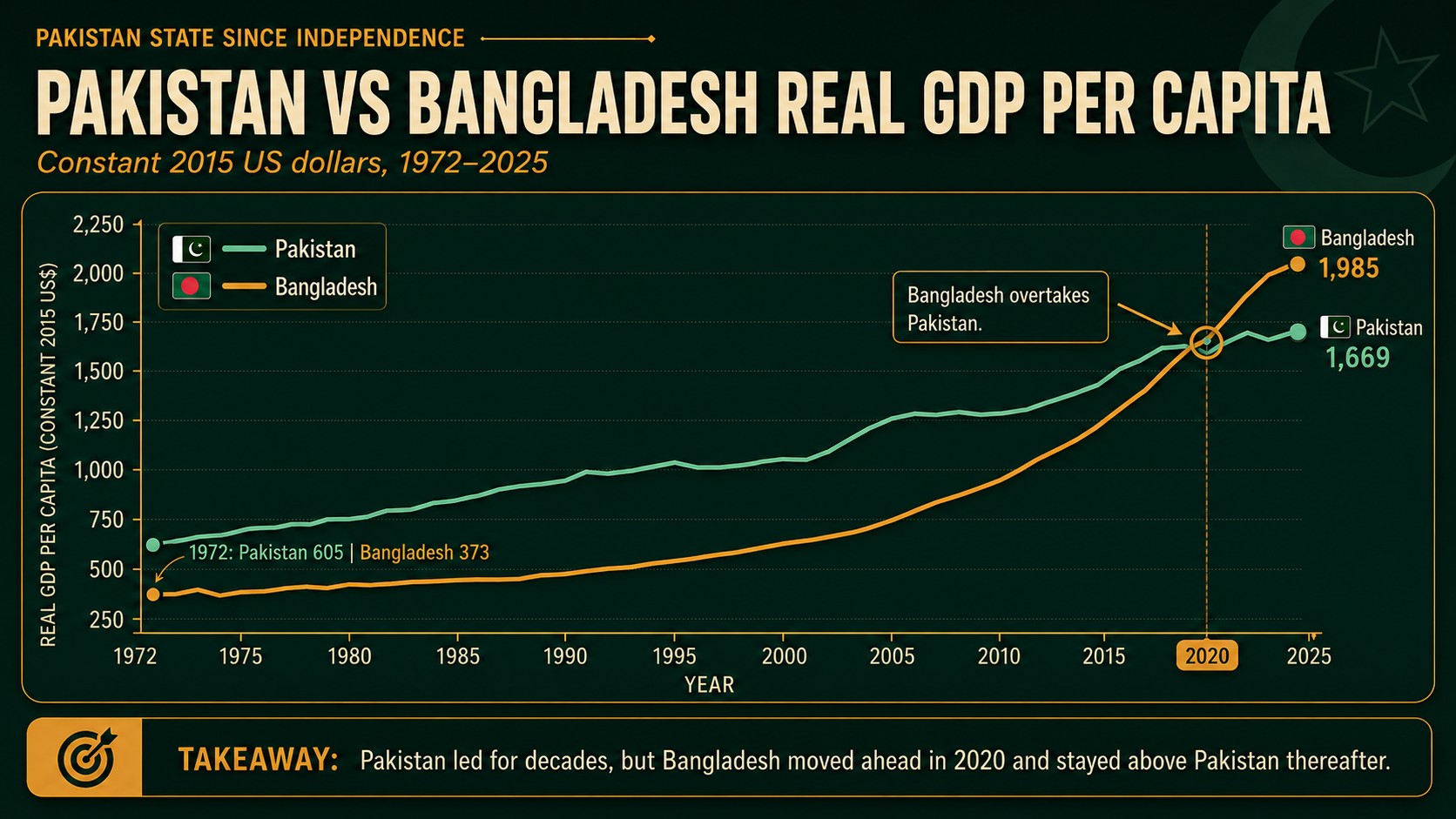
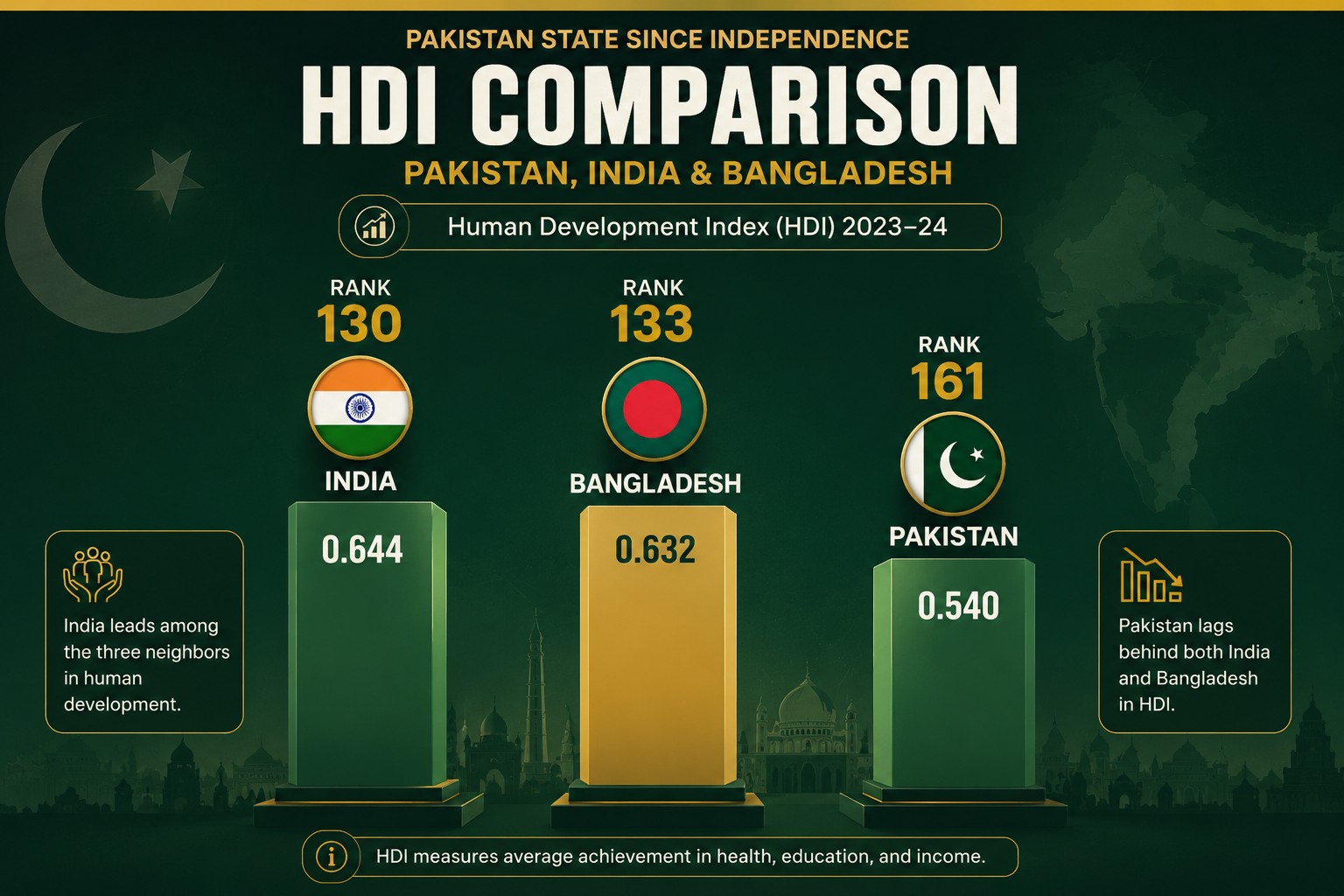
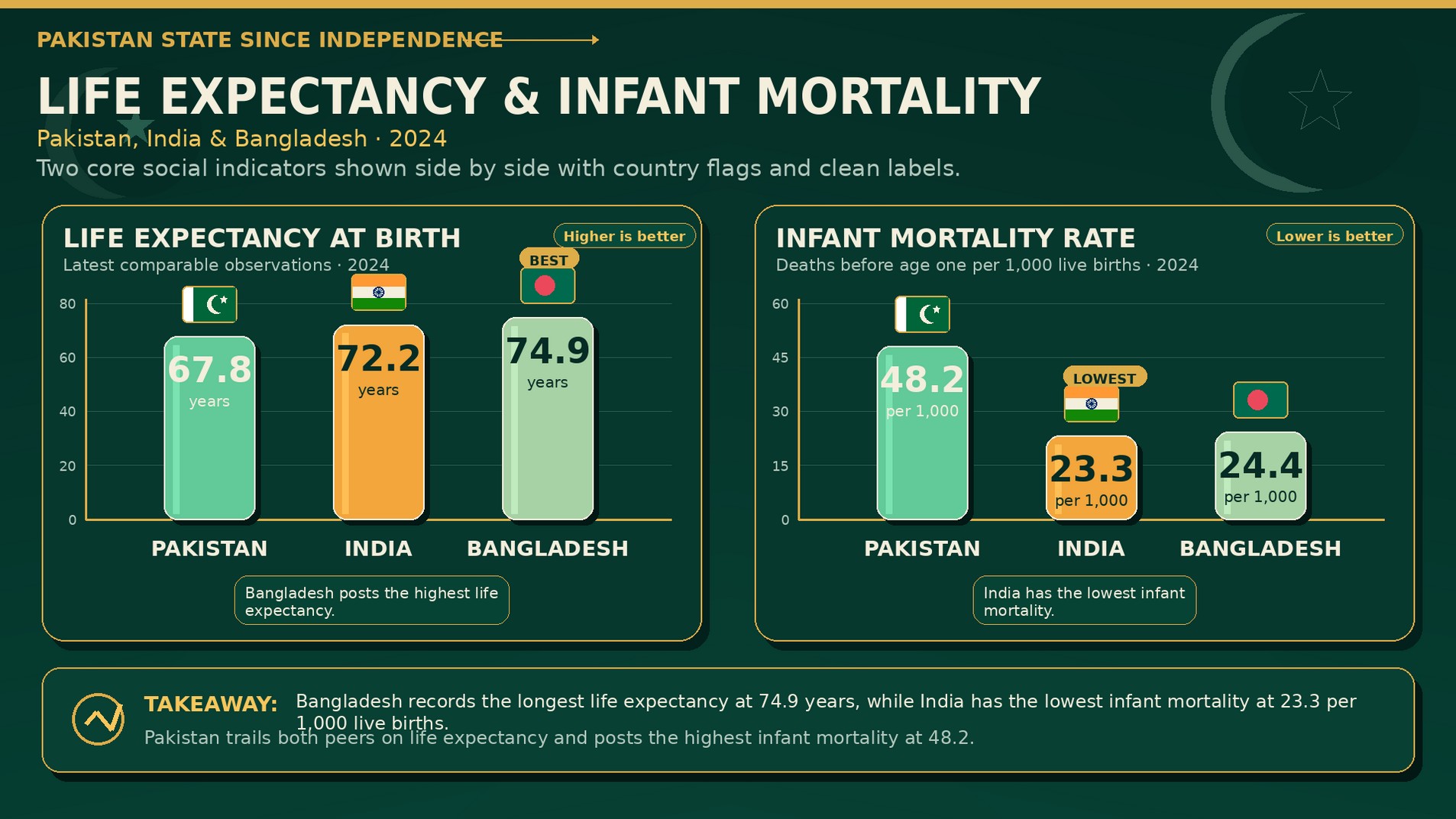
These are not abstract league tables. They describe how long people live, how many children survive infancy and how much human capability a state succeeds in building. The old claim that security must come before development becomes harder to sustain when decades of security-first policy end with weaker human outcomes than both neighbouring comparators.
The cost of "security first"
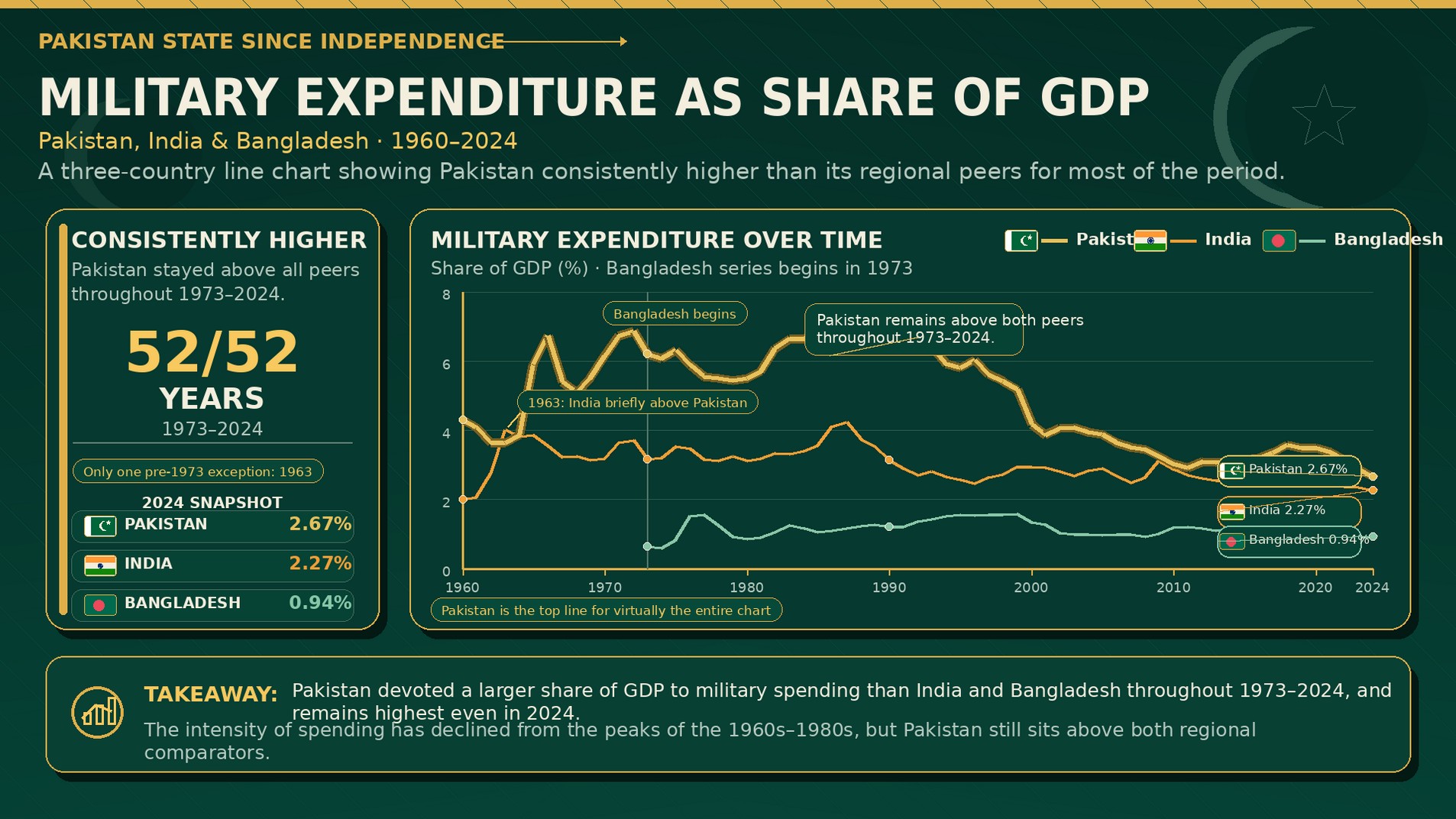
Defence, education and health spending cannot be compared carelessly. Social expenditure is distributed across different levels of government, and the definitions used by military-expenditure, education and health datasets are not identical. The source dossier itself contains graphics compiled from different indicators and data vintages.
Even after allowing for those caveats, however, the larger picture is difficult to miss. Pakistan has chronically underinvested in human development while maintaining a comparatively heavy security burden. The supplied long-run chart shows Pakistan devoting a larger share of GDP to military expenditure than India or Bangladesh for much of the period covered.
The problem is not that defence spending is inherently wasteful. Pakistan faces real security threats. The problem is what happens when national security is defined so narrowly that schools, public health, local government, employment and social trust become secondary concerns.
A badly educated population is a security problem. So is mass unemployment. So is weak healthcare. So is a state that cannot persuade citizens in peripheral regions that they are equal stakeholders in the republic. Security policy eventually has to answer for the conditions it leaves behind.
When the umpire also has material interests
Pakistan's civil-military imbalance is complicated by the economic footprint of military-linked institutions. The exact value of that footprint is contested, and sweeping estimates are not always independently auditable. But the basic architecture is not in serious doubt: welfare foundations, trusts, housing authorities, land allocations, listed companies, educational institutions and commercial entities extend the establishment's presence far beyond barracks and battlefields.
That creates a problem of political economy. An institution that can influence regulation, land use, public contracts and political outcomes while also occupying privileged commercial space is not merely a neutral referee. It has interests of its own.
This does not mean that every military welfare organisation is illegitimate or that it provides no genuine service. Many do support serving personnel, veterans and families. The constitutional question is different: can an institution remain an impartial guardian of the rules when it is simultaneously a strategic actor, a political actor and an economic actor?
The coup did not disappear. It evolved.
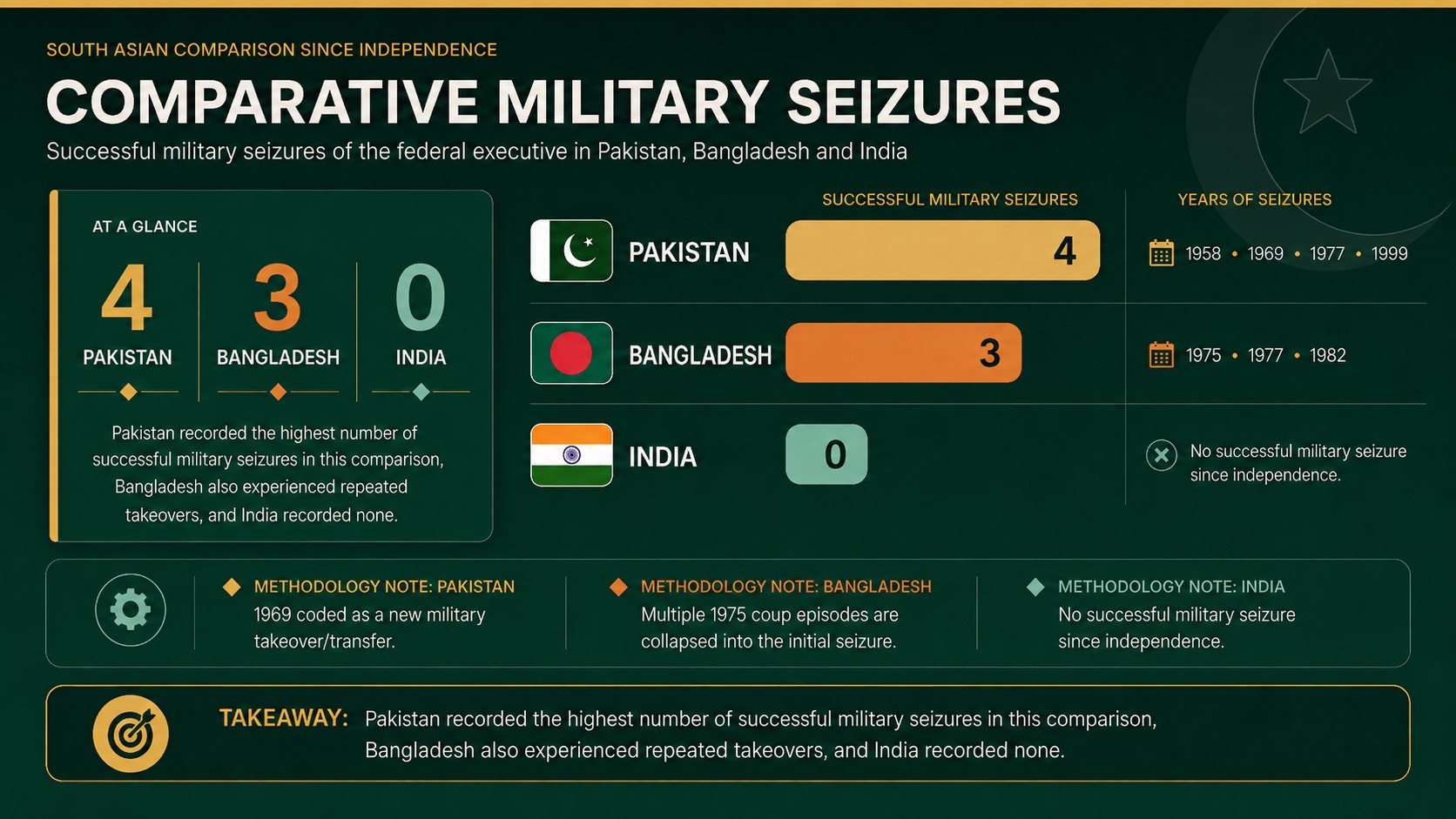
Pakistan's contemporary problem is not that tanks roll into Islamabad every decade. The method has become subtler. Since the return to elected government in 2008, the country has moved through varying forms of what analysts commonly describe as hybrid or tutelary rule.
Elections happen. Governments form. Parliament sits. Courts issue judgments. Television debates rage and social media remains politically explosive. Yet the boundaries of permissible politics often appear to be drawn somewhere outside the ballot box.
Civilian parties are not innocent in this story. Many sought establishment support when it suited them and discovered constitutional principle only after falling out of favour. Leaders personalised parties, weakened institutions and treated state power as spoils. Those failures made tutelage easier to sustain. They did not make it constitutional.
The period after 2022 sharpened the problem. The dossier records party restrictions, arrests, contested cases, pressure on the media, digital controls and the use of military courts against civilians. Taken together, these developments point towards an electoral order that retains the forms of representative government while narrowing its substance.
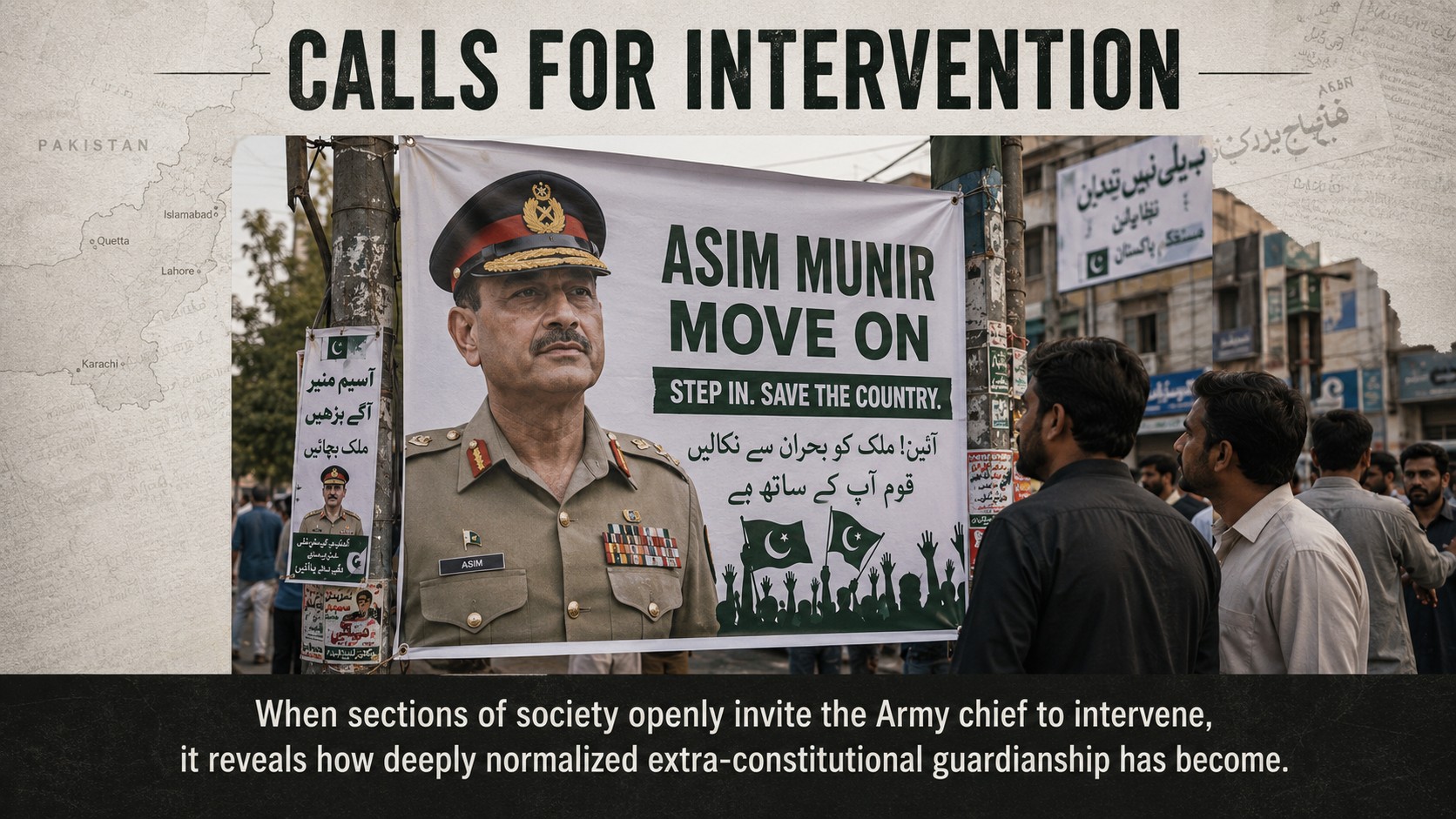
The deepest danger is habituation. Once a society becomes accustomed to the Army chief as a political referee, every civilian dispute produces calls for another intervention. Politics never matures because it is never allowed to own the consequences of governing.
Balochistan: where coercive governance reaches its limit
Balochistan is perhaps the clearest test of the security-state model. The state is right about one basic point: separatist violence is real, deadly and prosecutable. Civilians, workers and security personnel have been killed; infrastructure has been attacked. Armed insurgency should not be romanticised.
But neither should the methods used by the state escape scrutiny. Allegations of enforced disappearances, coercive restrictions and weak political consent have become central to the province's relationship with Islamabad. A security-first approach can hold terrain. It cannot manufacture political trust.
Extraction without representation, development without consent and security without accountability do not resolve alienation. They can deepen it. Balochistan is not merely a policing problem. It is a political question about power, resources, citizenship and the credibility of the federation itself.
AJK and the contradiction in Pakistan's Kashmir argument
Pakistan's international case on Kashmir rests heavily on the language of rights, representation and self-determination. That gives Islamabad a particular responsibility in Azad Jammu and Kashmir.
The 2026 material in the dossier notes protests, restrictions involving the Joint Awami Action Committee, fatal clashes, communication disruption and a contested political context. Some details remained disputed at the source material's evidence cut-off. The broader issue is nevertheless clear.
A state cannot credibly demand Kashmiri self-expression across the Line of Control while appearing uncomfortable with political expression under its own authority. Pakistan's case is strongest when its domestic conduct embodies the principle it asks the world to defend.
The economy and the cost of repeated political resets
Political instability is not only a constitutional problem. It is an economic one. Development depends on continuity: tax policy, energy reform, exports, industrial strategy, education and regulation all require governments that can work across long horizons.
Pakistan has repeatedly broken those horizons. Governments take office, are constrained, enter confrontation with unelected centres of power, are removed or politically reconfigured. Bureaucracies become cautious. Investors price in instability. Reform is postponed. Eventually the country returns to its lenders.
Pakistan's repeated IMF programmes cannot fairly be blamed on the military alone. Weak tax collection, elite privilege, energy-sector losses, import dependence, narrow exports and incoherent civilian policy have all contributed. But the security-state model has made reform harder by protecting powerful constituencies and making accountability uneven.
The irony is difficult to avoid: a state obsessed with strategic autonomy repeatedly failed to build economic autonomy.
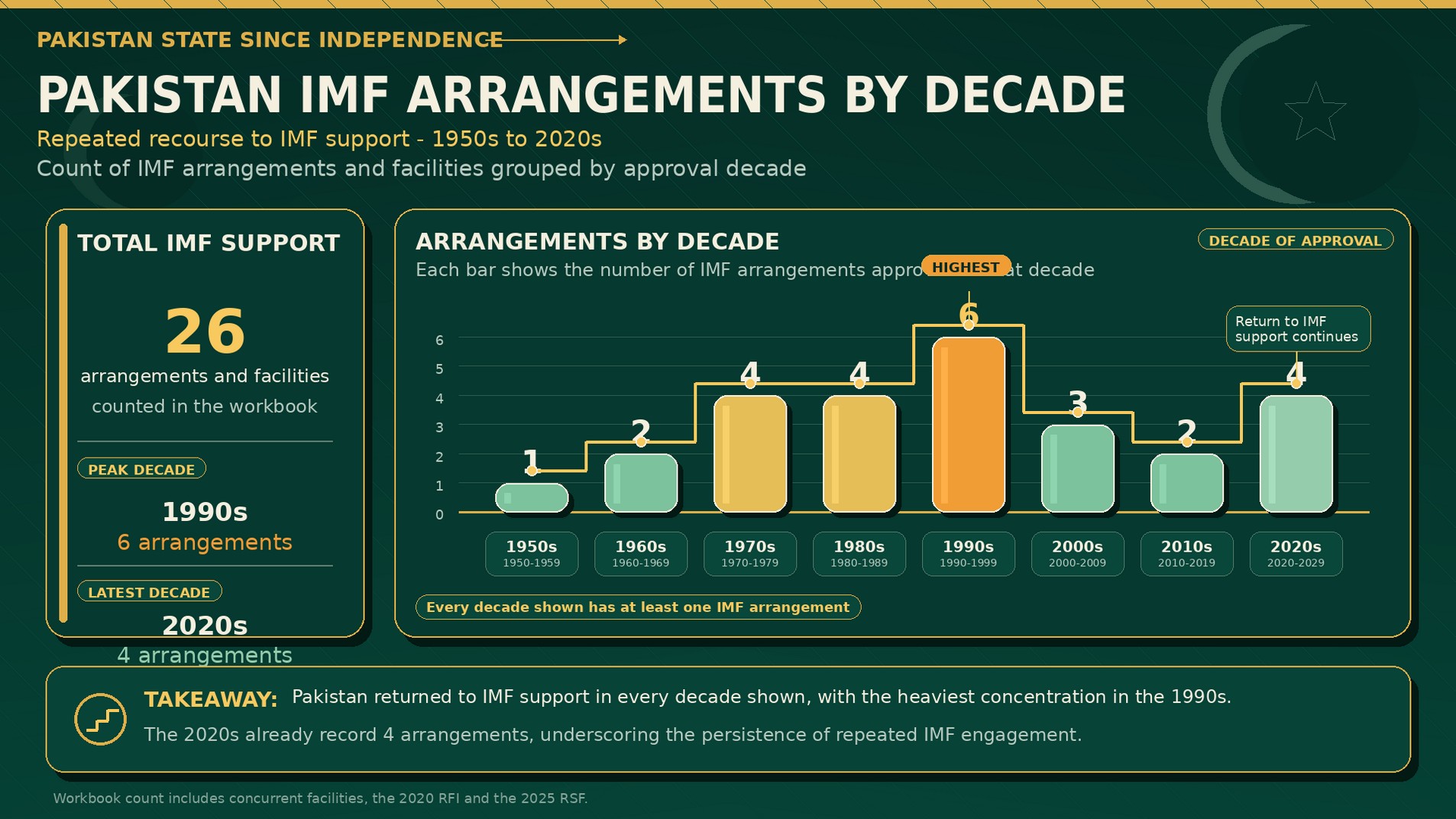
The present snapshot in the dossier is sobering: a population above 252 million, public debt above Rs83 trillion by the end of March 2026, persistent unemployment and poverty pressures, alongside continuing weaknesses in exports and education.
That is not a picture of a society made resilient by decades of security-first governance. It is a reminder that coercive capacity and national strength are not the same thing.
What prolonged tutelage does to a republic
The deepest damage is institutional. Parliament becomes performative when the decisive subjects sit elsewhere. Political parties become opportunistic when survival depends on establishment signals. Courts become vulnerable to selective courage. Civil servants learn to look upward for patronage rather than outward towards law. Police become politicised. Local government remains weak. The media learns self-censorship. Citizens begin to understand that the visible state and the real distribution of power are not always the same thing.
That is what the phrase 'security state' means in the Pakistani context. It is not simply a description of a powerful Army. It describes a constitutional order trained over decades to accommodate extra-constitutional weight.
Pakistan still has elections. The more difficult question is whether elections always possess sovereignty.
So how did Pakistan's defenders fail Pakistan?
They failed when national defence became political domination; when constitutions were suspended instead of strengthened; when parties and parliament were weakened and their weakness later cited as proof that civilians could not govern.
They failed most catastrophically in 1971, when the democratic verdict of the majority wing was treated as negotiable and the country was dismembered.
They failed when Kashmir became part of the permanent vocabulary of securitisation while Pakistan's own political practices weakened the credibility of its case. They failed when intelligence management became a substitute for democratic development, and when tactical counterterrorism success was not converted into durable political peace.
They failed when classrooms, clinics, local government and human capital were treated as secondary to a narrow understanding of national security. And they failed by normalising the proposition that elected governments may administer Pakistan without necessarily possessing the final authority to govern it.
Civilians share the blame. Some invited intervention. Some corrupted institutions. Some sought establishment support against rivals and objected only when the same machinery turned against them.
Pakistan's tragedy is not simply that generals became too powerful. It is that too many civilian elites learned to live with unaccountable power when it served them.
14 August should be more than a ritual
If Independence Day is to mean more than ceremony, Pakistan does not need another saviour. It does not need a more polished hybrid regime, another favourite civilian bloc, or another promise that constitutional shortcuts are necessary just this once.
It needs something less dramatic and much harder: constitutional normality.
The armed forces must be answerable to lawful civilian authority. Elections must decide political power rather than merely distribute office. Political parties must democratise themselves and stop searching for unelected patrons. Parliament must recover meaningful authority over national priorities, including security and expenditure. Balochistan and other peripheral conflicts must be treated as questions of political legitimacy as well as law and order. Human development must be treated as national security in the fullest sense of the term.
On 14 August 1947, Pakistan was born amid fear, bloodshed, hope and enormous possibility. It deserved a republic capable of defending its borders without colonising its politics; institutions strong enough to survive bad politicians rather than institutions suspended because politicians were bad; and an Army respected for defending the state rather than repeatedly drawn into arbitrating it.
Instead, the country was gradually reshaped into a security state that learned how to command, but never fully learned how to trust its own people.
That is why this Independence Day should ask more than what Pakistan achieved after 1947. It should also ask what the country lost along the way: democratic continuity, institutional confidence, federal trust, a developmental head start — and, perhaps most importantly, the uncomplicated principle that the people themselves have the right to decide who governs them.
Editorial note: This special report is based on the historical material, datasets and visual package supplied to Parrhesia News for its 14 August coverage. Where the source text and individual graphics use different data vintages or indicator definitions, the article avoids presenting those figures as directly interchangeable. The graphics are reproduced from the supplied package.

Reader comments
Subscribers can join the conversationSign in to join the conversation. Comments are open to everyone with a free account.
Sign in or create accountLoading comments…