
Pakistan's intelligence community entered June 2026 expecting a month of sustained terrorist violence.
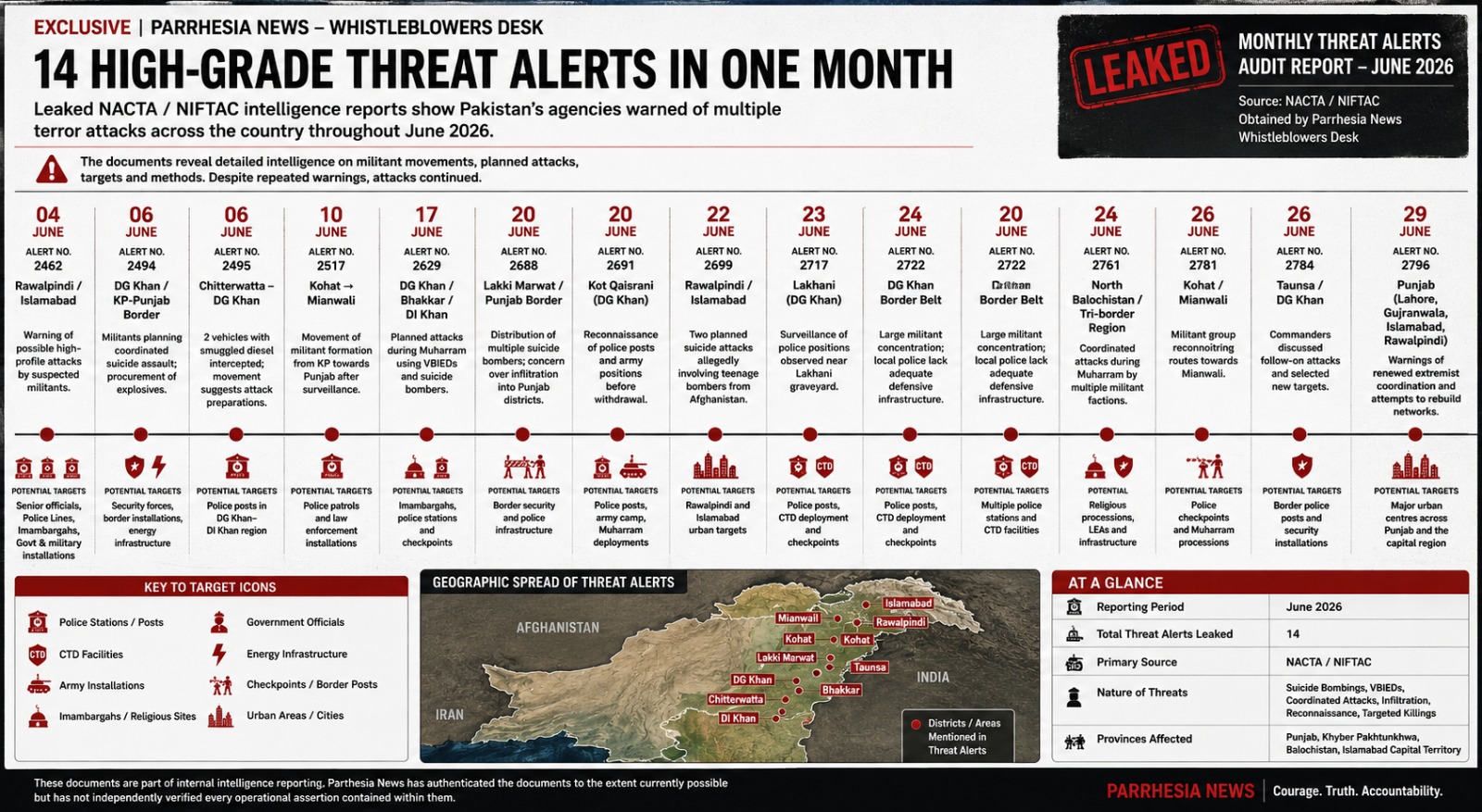
That is the picture emerging from a cache of leaked internal security documents obtained by the Parrhesia Whistleblowers Desk, which detail a series of threat alerts circulated among Pakistan's intelligence and law enforcement agencies throughout June. If authentic, the documents suggest that authorities anticipated multiple high-impact attacks across Punjab, Khyber Pakhtunkhwa, Islamabad and adjoining border regions, identifying potential targets, suspected militant formations, infiltration routes and even individuals allegedly involved in planning attacks.
Yet despite what appears to have been an extensive intelligence picture, terrorist incidents continued to unfold across Pakistan.
The leak raises an uncomfortable question for Islamabad's security establishment: if the warnings were so detailed, why was Pakistan unable to stop the violence?
A Month of Warnings
The documents, marked as a "Monthly Threat Alerts Audit Report – June 2026", record at least fourteen separate threat alerts attributed to NACTA/NIFTAC and circulated between 4 and 29 June.
The alerts cover an unusually broad geographical area, including Rawalpindi, Islamabad, Dera Ghazi Khan, Mianwali, Kohat, Bajaur and the Punjab-Khyber Pakhtunkhwa border belt.
Far from containing generic warnings, many entries identify suspected militant commanders, anticipated methods of attack, intended targets and areas where reconnaissance had allegedly already been carried out.
Several warnings describe plans for suicide attacks, vehicle-borne explosive devices and coordinated assaults on police stations, security installations and Muharram processions.
Intelligence That Appears Remarkably Specific
What makes the leaked documents particularly striking is the level of operational detail.
One alert issued on 6 June reportedly warned that militants had already procured explosive materials, identified intended targets and were awaiting the arrival of a suspected suicide attacker before launching a coordinated assault involving suicide bombers, vehicle-borne explosives and armed infiltration.
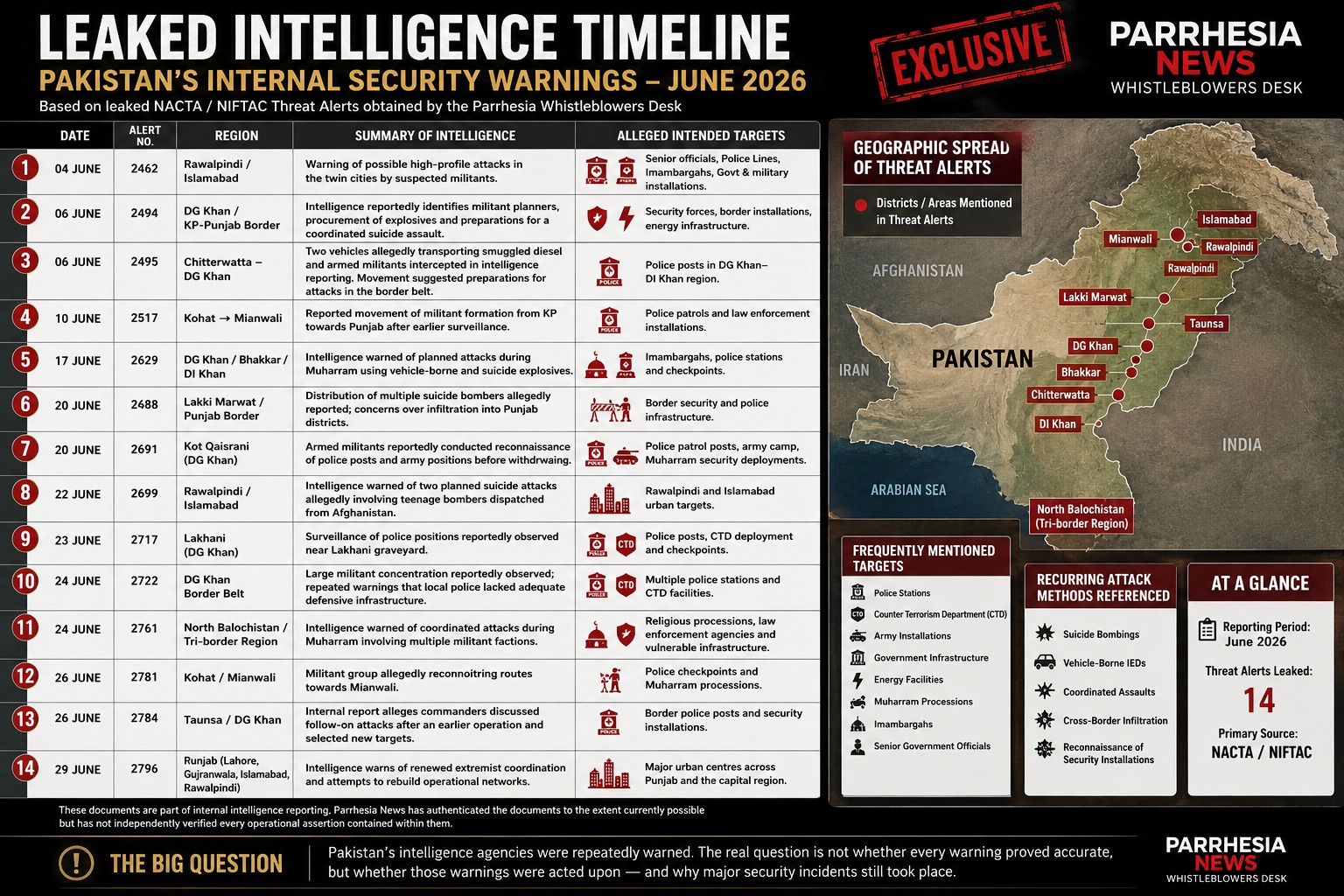
Another alert described reconnaissance of police facilities along the Punjab-KP border and warned that attacks could extend beyond law enforcement installations to include energy infrastructure.
Later reports referred to the movement of armed groups through border districts, surveillance of police checkpoints, alleged preparations for attacks on Muharram gatherings and infiltration into Punjab from neighbouring provinces.
Rather than isolated intelligence fragments, the documents portray what appears to be a continuously updated threat picture shared across Pakistan's internal security network.
A Country on Permanent High Alert
Collectively, the files suggest that Pakistan's security agencies were operating under an almost continuous state of alert throughout June.
Successive reports warned of militant movement across multiple districts, reconnaissance of government facilities and repeated attempts to infiltrate Punjab.
Several entries describe concerns over attacks targeting:
• police stations;
• Counter Terrorism Department facilities;
• army positions;
• intelligence installations;
• Muharram processions;
• civilian infrastructure;
• and senior government officials.
If accurate, the reports reveal that Pakistan's internal security agencies believed multiple militant organisations retained both operational capability and freedom of movement despite years of military operations.
The Question Intelligence Cannot Answer
Intelligence warnings are not predictions.
Every security service in the world receives more threat reporting than ultimately materialises. Some warnings prove accurate; others do not. Success cannot simply be measured by whether every alert results in an arrest or a prevented attack.
Nevertheless, the volume and specificity of these documents inevitably raises broader questions.
Were the warnings acted upon?
Were security deployments adjusted?
Were local police adequately briefed?
Were the resources available to intercept the threats?
Or do the documents instead expose deeper structural weaknesses within Pakistan's counter-terrorism architecture?
These are questions the leaked files themselves cannot answer—but they unquestionably raise.
Beyond Tactical Failure
The significance of the leak may extend beyond individual attacks.
The documents portray a security apparatus heavily focused on reacting to imminent threats rather than addressing the underlying conditions allowing militant networks to regenerate.
Repeated references to infiltration routes, border districts and known militant commanders suggest that many networks remained active despite years of military operations presented publicly as successful.
If Pakistan's intelligence services were repeatedly issuing warnings about the same regions and similar methods of attack, critics may argue that the country's counter-terrorism strategy has become increasingly reactive rather than preventative.
Transparency and Accountability
The Pakistani authorities have not publicly released these internal threat assessments, and Parrhesia News cannot independently verify every operational claim contained within them.
We are therefore publishing the documents because they reveal how Pakistan's own security agencies privately assessed the threat environment—not as proof that every allegation contained within them is accurate.
Should the documents prove authentic, they raise legitimate questions about accountability within Pakistan's security establishment.
If intelligence agencies possessed such extensive advance warning, the public has a right to ask whether those warnings translated into effective operational action.
An Intelligence Picture Hidden from the Public
For years, Pakistan's security narrative has emphasised the success of counter-terrorism operations and the restoration of stability.
These leaked files tell a more complicated story.
Behind official statements appears to be an intelligence system documenting an almost uninterrupted stream of warnings about suicide attacks, cross-border infiltration, surveillance of security installations and planned assaults on civilian and military targets.
Whether those warnings prevented even greater bloodshed—or instead reveal systemic failures—deserves independent scrutiny.
One thing, however, is already clear.
The documents suggest that Pakistan's internal security agencies entered June 2026 fully aware that the country faced a sustained terrorist threat.
The question that remains unanswered is whether knowing was enough.
Editor's Note
The documents analysed in this investigation were obtained by the Parrhesia News Whistleblowers Desk from sources with direct access to Pakistan's internal security reporting. Parrhesia News has authenticated the documents to the extent currently possible but has not independently verified every operational assertion contained within them. References to alleged militant activities reflect the contents of the leaked intelligence reports and should not be interpreted as independently established facts.


Reader comments
Subscribers can join the conversationSign in to join the conversation. Comments are open to everyone with a free account.
Sign in or create accountLoading comments…