
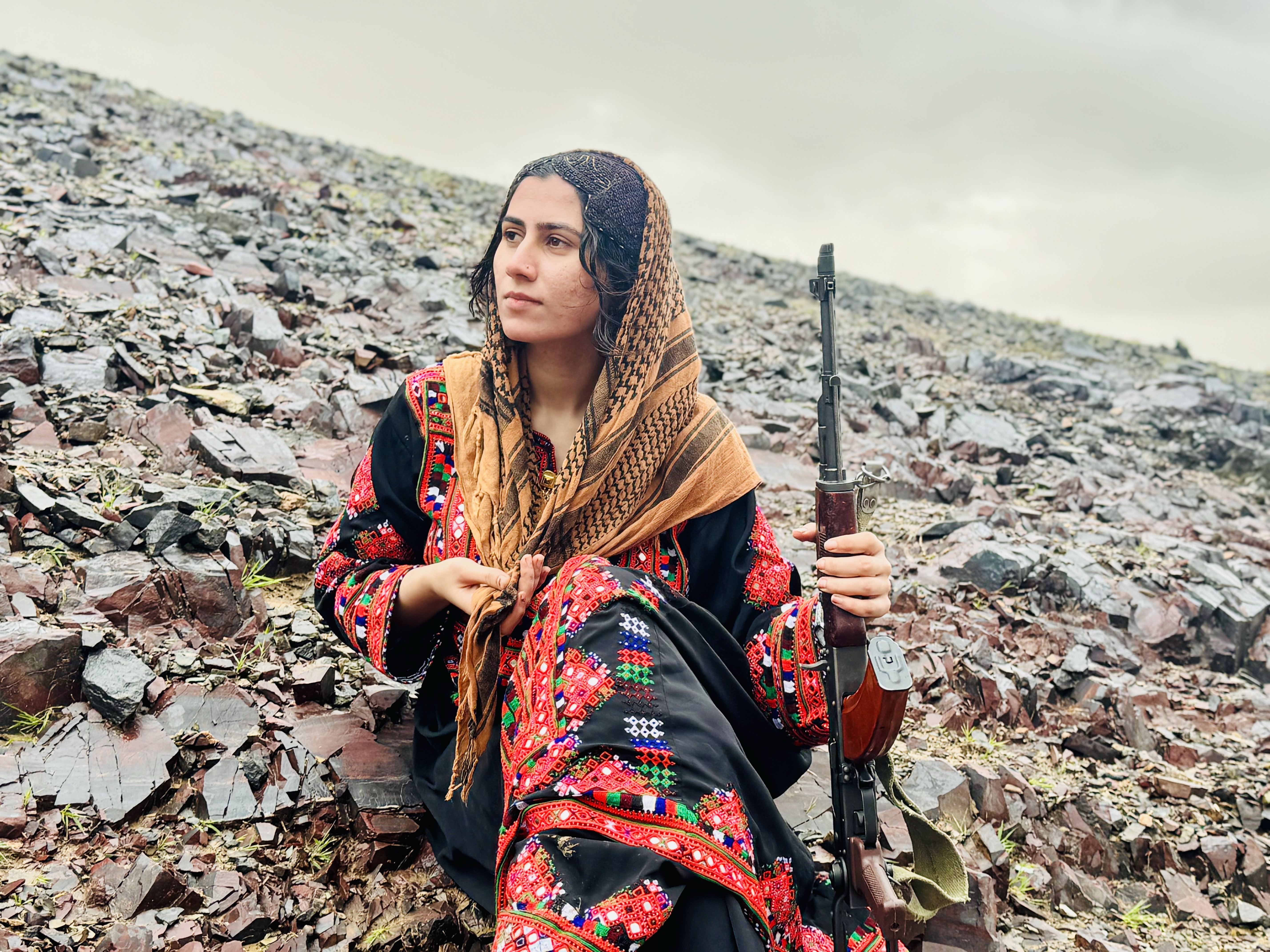
When a video emerged showing Shaynaz Baloch addressing the camera in military-style fatigues, surrounded by armed women against the rugged backdrop of Balochistan, it immediately drew attention across Pakistan and beyond. Identified by the Baloch Liberation Army (BLA) as one of its commanders — with the nom de guerre Sado — she is believed to be the first woman to publicly assume such a visible leadership role within the group. Her appearance comes at a moment when Balochistan is witnessing a deepening convergence between civic and armed forms of resistance. On one side, movements like the Baloch Yakjehti Committee (BYC), led by figures such as Mahrang Baloch and Sammi Deen Baloch, have drawn international attention to enforced disappearances, extrajudicial killings, and the heavy militarisation of daily life. On the other, armed groups have become more active. Shaynaz Baloch stands at the intersection — a politically conscious woman who has moved from the broader Baloch national movement into a direct command position. For decades, the state and much of the outside world have framed the Baloch question through the lens of tribalism, backwardness, or external interference. Women, in particular, have often been portrayed solely as victims. Shaynaz’s emergence challenges that narrative. She refuses to be confined to the role of mourner. Instead, she presents herself as an active participant shaping the direction of the struggle. This interview offers a rare direct insight into the thinking of a woman who has crossed from civic activism into armed resistance leadership at a time when the conflict in Balochistan is intensifying.
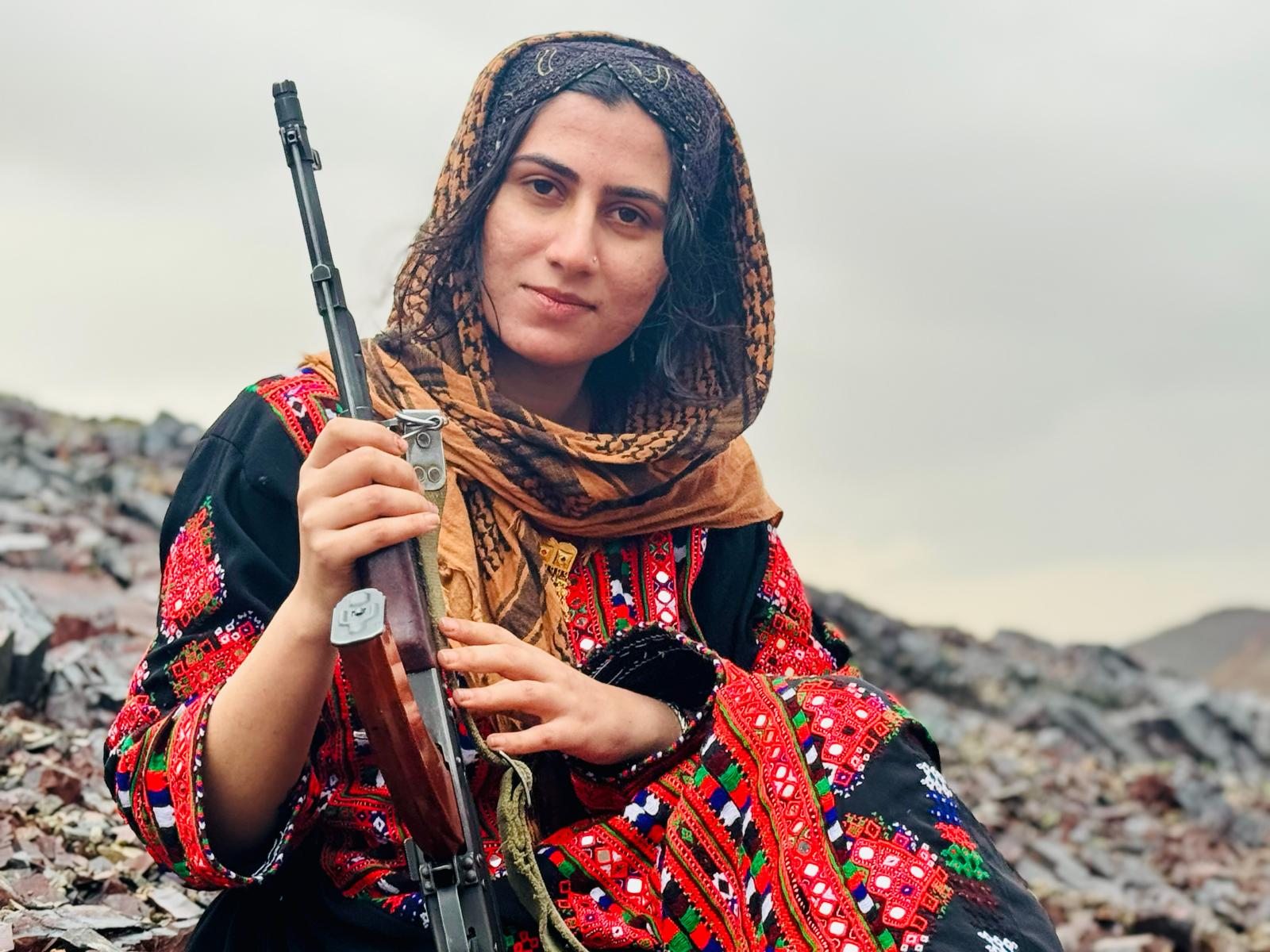
Q: You are the first woman to command a major Baloch armed formation. What personal path brought you to this role?
To answer this, we must look to the Hegelian concept of overcoming alienation (Entfremdung). Hegel posits that we do not discover our true selves in isolation; rather, we find our authentic being by situating ourselves within the broader current of history. My path to leadership was not triggered by a singular, external epiphany or an isolated traumatic event. Subjugation is not an external event that happens to you; under occupation, it is a structural reality that lives within you from birth. For a colonized individual, true consciousness begins when you realize that surviving under colonial rule is a form of self-alienation. Armed struggle, therefore, is not a sudden choice, it is the ultimate reconciliation with one’s inner essence. It is the realization that to exist authentically, one must resist. My transition from a supporter to a commander was the natural progression of this realization. The liberation of Balochistan cannot be achieved if half of its population remains historical spectators. Women are not joining the armed struggle merely to fill a quota or offer auxiliary support; we are reclaiming our historical agency to shape the destiny of our nation.
Q: How has the state’s systematic targeting of women — through disappearances, torture, and attacks on protesters — influenced your decision to take up arms rather than remain only in the civic sphere like the BYC marches?
First, we must correct a prevailing historical distortion: Baloch women have never been passive bystanders. Whether in the armed sectors or the unarmed political spheres, women have always formed the foundational core of our liberation movement. My visibility as a commander is not an abrupt anomaly; it is the direct evolutionary continuum of thousands of unnamed Baloch women who have quietly laid the groundwork for decades. I reject the patriarchal and Eurocentric analytical framework that constantly reduces a woman’s resistance to a mere "trauma response." The mainstream narrative loves to assume that a woman picks up a rifle only because she was driven to madness by personal grief or the loss of a male relative. This is a patronizing view. My decision to command in the armed resistance is an act of deliberate, intellectual conviction, not a visceral reaction to state atrocities. While the civic front, like the Baloch Yakjehti Committee (BYC), exposes the state's moral bankruptcy on the streets, the state’s escalating violence proves that peaceful dissent alone cannot dismantle a heavily armed colonial machinery.
Q: We have seen a noticeable increase in women’s participation in operations, including fidayeen actions by the Majeed Brigade. How do you explain this shift? Is it a response to the closing of peaceful avenues, a strategic choice, or both? What message does a woman fighter send to Baloch society and to the Pakistani state?
This qualitative shift has three distinct dimensions. The first is political and structural: the Pakistani state has systematically criminalized and shut down every peaceful avenue of democratic dissent that dares to demand Baloch sovereignty. When peaceful political advocacy is rendered ineffective and met with enforced disappearances, armed resistance ceases to be just an option—it becomes the only viable method of survival. The other two dimensions reflect profound, progressive transformations within Baloch society itself. Over the last quarter-century, our national liberation movement has not only struck blows against the occupying state, but it has also systematically dismantled the archaic, patriarchal, and feudal layers of tribal Baloch society that historically restricted women. The revolution has democratized agency, liberating Baloch women internally before they even step onto the battlefield. Secondly, the mass intellectualization and rising literacy rates among young Baloch women have fostered an advanced political consciousness. A female combatant sends a dual message: to the Pakistani state, she signals that its colonial rule has failed to terrorize our society into submission; to Baloch society, she demonstrates that total national liberation is impossible without total gender emancipation.
Q: Some observers worry that women are being pulled into suicide operations out of desperation rather than genuine agency. How do you respond to that? How does the Majeed Brigade (or BLA more broadly) ensure that women’s participation is voluntary and rooted in political conviction rather than coercion or revenge alone?
The insinuation that Baloch women are being "manipulated" or "pulled" into fidayeen operations is fundamentally sexist. It is an analytical double standard that international observers rarely apply to men. When a male fighter volunteers for a high-risk operation, he is judged as an ideologically driven soldier acting on his own agency. Yet, when a woman makes the same choice, the patriarchal gaze immediately looks for an external male handler, emotional vulnerability, or coercion. A male commander is simply called a commander, but I am consistently labeled a female commander. Why must a woman’s political consciousness constantly be cross-examined? Women suffer under the weight of colonial occupation just as acutely as men do. If the structural horrors of colonialism are enough to drive a man to pick up a rifle, why is it so difficult to accept that a woman can reach the exact same intellectual conclusion? Within the BLA and the Majeed Brigade, entry into any operational unit, particularly the fidayeen wings, requires a lengthy, rigorous process of ideological evaluation and political education. Our fighters are driven by sophisticated political consciousness, not blind revenge or coercion.
Q: The Baloch Yakjehti Committee and leaders like Mahrang Baloch and Sammi Deen Baloch have brought international attention to Balochistan through non-violent marches and sit-ins. How do you see the relationship between that civic front and the armed resistance?
Every politically conscious Baloch agrees on one fundamental premise: resistance against occupation is an absolute national duty. Whether that resistance manifests through civic mobilization or armed conflict depends entirely on an individual's specific circumstances, material realities, and political strategic placement. The civic front and the armed resistance are born from the exact same consciousness; they are two distinct currents flowing toward the same historical objective—the liberation of Balochistan. However, we must be clear-eyed about the nature of the adversary. As Frantz Fanon observed, colonialism is not a machine thinking with reason; it is violence in its natural state, and it will only yield when confronted with greater, organized violence. The non-violent civic marches are crucial for domestic mobilization and documenting state crimes, but they operate within a framework that the colonial state routinely ignores or crushes with impunity.
Q: The world still largely ignores Balochistan or views the resistance through a “terrorism” lens. What message would you give to governments, corporations, and international institutions investing in or arming Pakistan while Balochistan is turned into an extraction zone? Do you believe the Baloch struggle can gain genuine international legitimacy?
The concept of "legitimacy" within the current global order is deeply flawed. The international bodies and states that hand out certificates of legitimacy are often the very entities complicit in global exploitation, resource extraction, and illegal occupations. The Baloch movement does not look to the external actors for moral validation. Our legitimacy is derived from historical fact: Balochistan was forcibly and illegally occupied, and international law recognizes the inherent right of an occupied people to fight for self-determination by any means necessary. Furthermore, the semantic weaponization of the term "terrorism" has been thoroughly exposed in contemporary political science. It is an outdated rhetorical tool used by states to delegitimize indigenous national liberation movements while masking their own state-sponsored terrorism and genocide. We are not interested in fighting a public relations war to please foreign capitals. In international relations, states and corporations do not make decisions based on moral purity; they operate on realpolitik and align with whoever controls the material reality on the ground. We will alter international opinion through our strategic victories, not by appealing to global conscience. We will make our independence an unavoidable geopolitical reality.
Q: As a woman commander carrying both the weight of military leadership and the legacy of mothers, sisters, and daughters who have borne disappearances and loss, what kind of Balochistan are you ultimately fighting for? What would victory look like for the next generation of Baloch women and children?
I do not subscribe to what political theorists call the "burden of representation." I am a commander of the Baloch Liberation Army, period. My male peers are never asked to carry the collective emotional weight of their fathers, brothers, or sons; they are permitted to simply be strategists and soldiers. I refuse to let my command be sentimentalized or reduced to a maternal performance of grief. The Balochistan we are fighting for is precisely a society where these limiting binaries and burdens cease to exist. Our objective is not merely the replacement of a Pakistani ruling elite with a native Baloch elite, nor is it just about drawing a new border on a map. We are fighting for a profound socio-political transformation. Victory means building an egalitarian, secular republic rooted in absolute justice, gender emancipation, and collective ownership over our national wealth. It means creating a future where a Baloch child’s identity is defined by their intellectual and human potential, rather than the historical trauma of occupation, poverty, and war. We are fighting for the complete, unconditional reclamation of our dignity.
Editor's Note
The conflict in Balochistan has entered a new and significant phase.
While international attention has largely focused on peaceful campaigns led by the Baloch Yakjehti Committee (BYC) and prominent activists such as Dr Mahrang Baloch and Sammi Deen Baloch, developments within the armed insurgency have received comparatively little independent scrutiny. The emergence of Shaynaz Baloch—identified by the Baloch Liberation Army (BLA) as one of its commanders and believed to be the first woman to publicly occupy such a senior operational role—marks a notable evolution in the conflict and raises important questions about the changing nature of resistance in Balochistan.
Parrhesia News believes that journalism has a duty to examine all dimensions of conflicts that shape regional and international security. Understanding an insurgency does not require endorsing its methods, nor does reporting the views of its participants amount to support for them. Rather, it reflects the fundamental journalistic principle that audiences are best served by access to primary voices alongside rigorous reporting and contextual analysis.
This interview was conducted to provide readers with rare insight into the political thinking, motivations and ideological arguments of a prominent figure within an armed movement that remains largely inaccessible to international media. The views expressed throughout are those of the interviewee alone and should not be interpreted as those of Parrhesia News, its editors or contributors.
As with all reporting on armed conflicts, readers are encouraged to consider this interview alongside reporting from governments, independent observers, human rights organisations and academic researchers in order to develop a comprehensive understanding of one of South Asia's most enduring and least understood conflicts.
— The Editorial Board
Parrhesia News

Reader comments
Subscribers can join the conversationSign in to join the conversation. Comments are open to everyone with a free account.
Sign in or create accountLoading comments…