
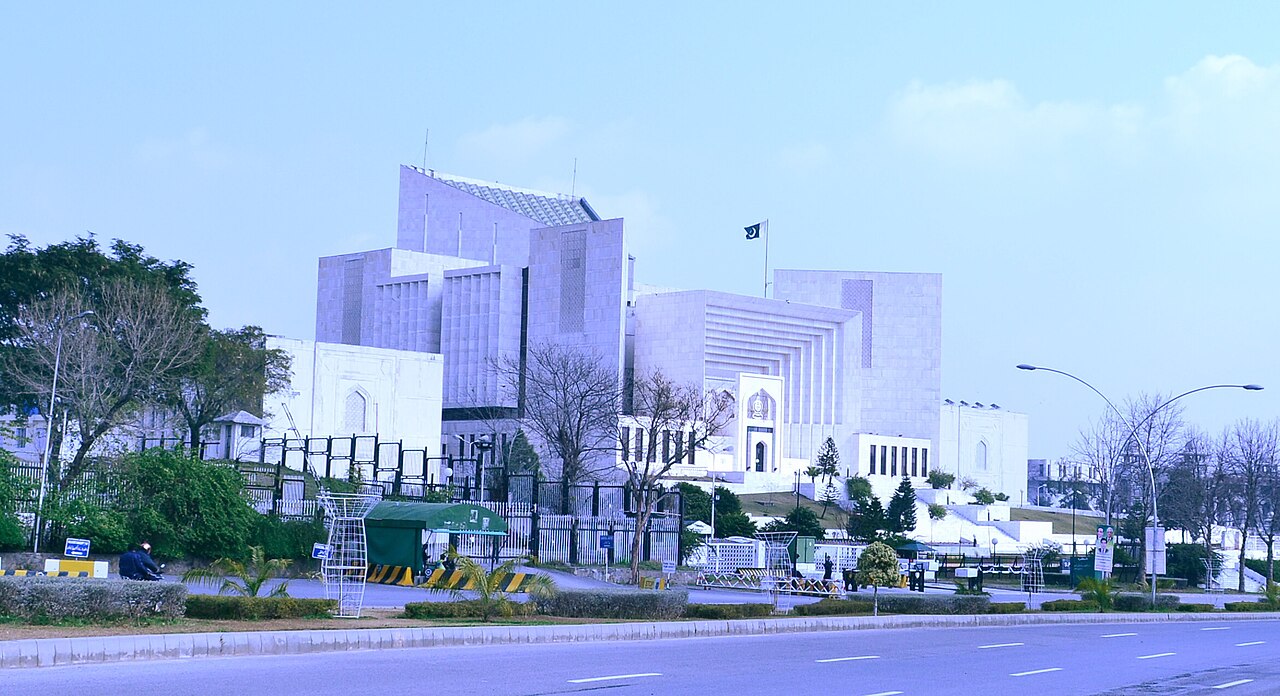
There is something profoundly disturbing, almost obscene, about the reports that Pakistan's newly created Federal Constitutional Court (FCC) is preparing to celebrate its first anniversary with considerable pomp and ceremony. On 13 November, the court completes one year of its existence. Apparently, there is much to celebrate. One wonders what exactly.
Perhaps the dismantling of the Supreme Court as we knew it. Perhaps the systematic erosion of judicial independence. Or perhaps the remarkable success with which an institution, created in the name of constitutional reform, has managed to make itself useful to those who have never had much patience with constitutional limitations.
Whatever the occasion, it is hardly one that calls for a birthday cake.
To understand the irony of this anniversary, one must travel back nearly three decades, to a time when the names Shahbaz Sharif, Benazir Bhutto, Asif Ali Zardari and Justice Malik Muhammad Qayyum were associated with one of the most disgraceful episodes in Pakistan's judicial history.
Between 1998 and 1999, Shahbaz Sharif, then chief minister of Punjab, was among those whose conversations with Justice Qayyum, a judge of the Lahore High Court hearing corruption proceedings against Benazir Bhutto and Asif Ali Zardari, were secretly recorded. The conversations exposed the extraordinary degree of political interference in judicial proceedings. The objective was hardly subtle. The judges were not expected to dispense justice independently; they were expected to ensure that the political opponents of the Sharif government did not escape punishment.
In 2001, the Sunday Times in London published details from some 32 recorded conversations, exposing how the political executive had sought to influence the judicial process. The revelations contributed to the Supreme Court overturning the convictions of Benazir Bhutto and Asif Ali Zardari and ordering a retrial.
The episode became a permanent stain on the reputation of Pakistan's judiciary. Justice Qayyum subsequently resigned. But the political culture that produced those telephone calls never really disappeared. It merely evolved.
Fast forward to November 2025.
Bilawal Bhutto Zardari, the son and political heir of the very couple who had suffered at the hands of a politically manipulated judiciary, was now standing alongside the same Shahbaz Sharif, this time as prime minister, to help establish a new constitutional court.
History, as they say, has a peculiar sense of humour. In Pakistan, however, it also has a particularly cruel one.
The Pakistan Peoples Party, with Bilawal enthusiastically embracing the project, joined the PML-N in pushing through the 27th Constitutional Amendment, creating the Federal Constitutional Court. Of course, anyone familiar with how constitutional engineering works in Pakistan would recognise that the parliamentary faces were only part of the story. Behind them stood the familiar, unseen power structure of the military establishment.
Bilawal appeared positively delighted. In Parliament, he presented the exercise as a historic correction, a long-overdue attempt to curtail an overreaching Supreme Court. He spoke with the confidence of a young political leader convinced that he had finally discovered the cure for Pakistan's judicial troubles.
There was, admittedly, a history to exploit.
Pakistan's Supreme Court has hardly been a consistent defender of constitutionalism. From validating military takeovers to disqualifying elected prime ministers, from selectively discovering judicial activism to conveniently abandoning it, its record has been deeply compromised. Benazir Bhutto and the PPP had genuine grievances. So did Nawaz Sharif, whose political fortunes had also been repeatedly shaped by judicial interventions. The judiciary's past complicity with military rulers and its selective treatment of political parties cannot be wished away.
But there is a fundamental difference between reforming an institution to make it independent and destroying its independence because one happens to dislike its previous decisions.
Bilawal either failed to appreciate that distinction or chose to ignore it.
The Federal Constitutional Court was not merely another court added to Pakistan's judicial structure. It represented a wholesale redistribution of constitutional power.
The Supreme Court was stripped of much of its original constitutional jurisdiction, including the enforcement of fundamental rights in matters of public importance, disputes between governments and significant constitutional appellate powers. The new FCC acquired authority to pronounce upon constitutional questions with decisions binding even on the Supreme Court.
Consider the absurdity. Pakistan's highest constitutional authority would now be exercised by a court whose first chief justice and founding judges were selected through an arrangement that placed the executive at the centre of the process.
The first chief justice, Justice Aminuddin Khan, and the initial appointments emerged from a constitutional mechanism under which the President acted on the advice of the Prime Minister. The ordinary judicial appointment process was bypassed for the founding cohort. Later appointments would pass through a Judicial Commission already restructured by the 26th Amendment to give political actors substantially greater influence.
The same constitutional package made it easier to transfer High Court judges without their consent, with potentially serious consequences for those unwilling to comply. It also introduced extraordinary protections for the holders of the country's highest political and military offices.
An institution supposedly created to protect the Constitution was thus born in circumstances that made its independence questionable from the very first day.
The International Commission of Jurists described the 27th Amendment as an assault on the rule of law. Amnesty International and constitutional lawyers raised similar concerns. Two senior judges of the Supreme Court, Justices Syed Mansoor Ali Shah and Athar Minallah, resigned in protest when the amendment became law.
They understood what was happening.
Justice Mansoor Ali Shah warned that the amendment dismantled the Supreme Court and subordinated the judiciary to executive control. Justice Athar Minallah went further, lamenting that the Constitution he had sworn to uphold was no longer the Constitution that remained.
Those were not the words of disgruntled politicians denied another opportunity in government. They were warnings from judges who had spent their professional lives within the constitutional system.
One year later, the question is not whether those warnings were justified. It is whether even their authors could have anticipated how quickly the new institution would begin demonstrating the consequences of the changes.
Take the Margalla Hills National Park case. The Supreme Court had previously intervened to protect the national park from commercial encroachment, ordering the closure of restaurants and other establishments. The FCC subsequently set aside the earlier judicial approach, describing the intervention as an extraordinary excess of judicial power.
The issue is not whether every aspect of the Supreme Court's earlier judgment was legally flawless. Courts can and do make mistakes. The issue is the larger pattern emerging from the new constitutional arrangement. Where the previous Supreme Court had attempted to impose limitations on powerful public authorities, the FCC has shown a striking willingness to revisit those limitations.
More troubling still is what has happened in Khyber Pakhtunkhwa.
In November 2026, the FCC invoked the constitutional consequences of the deployment of armed forces in aid of civil power under Article 245 to suspend the Peshawar High Court's Article 199 proceedings instituted from 12 October onwards. The immediate controversy included detention orders affecting PTI workers under the Maintenance of Public Order law.
Put aside political affiliations for a moment. A citizen detained by the state ordinarily approaches the High Court seeking protection against unlawful executive action. That is among the most basic functions of constitutional judicial review.
Now consider a system in which the deployment of the military can have the effect of shutting the doors of the High Court to a whole category of constitutional petitions.
The implications go far beyond Imran Khan or the PTI. They concern the ability of every Pakistani citizen to seek judicial protection when the executive invokes national security or the assistance of the armed forces.
The FCC has also upheld the government's super tax and subsequently declined to review that decision. Questions have arisen from its approach to workplace harassment protections and other rights-related litigation. Not every judgment favourable to a government is necessarily wrong. But neither can the emerging institutional pattern be dismissed as coincidence simply because each decision carries an elaborate legal justification.
A court must be judged not only by the language of its judgments but also by the courage it demonstrates when confronted with power.
And then there is the remarkable story of the National Accountability Bureau cases.
In July 2026, the Supreme Court declared that, following amendments to the accountability law, pending NAB-related criminal appeals and bail matters fell within the jurisdiction of the Federal Constitutional Court. Even criminal proceedings arising from accountability cases were now finding their way into an institution ostensibly created for constitutional adjudication.
The consequences for Imran Khan are obvious.
Proceedings connected with his conviction in the £190 million Al-Qadir Trust case, including challenges relating to suspension of sentence, became subject to the new jurisdictional arrangement.
Why should an ordinary criminal appeal under the NAB law be diverted from the Supreme Court to a constitutional court?
The government's legal explanation rests on the amended statutory framework. But the political question is altogether different.
The establishment's overriding priority has been to prevent Imran Khan from returning to the political arena. His continued incarceration serves the interests of those who have invested so heavily in the present political arrangement. In that context, moving sensitive NAB proceedings into a newly constituted, executive-influenced court can hardly be viewed without suspicion.
To my mind, the purpose is to remove the risk that an independently minded bench might provide relief to Imran Khan. Whether the FCC ultimately does so or not remains a matter for judicial determination, but the design of the arrangement tells its own story.
There is also a constitutional absurdity here. A court supposedly established to specialise in constitutional questions has become a destination for criminal accountability appeals involving the country's most prominent political prisoner.
What possible principle of judicial reform explains that?
The answer appears to have less to do with constitutional jurisprudence and considerably more to do with political management.
And this brings us back to Bilawal Bhutto Zardari.
It is possible that Bilawal genuinely believed he was fulfilling his mother's political legacy by establishing a separate constitutional court. After all, the Charter of Democracy contemplated such an institution. But the Charter of Democracy was negotiated in a very different spirit. Its stated objective was to strengthen civilian supremacy and democratic constitutionalism, not to create another mechanism through which the executive and the establishment could exercise influence over the judiciary.
The difference is not technical. It goes to the heart of the entire arrangement.
Bilawal appears to have mistaken the use of democratic language for a democratic outcome.
And he may soon discover the cost of that mistake.
There is growing discussion in Pakistan's political circles about the next stage of constitutional engineering. The National Finance Commission Award, provincial autonomy and even the redrawing of provincial boundaries have become subjects of political speculation and debate.
The establishment's appetite for restructuring the constitutional order, it is feared, may not end with the judiciary.
For the PPP, this should be an alarming prospect.
The party's political survival is inseparable from Sindh. Its entire claim to federal relevance rests substantially on its electoral strength in the province and on the constitutional guarantees that protect provincial autonomy.
The NFC Award is not some administrative concession granted by Islamabad. It is part of the federal bargain reflected in the Constitution. Provincial boundaries are equally protected by constitutional requirements that cannot simply be brushed aside by an impatient federal government.
Article 239(4), in particular, requires the consent of the concerned provincial assembly by a two-thirds majority before an amendment altering provincial limits can become law.
Yet those are precisely the kinds of constitutional guarantees that become vulnerable when institutions charged with interpreting the Constitution are made dependent upon the very power structure they are supposed to restrain.
There is speculation about possible referendums and novel legal devices designed to overcome the political obstacles to such changes. Whether any such plan has been formally adopted is not established. But the concern is real: could an establishment determined to reshape the federation seek judicial validation for a method that circumvents the ordinary constitutional safeguards?
A referendum, by itself, cannot lawfully erase the requirements of Article 239. Nor can a constitutional court legitimately manufacture a route around an express constitutional prohibition. But Pakistan's history teaches us that legality and political power do not always travel together.
We have seen courts validate martial laws, justify constitutional deviations and invent doctrines to accommodate what powerful men had already decided.
The fear is that the FCC may become the next institution asked to provide the constitutional vocabulary for an otherwise unconstitutional political project.
Imagine the predicament for Bilawal Bhutto.
Having celebrated the weakening of the Supreme Court, he may find himself approaching the Federal Constitutional Court to defend Sindh's autonomy against the very forces that helped bring that court into existence.
What then?
Will he appeal to the independence of judges whose founding appointments were controlled by the executive? Will he invoke constitutional limitations after helping establish an institution that has diminished the judiciary's capacity to enforce them? Will the PPP rediscover the sanctity of provincial rights only when its own electoral base comes under threat?
In Pakistani politics: an institution weakened to defeat your opponent seldom remains under your control when your turn arrives.
The PPP should know this better than most.
Bilawal, who so proudly presented the FCC as a product of his own political vision, may discover that he was never its architect. At best, he was the puppet who played the part.
The seed of this project was planted elsewhere, within the unseen power structure that has repeatedly shaped Pakistan's constitutional and political arrangements. Bilawal was merely persuaded to nurture it and then claim the credit when it emerged.
And like so many politicians before him, he may eventually be bitten by the very institution he helped create.
One year into the FCC's existence, there is little reason for constitutionalists to celebrate.
Pakistan's tragedy is not simply that the military establishment repeatedly seeks to dominate civilian institutions. It is that elected political parties, in their anxiety to defeat their immediate opponents and secure their own survival, repeatedly volunteer to provide the legal and parliamentary machinery for that domination.
The PPP and the PML-N have participated in creating an institution that may long outlive their present political understanding with the establishment.
They may discover, sooner than they imagine, that the constitutional weapons they helped fashion against Imran Khan are equally capable of being turned against them.
And when that happens, the damage will not be confined to any one politician or party. It will be borne by the federation, by citizens seeking justice and by whatever remains of the constitutional order.
So, by all means, let the Federal Constitutional Court mark its first anniversary.
But spare us the celebrations.
The country has already paid a heavy enough price for its creation.

Reader comments
Subscribers can join the conversationSign in to join the conversation. Comments are open to everyone with a free account.
Sign in or create accountLoading comments…