
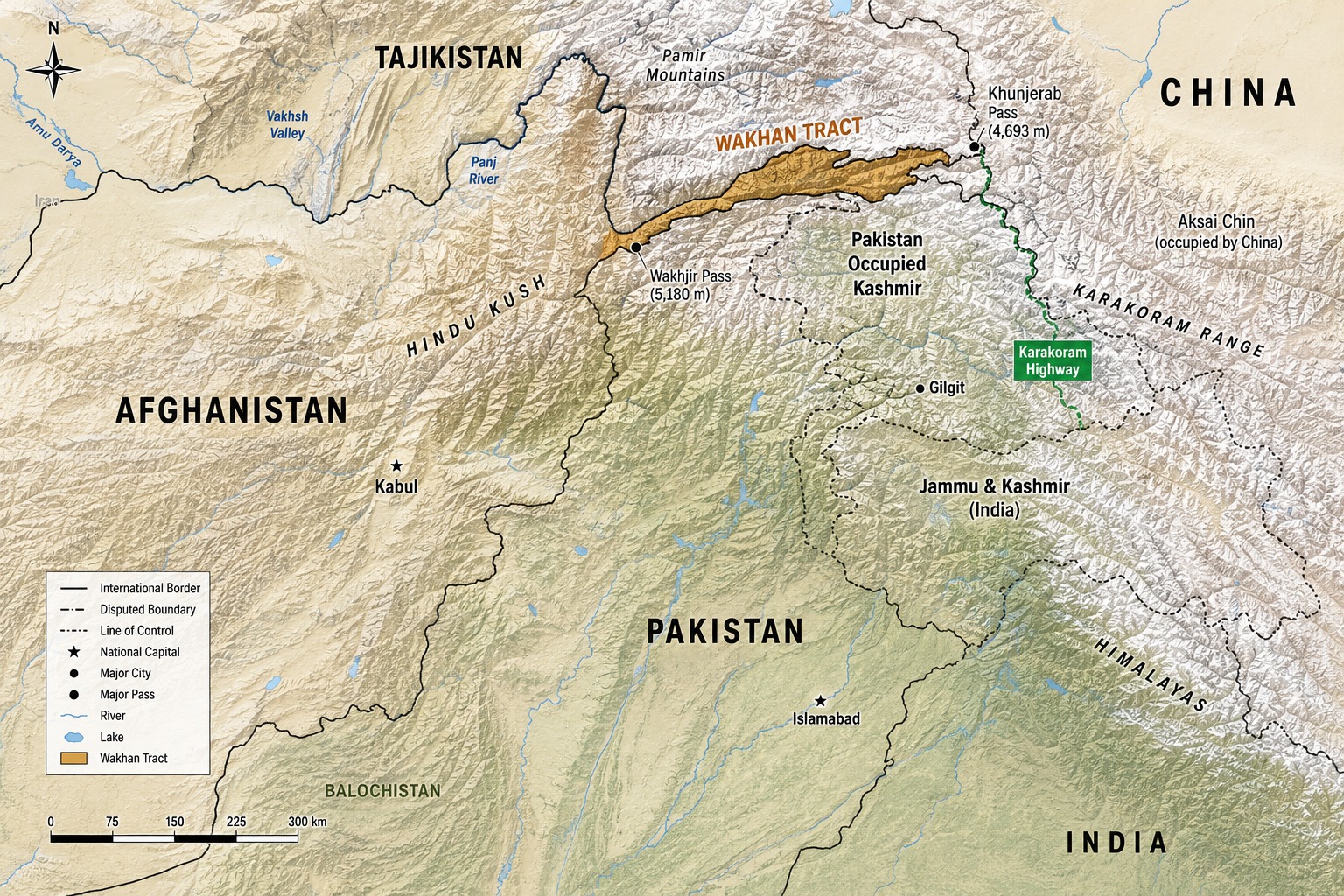
For more than a decade, China has presented the China-Pakistan Economic Corridor as the indispensable western arm of the Belt and Road Initiative: the road from Xinjiang through the Karakoram Highway and across Pakistan to the Arabian Sea. CPEC was supposed to shorten China’s access to global markets, develop Pakistan, stabilise Xinjiang and transform Gwadar into the maritime outlet of western China. It has done none of those things quite as advertised.
CPEC remains strategically important, but it has also become an expensive lesson in geography, insurgency and Pakistani political dysfunction. The Karakoram Highway is spectacular, vulnerable and difficult to maintain. Gwadar remains commercially marginal. Chinese engineers and workers require military protection. Baloch insurgents have repeatedly demonstrated that roads, ports and security convoys can be attacked far more easily than Beijing and Islamabad can protect them. And Pakistan, once presented as China’s uniquely reliable partner, has become a source of both leverage and liability.
Against this background, the Wakhan Corridor is beginning to acquire a significance that goes far beyond the road itself. The narrow Afghan strip running between Tajikistan and Pakistan to the Chinese frontier was created in the nineteenth century as a buffer between the Russian and British empires. In the decades that followed independence, Pakistan largely inherited the British impulse to control, rather than merely buffer, the Afghan space. For most of modern history, it has remained what its creators intended: a geopolitical space separating powers rather than connecting them.
There is still no functioning international border crossing between Afghanistan and China at the Wakhjir Pass. Afghanistan has completed basic construction work on a road extending towards the frontier, but a road ending at a closed border is not yet a trade corridor.
Nor is Wakhan naturally an all-weather route. The Wakhjir Pass is even higher than Khunjerab and lies in some of the most difficult terrain on earth. Turning it into a twenty-four-hour, twelve-month corridor would require much more than grading a road through the Afghan Pamirs. It would require tunnels, bridges, avalanche barriers, permanent maintenance facilities, communications, fuel depots, customs posts and a substantial security presence.
Most importantly, it would require China to open a frontier it has deliberately kept closed because of concerns about militancy, smuggling and the security of Xinjiang. But the geopolitical importance of Wakhan lies precisely in the possibility that Beijing may eventually decide that keeping the border closed is more costly than opening it.
China does not need Wakhan to replace CPEC. It needs Wakhan to reduce its dependence on it. Khunjerab was formally converted into a year-round crossing in December 2024, and Beijing and Islamabad continue to describe its permanent opening as an important step in expanding bilateral trade.
Yet official year-round status does not make the Karakoram immune to snow, landslides, flooding or political disruption. Nor does it protect Chinese traffic once it descends into Pakistan. The real weakness of CPEC is not simply the mountain pass. It is the long strategic funnel below it: Gilgit-Baltistan, Khyber Pakhtunkhwa, Punjab, Sindh and finally Balochistan. Every kilometre creates another point of exposure.
A functioning Wakhan corridor would give Beijing a second gate into the region. From Xinjiang, Chinese traffic could enter Afghanistan directly, avoiding Pakistani territory altogether. It could then move west through Badakhshan and the Afghan interior towards Iran, or south through Afghanistan into Pakistan. In theory, branches could connect the corridor to Central Asian networks through Tajikistan and Uzbekistan, creating not one road but a lattice of alternative routes.
The strategic word is not efficiency. It is redundancy.
No road through Wakhan is likely to compete with maritime shipping in terms of volume or cost. Even CPEC has never provided a commercially convincing substitute for the sea lanes carrying Chinese energy imports. Transporting oil from Gwadar across Pakistan and over the Karakoram into Xinjiang remains far more expensive than shipping it to China’s eastern ports. Wakhan would face even more formidable engineering and logistical constraints.
But China’s Belt and Road Initiative was never merely a commercial balance sheet. Its roads, ports, railways, pipelines and telecommunications systems are also instruments of political access. A corridor does not have to carry the majority of China’s trade to be strategically useful. It needs only to give Beijing another option during a crisis, another point of entry into a neighbouring state and another mechanism through which regional governments become dependent upon Chinese finance, technology and diplomatic protection.
A direct Afghan route would fundamentally alter China’s relationship with the Taliban. Until now, Beijing has been able to engage Kabul cautiously, promising investment while avoiding large-scale commitments. China wants Afghan minerals, political influence and security cooperation against Uyghur militant organisations, but it does not want to inherit Afghanistan’s economic collapse or become responsible for Taliban survival.
Wakhan would change that equation. Once China invested in the border crossing and the transport infrastructure behind it, Afghanistan would cease to be merely a peripheral security problem. It would become part of China’s continental strategic architecture.
For Afghanistan, the benefits would be enormous. A direct connection with China would reduce the country’s chronic dependence on Pakistan’s ports and border crossings. Islamabad has historically used transit access, arbitrary border closures and customs restrictions as instruments of political pressure against Kabul, treating Afghanistan less as a sovereign neighbour than as a strategic backyard.
Wakhan would weaken that leverage. It would give Afghanistan an alternative commercial outlet and reinforce the possibility that the country can function as an independent crossroads rather than as an appendage of Pakistan’s security doctrine.
This is precisely why the route would be politically uncomfortable and potentially intolerable for Islamabad. Pakistan would publicly celebrate Wakhan as an extension of regional connectivity and would almost certainly attempt to absorb it rhetorically into CPEC. Chinese and Pakistani officials already speak of expanding CPEC into Afghanistan. But a direct China-Afghanistan frontier would make Pakistan less indispensable.
The bilateral corridor on which Islamabad has built much of its claim to strategic relevance would gradually become merely one branch of a wider Chinese network. For a state that has long regarded influence over Afghanistan as a vital national interest, the erosion of that monopoly would be difficult to accept.
Pakistan’s anxiety would deepen if the Wakhan road were extended westward towards Iran. Afghanistan could eventually connect Chinese transport networks with Iranian roads, railways and ports, including Chabahar and Bandar Abbas. Such a route would not be simple, cheap or politically neutral, but its existence would give China an overland axis running from Xinjiang through Afghanistan to Iran without requiring passage through Pakistan.
Beijing would then possess several overlapping western options: CPEC towards Gwadar, Central Asian routes towards Iran and Europe, and an Afghan corridor capable of linking both systems. Pakistan would remain useful, but it would lose the ability to present itself as China’s only viable gateway to the Arabian Sea and the wider Middle East.
Iran would welcome the trade while understanding the danger. Chinese-backed connectivity could help Tehran overcome isolation and sanctions, integrate Afghanistan into Iranian commercial networks and increase traffic through Iranian ports. At the same time, it would deepen Iran’s structural economic dependence on China.
Infrastructure built to escape Western pressure could become the mechanism through which Beijing acquires unprecedented influence over Iranian trade, energy exports and relations with Afghanistan.
India would view the development through a different lens. A Chinese road through Wakhan would expand Beijing’s physical presence close to the disputed territories of Gilgit-Baltistan and the wider Kashmir region. It would also allow China to shape the commercial geography linking Afghanistan to Iran, including the strategic space in which India has invested through Chabahar. New Delhi would therefore have an interest in strengthening its own Afghan and Iranian connections before they are incorporated into a Chinese-centred system.
Russia and the Central Asian republics would face an equally familiar dilemma: they need infrastructure but fear becoming transit appendages of China. A functioning Wakhan axis could complement existing routes through Tajikistan, Uzbekistan and Turkmenistan, yet it would also confirm that Beijing, rather than Moscow, now possesses the capital and strategic patience to organise the economic geography of Eurasia.
The largest obstacle remains security. China has watched Pakistani assurances collapse repeatedly under the weight of insurgency and militant violence. It has no reason to assume that Taliban promises will prove more reliable. Islamic State Khorasan Province (ISKP) has already identified China and Chinese interests as legitimate targets. Uyghur militants remain a central concern for Beijing. And a corridor passing through sparsely governed territory would create opportunities for smuggling, infiltration and attacks.
China would therefore demand more than a road. It would demand intelligence access, surveillance, checkpoints and the right to shape Afghan security policy around the corridor. This is where infrastructure becomes power projection.
Beijing does not need to deploy divisions of the People’s Liberation Army into Afghanistan to establish a strategic presence. Engineers, communications systems, private security companies, border police, satellite monitoring and Chinese-funded Afghan units could create a security architecture without the formal appearance of occupation.
Economic protection would become intelligence cooperation; intelligence cooperation would become political influence; political influence would eventually constrain Afghan foreign policy. The Wakhan Corridor would thus mark something larger than the geographical expansion of the Belt and Road Initiative.
It would represent China’s transition from financing regional infrastructure to managing the political order required to protect it. CPEC gave China a road through Pakistan. Wakhan could give it a network across the region.
That network would not eliminate Pakistan, replace the Karakoram Highway or transform the Afghan Pamirs overnight into a new Silk Road. But it would end Islamabad’s monopoly over China’s southern access. It would provide Kabul with strategic room to manoeuvre, draw Iran more deeply into China’s continental orbit and place Beijing at the centre of the routes connecting South Asia, Central Asia and the Middle East.
The nineteenth-century empires created Wakhan to keep rival powers apart. China may eventually turn it into the corridor through which a new power binds them all together.


Reader comments
Subscribers can join the conversationSign in to join the conversation. Comments are open to everyone with a free account.
Sign in or create accountLoading comments…