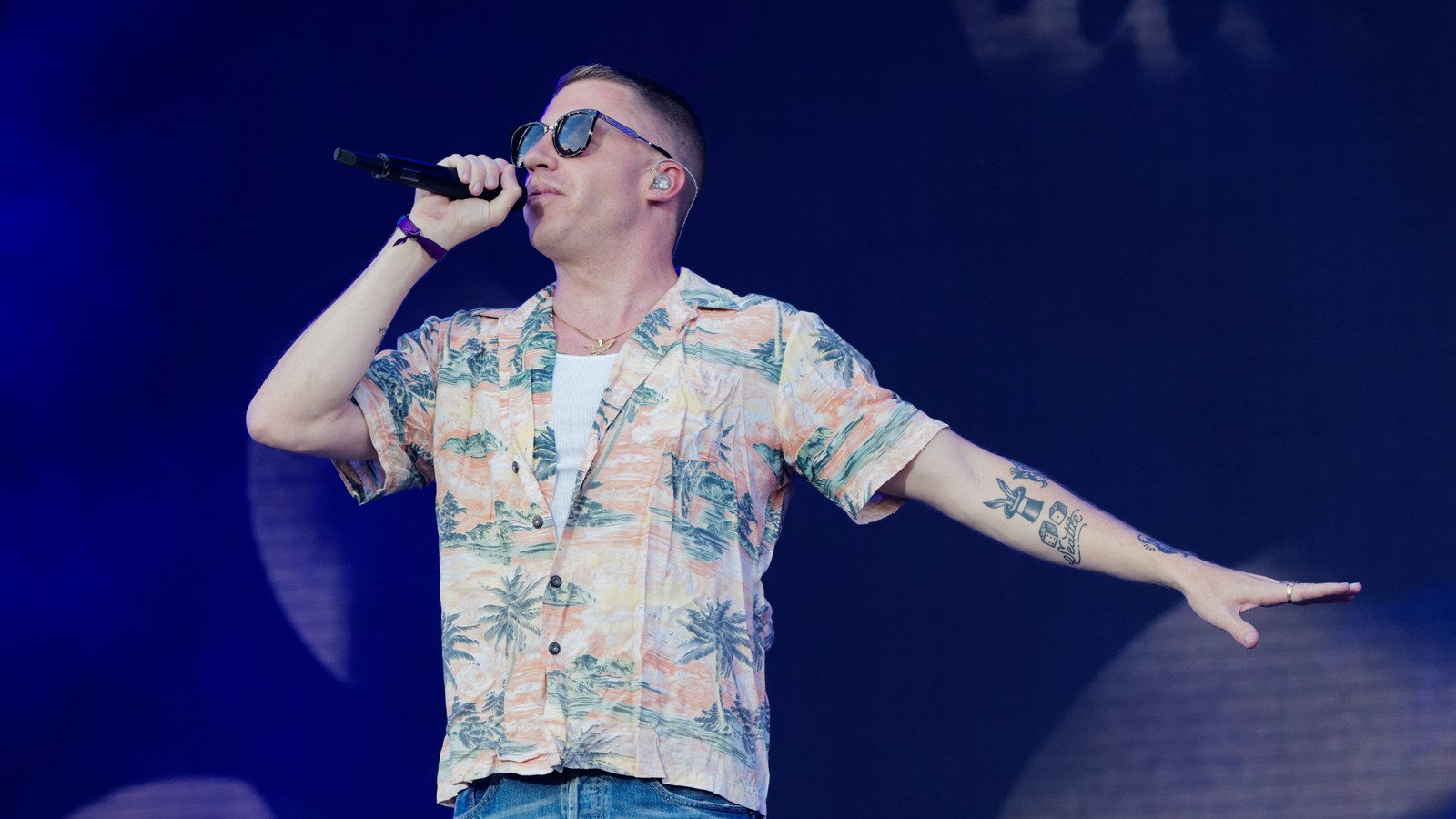
The stadium has always been more than concrete, corporate suites and merchandise booths. It is a modern public square: a place where thousands of strangers gather to feel something together, sing something together, perhaps remember that they are human together. That is why the decision to remove Macklemore from Ed Sheeran’s tour following his onstage declaration—“Free Palestine”—matters far beyond one rapper, one singer, one promoter or one billionaire owner.
Macklemore says he was removed after venues, led by Robert Kraft’s Gillette Stadium, threatened not to host the tour with him on the bill. Kraft confirmed barring him from Gillette, arguing that the stadium should not be used as a platform for hate speech and citing what he described as a wider history of offensive rhetoric. The promoter said other venues also informed it they would not permit Macklemore’s participation, placing the tour itself at risk.
But this is where the moral question begins, not ends.
To say “Free Palestine” is not inherently an act of hatred toward Jewish people. It is an assertion of Palestinian humanity—the humanity of people subjected to mass death, displacement, trauma, hunger, fear and the daily terror of bombardment. One may grieve every Israeli civilian murdered on October 7, condemn antisemitism without equivocation, reject Hamas’s crimes, and still refuse to avert one’s eyes from the obliteration of Gaza and the suffering of Palestinian children.
Indeed, that is precisely the point. Our humanity must not be selective. It must not be filtered through nationality, faith, ethnicity, geopolitical allegiance or access to wealth.
The attempted silencing of Macklemore had an unintended consequence: it awakened artistic solidarity. Finneas, Aaron Rowe, Beoga and Lukas Graham—all scheduled support acts—pulled out of Sheeran’s remaining tour dates in solidarity with Macklemore. These were not symbolic online gestures made from the comfort of a private room. They were professional decisions with costs: lost stages, lost income, disappointed fans and possible industry backlash.
That matters.
In an age of TikTok scrolls, X outrage, Instagram optics and the numbing repetition of horrific images, it is easy to believe that attention has replaced conviction. Yet these artists have reminded us that the moral imagination is not entirely dead. They have chosen discomfort over complicity. They have stated, by their actions, that a lucrative stage is not worth more than the right to bear witness.
As a musician who has lived the collision of art, power, faith and politics, I explored in Rock & Roll Jihad the ability of pop culture to cross borders that politicians turn into battlefields.
Music has never been merely entertainment. It has been testimony. It has carried the voice of the dispossessed through censors, dictatorships, war zones and exile. A song can travel where a passport cannot. A lyric can puncture the armor of propaganda. A guitar can become an instrument of memory.
John Lennon sang: “You say you want a revolution / Well, you know / We all want to change the world.” The line endures because it asks a hard question: Do we want change only when it is fashionable, profitable and risk-free? Or do we accept that genuine change always unsettles somebody with power?
The same battle over truth is taking place in cinema. Israel’s culture minister, Miki Zohar, has called for examining whether the citizenship of Israeli filmmakers Yuval Abraham and Rachel Szor can be revoked after their documentary NAZA, which addresses civilian killing in Gaza, won a Special Jury Prize at Venice. Zohar described the filmmakers as traitors and invoked a supposed breach of allegiance; Prime Minister Benjamin Netanyahu also condemned the film and its reception.
What does it say about a society when filmmakers who document suffering are denounced as enemies of the state? What does it say when creative artists are told that freedom of expression is permitted only when it flatters power?
The filmmakers’ predicament and Macklemore’s removal are different events, in different countries and under different legal systems. Yet they are linked by the same anxiety: that art might make people see. Not see a slogan, not see a tribal allegiance, but see children beneath rubble, mothers grieving, families fleeing, and the unbearable human cost hidden behind sanitized military language.
Norman Finkelstein’s recent work, Gaza’s Gravediggers, has contributed to this urgent reckoning. He has pointed to Gaza health authorities’ casualty data indicating that children comprise roughly 30% of those reported killed—an appalling proportion that demands serious moral and factual attention, whatever one’s politics.
Roger Waters, too, has long used his platform to denounce Palestinian suffering. He recently released a reimagined “Comfortably Numb” with Palestinian singer Mona Miari and has publicly backed Macklemore in this controversy. Artists may disagree with Waters’ language, his tactics or his politics. But no one can deny the larger principle: art is not meant to be a decorative curtain drawn over atrocity.
The war economy has trained us to call dead women and children “collateral damage,” as if language could erase a life. The wealthy and politically connected often demand restraint only from the powerless. They insist that the artist be neutral while bombs are not neutral, blockades are not neutral, hunger is not neutral, and the grave is not neutral.
This is why the current artistic revolt feels, to me, like spring arriving in Siberia.
It is not a final victory. It is not enough. It will not rebuild a home, revive a child or console a parent who has lost an entire family. But it is a refusal to surrender the most important territory of all: the conscience.
When wealth tries to dictate the setlist, when institutions confuse solidarity with hatred, and when propaganda asks us to stop seeing, artists must do what artists have always done. They must raise the volume.
Because truth does not need permission to sing
Reader comments
Subscribers can join the conversationSign in to join the conversation. Comments are open to everyone with a free account.
Sign in or create accountLoading comments…