Pakistan’s political crisis entered a dangerous new phase on Sunday when a presidential proclamation imposed emergency measures in Khyber Pakhtunkhwa (KP), transferring key provincial functions to federal control and requiring the chief minister and provincial ministers to cease holding office.
The two-page proclamation, published in the Gazette of Pakistan on 11 October 2026, invokes Article 232 and clause (1) of Article 234. It cites an intensification of militant attacks and a report from the provincial governor alleging a breakdown of constitutional machinery. The official rationale is security; the political consequence is the displacement of an elected provincial administration associated with Imran Khan’s Pakistan Tehreek-e-Insaf (PTI).
This is a moment that demands more than competing declarations of victory and betrayal. It raises a question about whether exceptional constitutional powers are being used as a last resort to restore governance or as a means of settling a confrontation between the centre and its principal political opponent.
A constitutional emergency — and its limits
The proclamation states that the federal government may direct the governor to assume provincial executive functions, while the powers of the provincial assembly become exercisable by or under the authority of parliament.
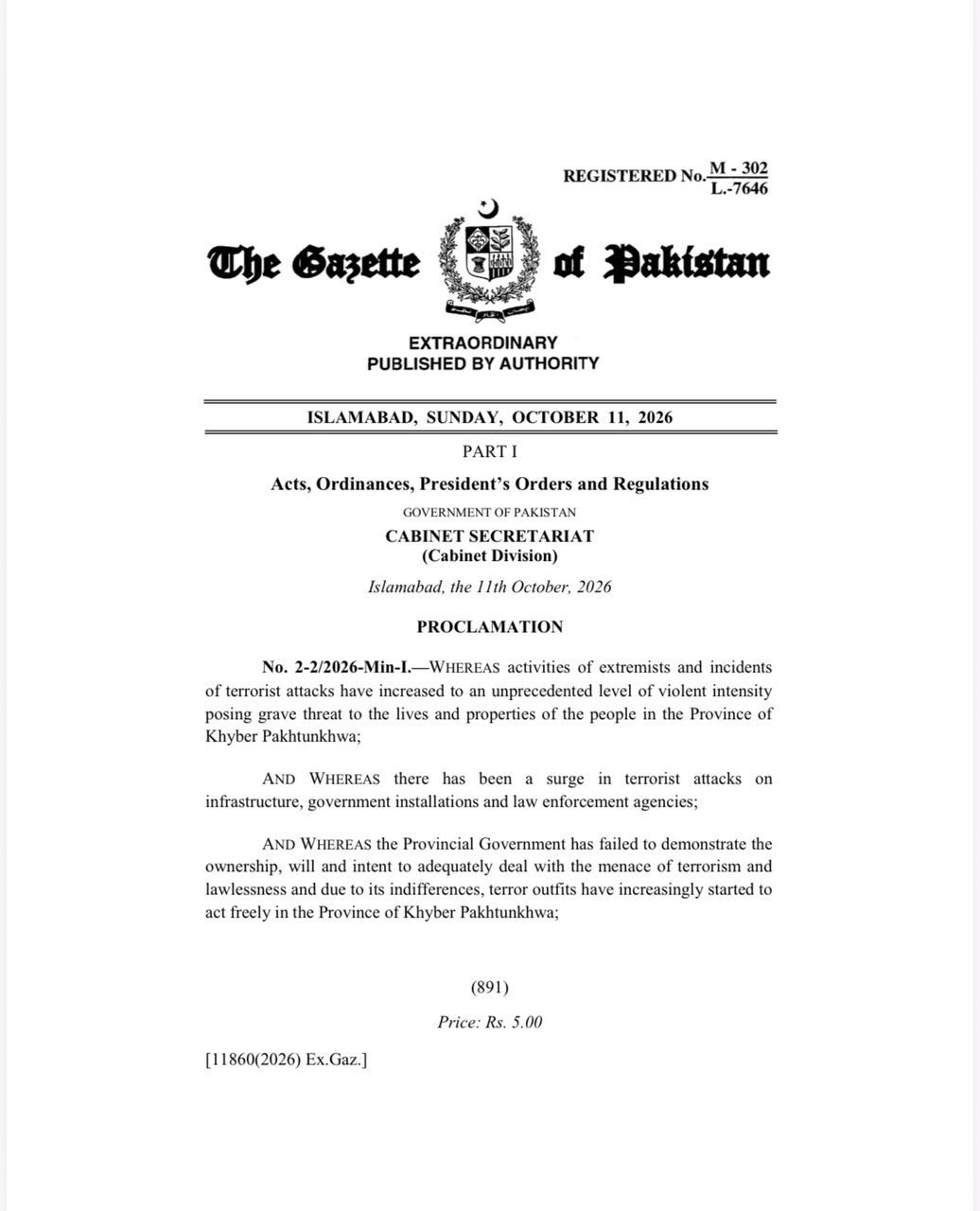
Pakistan Gazette, Extraordinary, Part I, 11 October 2026, p. 891. The page sets out the proclamation’s stated security grounds.
It explicitly excludes the provincial assembly from the category of bodies whose executive powers may be assumed by the governor. The document also orders the chief minister, ministers, advisers, special assistants and advocate general to cease holding office immediately.
The distinction between an emergency provision existing in law and its lawful application is critical. Article 234 sets out parliamentary approval requirements and temporal limits. The federal government’s security case deserves examination, but so do the proportionality of its response, the evidence for constitutional breakdown and the availability of less intrusive measures.
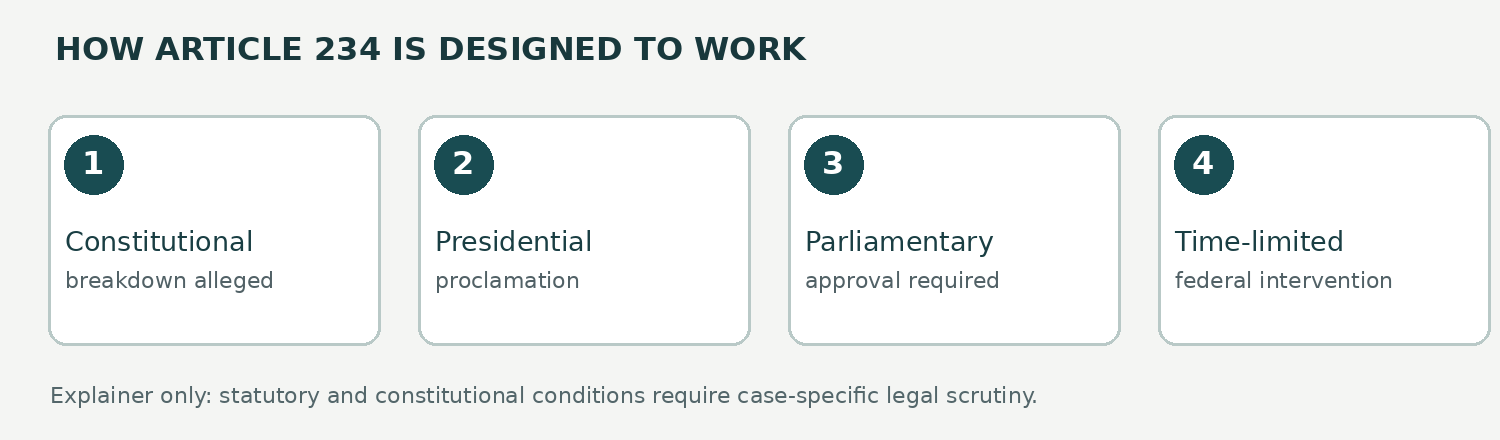
Explainer: the broad sequence described by Article 234. This graphic is illustrative, not a legal determination.
The military question Pakistan cannot escape
Behind the legal arguments sits Pakistan’s recurring problem of civilian–military imbalance. Field Marshal Asim Munir commands exceptional influence in the country’s security architecture. Critics of the present order contend that the armed forces exercise an outsized influence over civilian politics; the military has historically rejected claims of improper political interference.
The risk is not limited to an overt declaration of martial law. Democratic institutions may continue to exist while losing practical authority. A parliament can sit, a cabinet can meet and elections can be held, yet meaningful accountability weakens if elected officials cannot independently determine policy and exercise their constitutional powers.
Zardari and the paradox of “democracy is the best revenge”
President Asif Ali Zardari’s signature is politically significant. The Pakistan Peoples Party has long claimed a distinctive place in the country’s struggle for parliamentary government, invoking the sacrifices of Zulfikar Ali Bhutto and Benazir Bhutto. The decision to approve intervention in a rival party’s provincial administration now confronts the PPP with a question of consistency.
If emergency powers are accepted when directed against an opponent, what prevents their later use against an ally? Sindh, governed by the PPP, is an obvious focus of political speculation. There is no verified evidence in the supplied material that an intervention in Sindh has been ordered or planned. But the precedent, rather than a confirmed next target, is the immediate constitutional concern.
A federation under pressure
The Eighteenth Amendment of 2010 sought to strengthen provincial autonomy. A pattern of central intervention would reopen arguments about the balance of power between Islamabad and the provinces. In KP, decades of militant violence, displacement and security operations have already complicated the relationship between citizens and the state. In Balochistan, disputes over representation and coercion remain acute; in Sindh, provincial autonomy has its own political history.
Security is indispensable, but compliance obtained through administrative authority is not the same as legitimacy earned through representation. The durability of a federation depends on both.
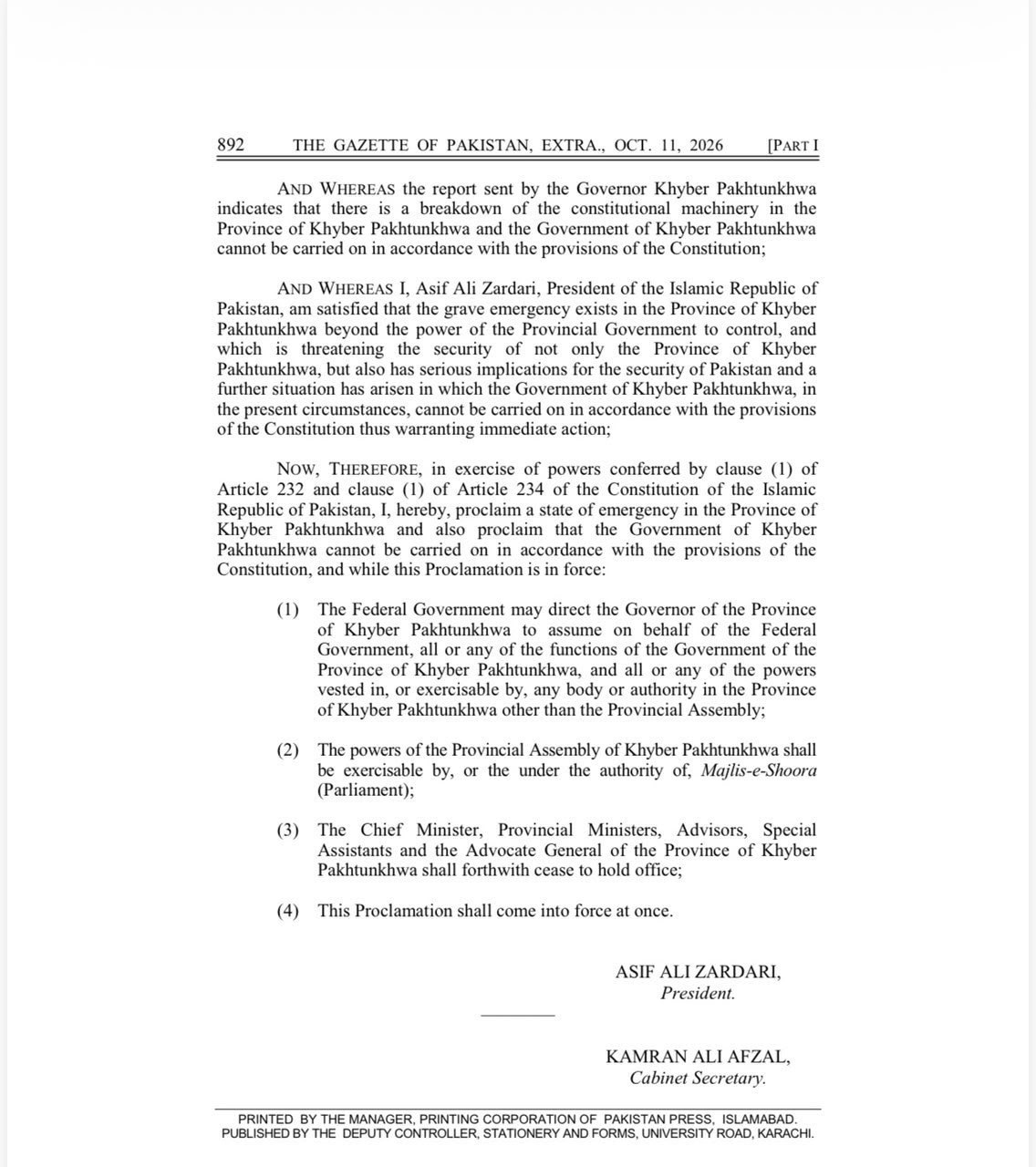
Pakistan Gazette, Extraordinary, Part I, 11 October 2026, p. 892. The page contains the operative provisions of the proclamation signed in the name of President Asif Ali Zardari.
Imran Khan, the Long March and political exclusion
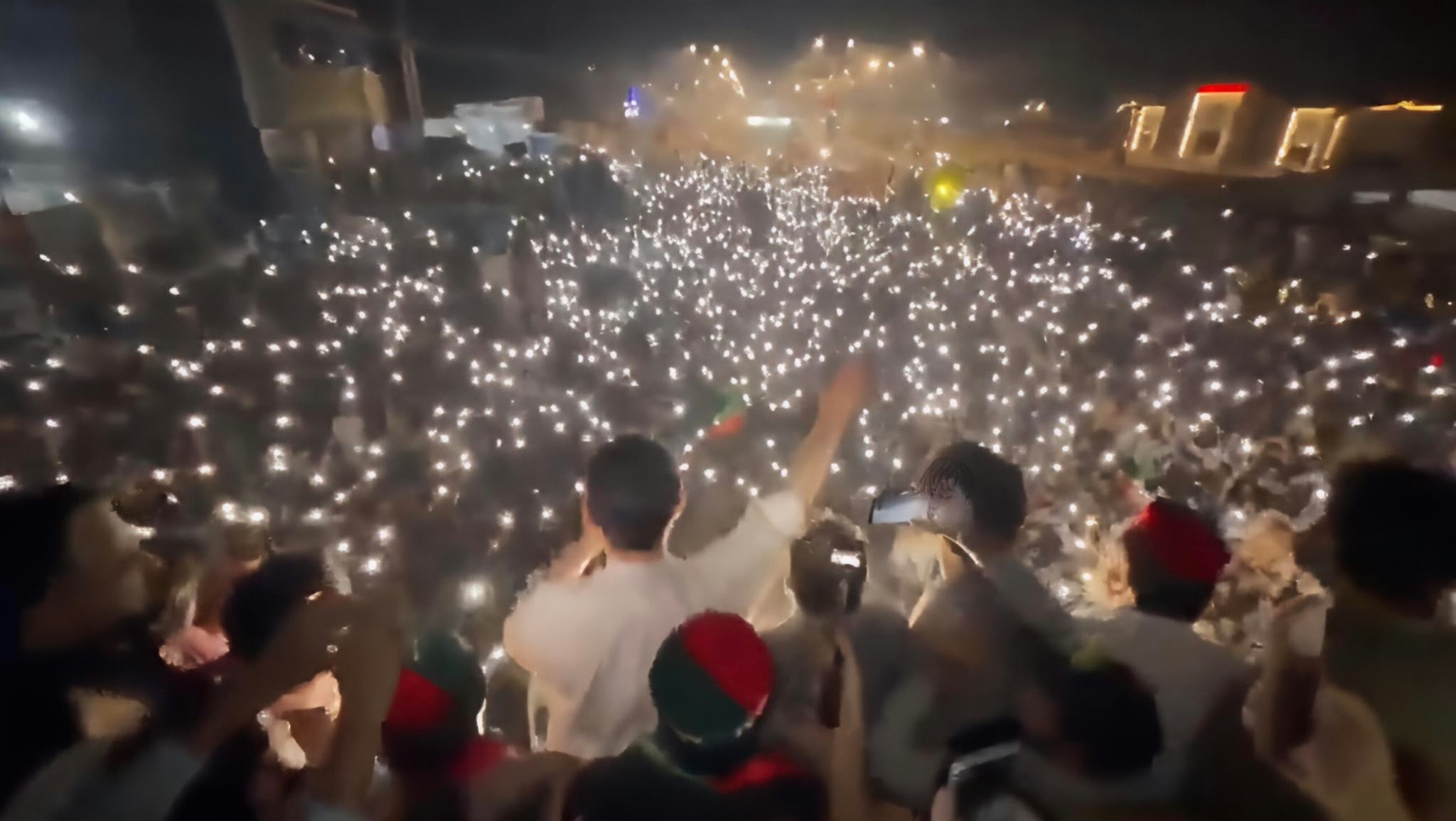
The intervention comes amid continuing PTI mobilisation demanding Khan’s release and challenging the treatment of its leadership. Islamabad may see emergency administration as a route to stronger coordination and security control. PTI supporters may instead regard it as confirmation that electoral success offers little protection against federal intervention.
Neither interpretation promises a simple resolution. Opposition movements rarely vanish because their institutional space narrows. They can become more distrustful of ordinary political processes. Independent judicial review, parliamentary oversight and peaceful political participation are therefore safeguards for the state, not concessions to a particular party.
The Pakhtun question
Khyber Pakhtunkhwa has paid a severe price for militancy and counterterrorism operations. Security personnel and civilians alike have suffered. Effective counterterrorism requires intelligence, policing and intergovernmental cooperation; it also requires local confidence that decisions are made with communities rather than merely imposed upon them.
The danger of political alienation should be taken seriously without treating further unrest as inevitable or endorsing violence. Pakhtun citizens are entitled both to protection from armed groups and to meaningful constitutional representation.
Iran and the danger of strategic miscalculation
The prospect of a crisis on Pakistan’s border with Iran adds another layer of concern. There is no independently established evidence that the army leadership has decided to provoke hostilities with Iran as a distraction from domestic events, or at the request of foreign patrons. Those assertions must remain clearly labelled as allegations or predictions.
What can be said is that an already strained state has little strategic room for an avoidable regional confrontation. Any cross-border action should rest on demonstrable national-security grounds, accountable civilian decision-making and an assessment of the diplomatic and economic costs.
The spectre of prolonged authoritarian rule
The “mad king” of this article’s title is a polemical metaphor for the concentration of political power, not a medical characterisation. Nor is a forecast of 15 years of personal rule an established fact. The more measurable danger is institutional: weakened courts, reduced provincial autonomy, diminished political competition and executive powers deployed without effective scrutiny.
Economic consequences follow political ones. Investors and lenders may welcome predictable administration, but confidence ultimately rests on legal certainty, policy continuity and legitimate institutions. A constitutional order perceived as contingent on the preferences of powerful individuals is a fragile foundation for growth.
Pakistan’s choice is institutional, not personal
The federal government has a duty to confront terrorism. Provincial administrations have an obligation to cooperate in protecting citizens. But extraordinary intervention must meet constitutional tests and remain accountable to parliament and the courts. The public deserves to see the evidence supporting the proclamation and a credible path back to ordinary provincial government.
PTI, the PPP, the PML-N and the military leadership all have a stake in preserving rules that do not depend on who holds power today. Peaceful political contestation and impartial adjudication are not obstacles to stability; they are among its preconditions.
Pakistan is not being undone by political disagreement. It risks being undone when institutions cease to offer a credible, peaceful and constitutional means of resolving it.
Documents and references
Gazette of Pakistan, Extraordinary, Part I, 11 October 2026, pp. 891–892.
Constitution of the Islamic Republic of Pakistan, Articles 232 and 234.
Associated Press, reporting on the 11 October 2026 KP emergency and suspension of provincial administration.
Dawn, reporting on the imposition of emergency and Governor’s Rule in Khyber Pakhtunkhwa.
Adil Raja is a former Pakistan Army officer, journalist and editor-in-chief of Parrhesia News. This article is analysis and opinion. Predictions and contested allegations are distinguished from the proclamation’s text.


Reader comments
Subscribers can join the conversationSign in to join the conversation. Comments are open to everyone with a free account.
Sign in or create accountLoading comments…