
Pakistan’s tragedy is not that its people have failed their country. It is that power has so often refused to answer to them.
A nation of diverse languages, colours, subcultures and whirling mystical traditions needs consent, not command. Yet seventy-nine years after independence, Pakistanis are still asked to mistake the general’s survival for the republic’s salvation.
Two histories run through the country: the honours bestowed upon military rulers abroad, and the interrupted lives of civilian leaders at home.
India offers a comparison, not a fairy tale. Nehru governed until his death in 1964; Shastri followed, then Indira Gandhi. Her Emergency assaulted democracy, but voters subsequently removed her. India’s army never became the permanent arbiter of who could govern.
Civilian continuity alone cannot explain economic transformation, but it preserved the institutional ground on which change could take root.
( India’s economy is roughly ten times Pakistan’s size, with nearly twice the output per person; meanwhile, almost half of Pakistanis live below the World Bank’s poverty threshold for lower-middle-income countries—a devastating measure of the distance between the generals’ prestige and their people’s welfare.)
Pakistan’s civilian history reads differently.
Jinnah died in 1948, barely a year after independence. The ambulance breakdown during his final journey remains a haunting symbol of a state unable to care adequately for its founder.
Liaquat Ali Khan was assassinated in 1951. Zulfikar Ali Bhutto was overthrown and hanged under Zia. Benazir Bhutto’s governments were dismissed twice; in 2007, she was assassinated while campaigning to return. No Pakistani prime minister has completed a full five-year term.
Civilian leaders have made grave mistakes of their own. Some accommodated military power; others benefited from its patronage before confronting its limits. But their failures cannot justify an unelected institution’s permanent claim to political supremacy.
Imran Khan was removed through a parliamentary no-confidence vote in April 2022. He accused General Bajwa of engineering his ouster; The diplomatic cipher controversy raised further questions about American pressure, although Washington denied orchestrating his removal.
The Intercept subsequently reported that Pakistani arms sales intended for Ukraine helped secure an IMF bailout, drawing on leaked documents and sources familiar with the arrangement. theintercept.com/2023/09/17/pakistan-ukraine-arms-imf/
Nevertheless, the reporting raises a serious question about the relationship between strategic cooperation abroad and political accountability at home.
Different circumstances, different responsibilities—but a recurring rupture between public choice and the exercise of power.
Meanwhile, the generals drank from empire’s chalice.
Ayub Khan received Kennedy’s embrace in 1961, complete with a Mount Vernon dinner, an address to Congress and a ticker-tape parade. Washington gave military authority the ceremony of visiting royalty. When protests forced Ayub’s resignation in 1969, he handed power to another general rather than to the electorate. The honours had not purchased consent.
Yahya Khan became useful to Nixon’s opening to China. Strategic importance sustained Washington’s embrace as Pakistan descended into the catastrophe of 1971. His refusal to honour the Awami League’s electoral mandate helped precipitate repression, war and Bangladesh’s independence. He lost power; a nation bore the consequences.
Zia’s opportunity was the anti-Soviet Afghan war. American assistance strengthened a ruler who postponed elections and suppressed political opposition. Bhutto went to the gallows; Zia went to the White House. His death in the 1988 aircraft crash ended his rule, but not its legacy.
Musharraf renewed the bargain after September 11. The coup-maker became an indispensable counterterrorism partner, until indispensability expired. He resigned under threat of impeachment in 2008 and died in Dubai in 2023.
Bajwa continued the Machiavellian pantomime of military predominance beneath civilian forms. Before retiring in 2022, he acknowledged the military’s history of unconstitutional political interference. An admission, however, is not accountability.
Now Munir occupies the same role in an apocalyptic age. White House hospitality and praise for Munir’s subservience may enhance his standing abroad. They cannot confer the democratic mandate that belongs to citizens alone.
These generals were not merely foreign puppets. They pursued their own authority through partnerships that rewarded strategic usefulness more reliably than democratic legitimacy. Foreign recognition became a shield against scrutiny at home.
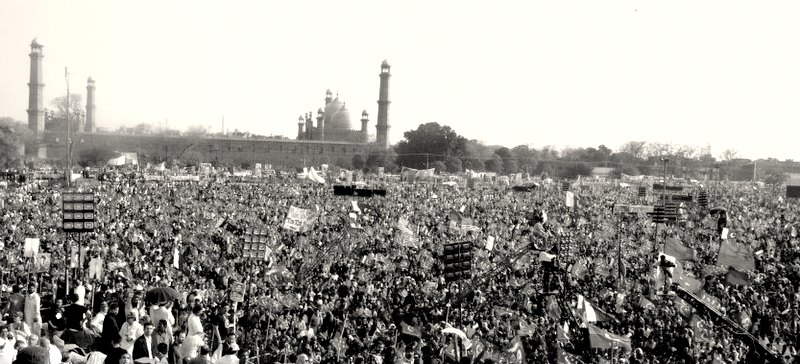
The movement to free Imran Khan draws strength from a genuine electoral constituency. On February 8, 2024, Khan-backed independents won more National Assembly seats than any individual party. Whatever one thinks of Khan’s cabinet and record, that support cannot honestly be dismissed as political irrelevance.
Nor does defending his rights require declaring him infallible. The democratic argument is stronger than devotion to any leader: charges must be tested through fair proceedings, imprisonment must not become an instrument of selective persecution , and voters must be free to choose without coercion.
Khan remains imprisoned, but prison has not erased his political presence. For his supporters, he is the last man standing—even behind walls.
The imagery is ancient: Moosa confronting Pharaoh, David facing Goliath, Ibrahim passing through Nimrod’s fire. These are metaphors of hope, not guarantees of real freedom.
Their power lies in the conviction that authority, however intimidating, is not beyond moral judgment.
But Pakistan’s salvation cannot depend on replacing one indispensable man with another.
A democratic breakthrough must establish rights that survive personalities: civilian supremacy, credible elections, independent courts and equal protection for political opponents.
The promise of a Mandela moment must therefore reach beyond a prison gate. It must mean a republic in which no citizen must become a martyr simply to claim the right to govern.
Is this Pakistan’s Mandela moment?

Reader comments
Subscribers can join the conversationSign in to join the conversation. Comments are open to everyone with a free account.
Sign in or create accountLoading comments…