

Pakistan’s Long March is being described as a threat before it has been allowed to make its democratic argument.
That is the wrong starting point.
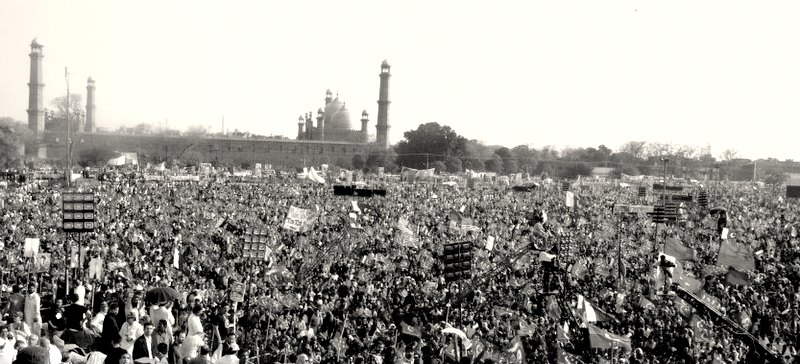
The march led by supporters of Pakistan Tehreek-e-Insaf began on 4 October after negotiations between the federal government and the opposition failed. The Associated Press reported that more than 5,000 supporters set out from Khyber Pakhtunkhwa, demanding the release of Imran Khan and travelling in a convoy towards Islamabad. The government placed shipping containers and other barriers around the capital, while ministers warned of risks to public order and the economy. AP’s report documented the start of the march and the official response.
The argument for democracy does not depend on accepting every claim made by PTI. It begins with a simpler principle: citizens do not lose their political rights because the government finds their protest inconvenient, expensive or threatening.
The people are not a security problem
For ordinary Pakistanis, politics is not a television contest between party leaders. It is the price of food, the safety of a road, the treatment of a family member in custody, the future of a province and the question of whether a vote can still change anything.
The participants in this march are not an abstract crowd to be moved around a map. They are people travelling from towns and districts in Khyber Pakhtunkhwa, a province already carrying the weight of insecurity, displacement and a long argument with Islamabad over how it is governed.
Dawn reported that the convoy moved through Khyber and that its route changed as it advanced. The paper said the march was expected to reach Peshawar, with later plans for Charsadda and Swabi still subject to change. It also reported that KP Chief Minister Sohail Afridi opposed another military operation in the province and linked that position to the concerns of displaced families. Dawn’s account sets out the changing route and the provincial dispute.
Those are political positions. They should be answered politically.
There is a legitimate duty to protect the public. A protest must not become an excuse for attacks, intimidation, the destruction of property or the obstruction of emergency services. The organisers should insist on discipline, non-violence and clear routes for ambulances, workers and residents. The state should do the same: protect people without treating every dissenter as an enemy.
That is what a democratic security response looks like. It does not begin by placing a whole population behind containers.
A march can be disruptive and still be democratic
The government’s economic concern is not imaginary. Prime Minister Shehbaz Sharif has warned that prolonged sit-ins and marches could affect factories, offices, exports and manufacturing. Geo News reported that he offered fresh talks on the condition that PTI end its march towards Islamabad. The government’s position was reported by Geo News.
But disruption is not the same as illegitimacy. Public protest is meant to interrupt the normal political routine when the normal political routine has stopped listening. If a government can answer a political movement only by asking it to disappear first, it is not offering dialogue; it is offering surrender under another name.
The answer is not to romanticise every road closure or pretend that citizens who disagree with PTI do not exist. The answer is to negotiate a route that protects residents while keeping the protest visible. A democracy must be capable of managing inconvenience without converting it into repression.
Dialogue cannot require capitulation
The most promising statement from the opposition this week has been a call for a middle way. The Express Tribune reported that PTI chairman Barrister Gohar Khan said the party remained ready for meaningful negotiations and that neither the government nor the opposition could move forward by insisting on its own way alone. The Tribune reported Gohar’s call for renewed dialogue.
That opening should be taken seriously.
The government should meet the opposition without demanding that the protest first be erased. PTI should make its demands concrete, lawful and negotiable rather than treating the march as a test of loyalty. Both sides should agree to protect journalists, bystanders, public services and political opponents. If there are allegations about prison conditions, elections, disappearances or security policy, they should be investigated through procedures that can survive public scrutiny.
The alternative is a cycle in which each side uses the other’s most extreme language to justify its own next escalation. The government invokes disorder to restrict politics. The opposition invokes restriction to deepen confrontation. Ordinary people are then left with the traffic, the fear and the bill.
Democracy belongs to the people who carry its cost
Pakistan’s political class has often treated citizens as numbers: turnout figures, convoy estimates, votes, casualties, economic losses. Those numbers matter, but they do not tell the whole story.
The people who have joined the Long March are making a claim about political ownership. They are saying that the future of Pakistan cannot be decided only in guarded buildings, closed-door meetings or statements from powerful institutions. That claim deserves an answer, even when it is politically uncomfortable.
Supporting that democratic claim does not mean declaring PTI infallible, Imran Khan beyond criticism or the government guilty of every accusation made against it. It means refusing the idea that a citizen’s right to be heard depends on whether the ruling coalition approves of the message.
The Long March should therefore be met with lawful protection, open reporting and serious negotiation. Its organisers should commit themselves to peaceful conduct. The state should commit itself to proportionate policing, transparent rules and no collective punishment. The political parties should remember that the people watching this confrontation will have to live with whatever precedent it creates.
Pakistan does not need another victory built out of silence. It needs a political settlement that ordinary citizens can recognise as their own.
The Long March is not, by itself, a threat to democracy. It is a demand that democracy make room for the people.


Reader comments
Subscribers can join the conversationSign in to join the conversation. Comments are open to everyone with a free account.
Sign in or create accountLoading comments…