
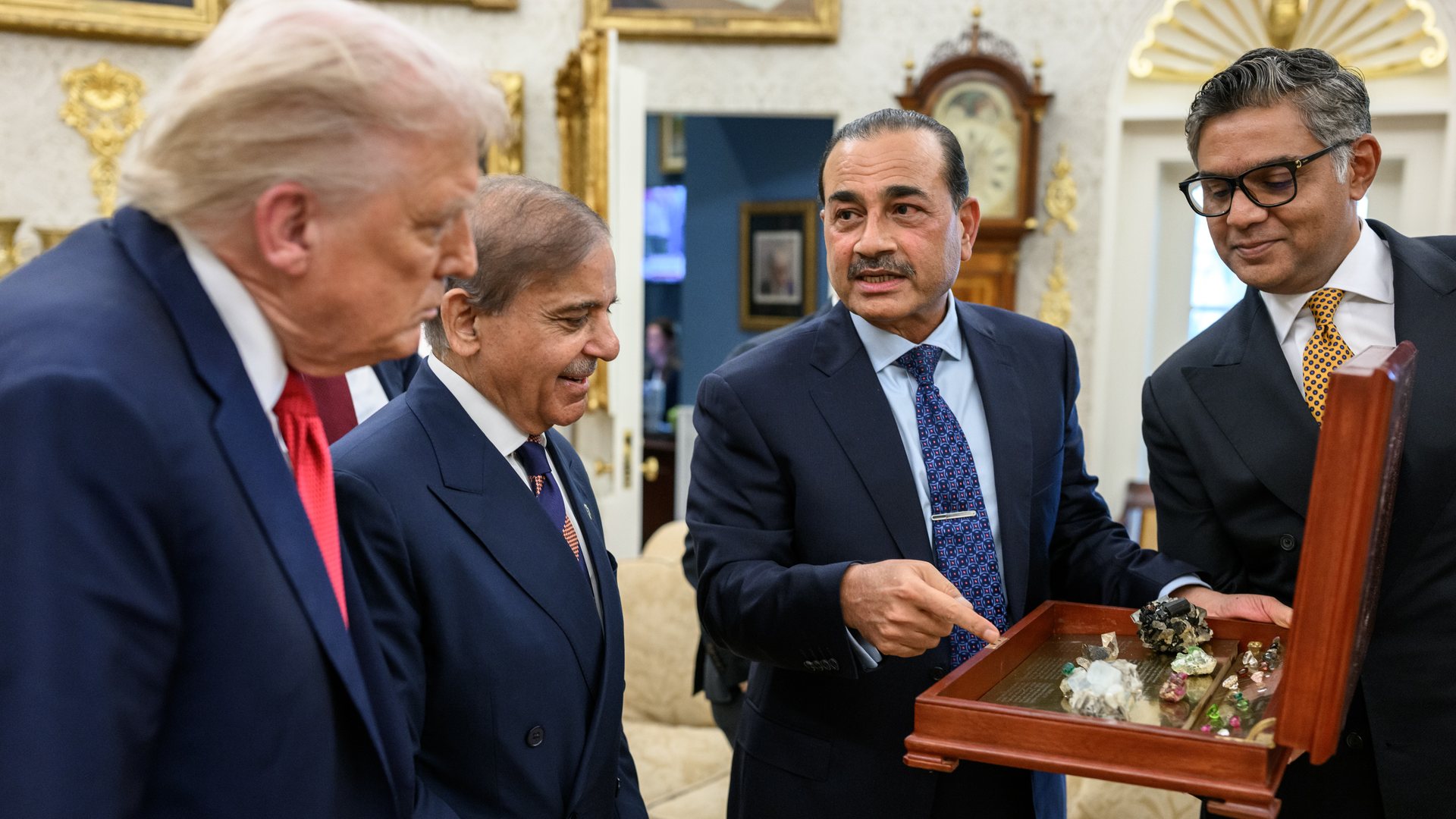
The mineral box in the Oval Office
The official White House photograph captured a carefully staged diplomatic moment. During a White House encounter, Pakistan’s military chief Asim Munir and Prime Minister Shehbaz Sharif presented President Donald Trump with mineral specimens. The display positioned Pakistan as a potential participant in Washington’s search for critical-mineral supply chains outside China.
But the essential question was not what the specimens looked like. It was whether Pakistan could supply commercially meaningful quantities of independently verified rare-earth materials, with reliable provenance and processing capacity.
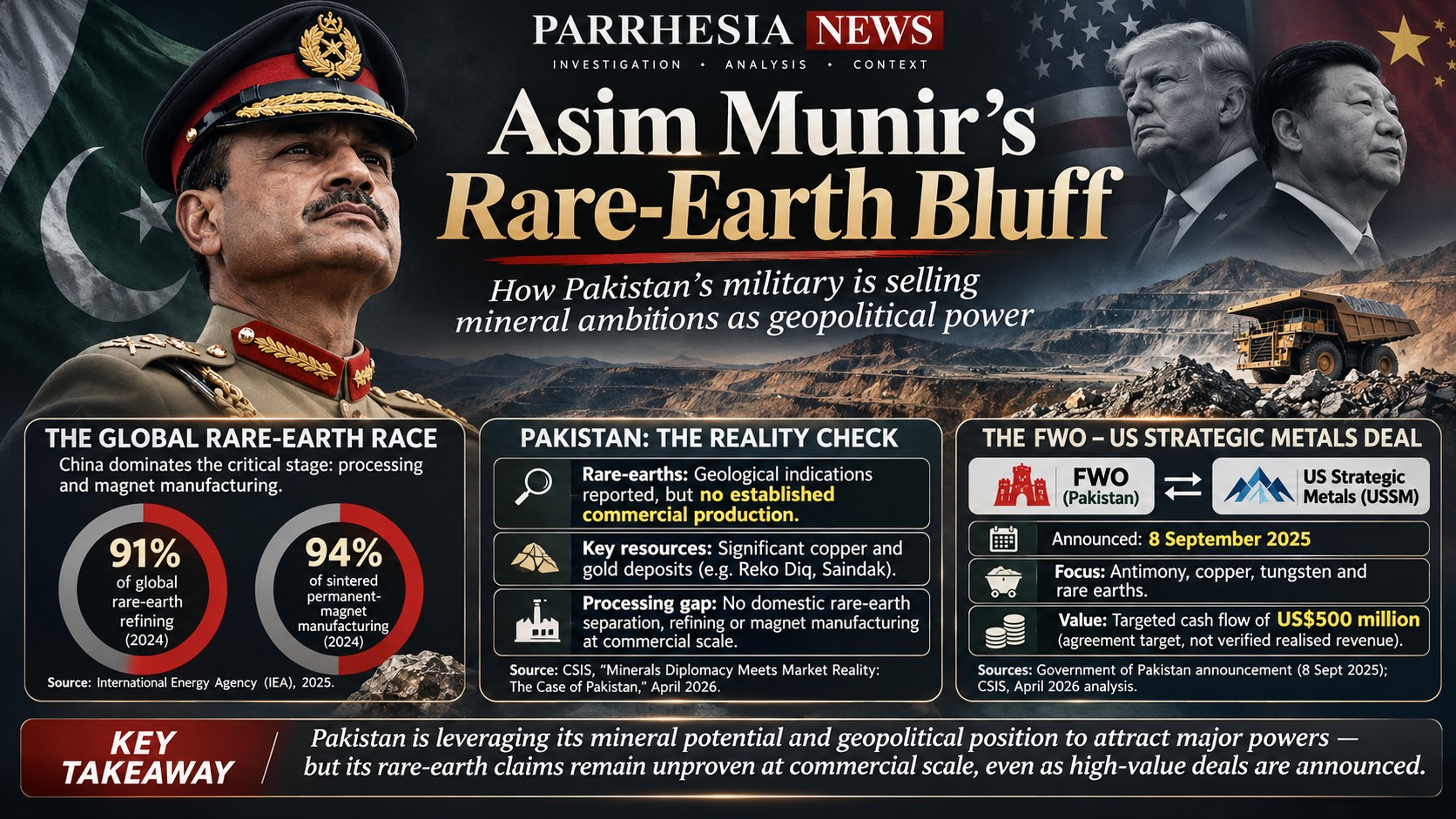
An April 2026 assessment by the Center for Strategic and International Studies (CSIS) found major gaps between Pakistan’s mineral ambitions and its established production capabilities. It reported no established commercial production of rare earths, antimony or tungsten, despite their inclusion in a publicised agreement with an American company. This does not prove the absence of geological deposits. It challenges claims of an existing mature supply chain. [1]
China’s real advantage is processing
Rare-earth competition is about more than ore in the ground. Separation, refining, metal production and magnet manufacturing are essential industrial stages. The International Energy Agency reported that China accounted for approximately 91% of magnet rare-earth refining and 94% of sintered permanent-magnet production in 2024. [2]
A new mine in Pakistan would not, by itself, create an alternative supply chain. It would require energy, transport, skilled labour, specialised processing, environmental safeguards and dependable customers. Without these, mined material may still be shipped overseas for value-added processing.
The $500 million FWO–US Strategic Metals arrangement
On 8 September 2025, Pakistan announced a critical-minerals arrangement involving the military-linked Frontier Works Organization (FWO) and US Strategic Metals. The announced scope included antimony, copper, tungsten and rare earths. The agreement was associated with a $500 million targeted commercial framework, not proof of $500 million in realised revenues. [3]
US Strategic Metals subsequently announced an initial shipment of critical minerals to the United States. But public announcements alone do not independently establish the shipment’s mine of origin, detailed mineral assay, commercial value or recoverable quantities. CSIS raised questions about both the provenance of materials and the maturity of processing capabilities. [1, 4]
Early-stage exploration and development agreements are not inherently improper. What they cannot fairly be presented as is evidence of an already operational, internationally competitive rare-earth industry.
Pakistan’s real mineral wealth is substantial
Pakistan possesses significant copper and gold resources, particularly in Balochistan. Reko Diq is a major undeveloped copper-gold project, while Saindak has a history of copper and gold production. Thar coal and Khewra rock salt are further examples of commercially important resources. Copper, gold and coal, however, are not rare-earth elements.
Barrick’s published Reko Diq ownership structure allocates 50% to Barrick, 25% to Balochistan and 25% to Pakistani federal state-owned enterprises. Ownership percentages should not be confused with guaranteed net profits, royalties or local development outcomes. [5]
The challenge is to convert geological wealth into durable economic value through investment, infrastructure, fair contracts, environmental protection and transparent distribution of revenues.
SIFC and the question of military gatekeeping
Established in 2023, the Special Investment Facilitation Council (SIFC) was intended to coordinate investment and accelerate approvals. Mining and minerals are among its priority sectors. Supporters see military participation as a means of addressing implementation and security obstacles. Critics question whether this gives the armed forces excessive influence over decisions that should remain under civilian and provincial oversight.
This is the core political concern: control over access to concessions, investors and security arrangements can produce international influence before projects generate meaningful public revenue. It is reasonable to examine whether mineral diplomacy strengthens the establishment’s role as a gatekeeper. It is not established, on the evidence reviewed here, that Munir personally profited or knowingly deceived foreign officials.
Balochistan: whose resources, whose returns?
The concentration of valuable deposits in Balochistan makes provincial consent and benefit-sharing indispensable. Questions about licensing, royalties, taxation, environmental obligations, employment and community consultation cannot be answered by investment summits alone.
CSIS also described legal and constitutional tensions around Balochistan’s mining reforms and provincial autonomy. A durable mineral strategy needs legitimacy, not merely access to capital. [1]
The China paradox
Pakistan’s overtures to Washington are often framed against US efforts to diversify away from China. Yet China already has deep commercial links with Pakistan’s mining sector. CSIS reported that Chinese companies had interests in four of six active Pakistani critical-mineral projects and were major destinations for Pakistan’s copper exports. [1]
If Pakistani ore is processed through Chinese industrial facilities, its extraction does not automatically reduce global dependence on China. Pakistan needs processing and technical capabilities of its own to capture more value.
Seven questions requiring public answers
- What independently certified resource and reserve estimates support Pakistan’s rare-earth claims?
- What were the origin, composition, quantity and independently assessed value of the mineral specimens and shipments?
- What binding financial commitments and milestones exist in the FWO–US Strategic Metals arrangement?
- What is FWO’s exact legal and commercial role in mineral concessions and marketing?
- How are SIFC decisions scrutinised by parliament, courts and provincial authorities?
- What revenue, jobs and infrastructure are contractually guaranteed to Balochistan communities?
- What audits and beneficial-ownership disclosures prevent conflicts of interest and preferential treatment?
Conclusion: a mineral economy, not mineral mythology
Pakistan’s mineral resources are real. Its rare-earth potential may also prove significant after further exploration. But potential is not production; diplomatic access is not processing capacity; and control over concessions is not public prosperity.
The available record supports scrutiny of the gap between high-profile mineral announcements and commercially demonstrated capacity. It does not establish personal enrichment, deliberate fraud or the absence of all rare-earth deposits. Those distinctions are essential to an evidence-led investigation.
The ultimate test is not whether Asim Munir can persuade Donald Trump that Pakistan has strategic minerals. It is whether Pakistan can convert its resources into public prosperity while preserving democratic and provincial control over them.
Sources and publication links
1. CSIS, Minerals Diplomacy Meets Market Reality: The Case of Pakistan (15 April 2026)
https://www.csis.org/analysis/minerals-diplomacy-meets-market-reality-case-pakistan
2. IEA, Rare Earth Elements: Pathways to Secure and Diversified Supply Chains
https://www.iea.org/reports/rare-earth-elements/executive-summary
3. Government of Pakistan, FWO–USSM announcement (8 September 2025)
https://pid.gov.pk/site/press_detail/30249
4. US Strategic Metals, initial shipment announcement (2 October 2025)
https://www.prnewswire.com/news-releases/pakistan-dispatches-first-ever-shipment-of-rare-earth-and-critical-minerals-to-united-states-under-landmark-500m-agreement-302573210.html
5. Barrick, Reko Diq project overview
https://www.barrick.com/English/operations/reko-diq/
6. The White House, President Donald Trump meets with Prime Minister Shehbaz Sharif and Field Marshal Asim Munir of Pakistan (25 September 2025); official photographs by Daniel Torok.
https://www.whitehouse.gov/gallery/president-donald-trump-meets-with-prime-minister-shehbaz-sharif-and-field-marshal-asim-munir-of-pakistan/

Reader comments
Subscribers can join the conversationSign in to join the conversation. Comments are open to everyone with a free account.
Sign in or create accountLoading comments…