
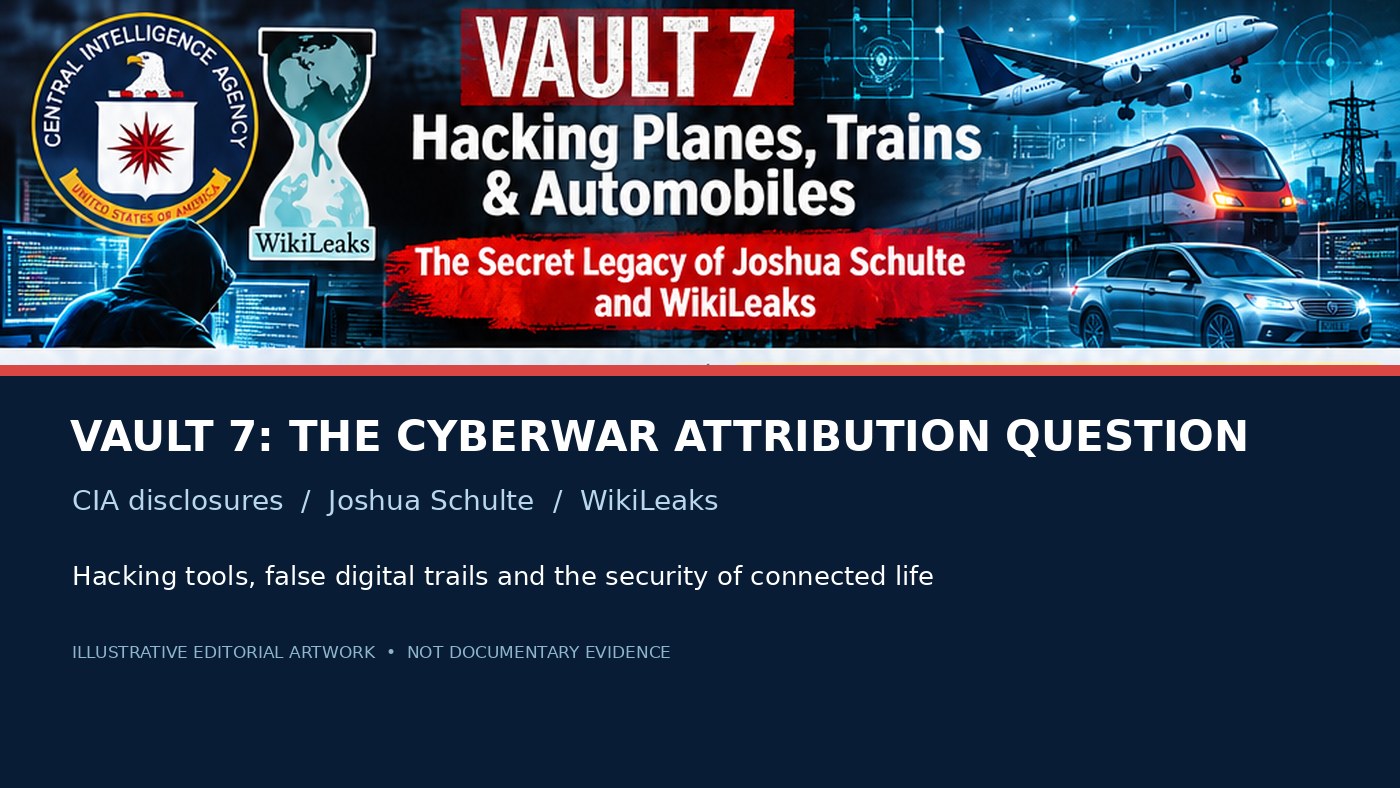
An AI-assisted editorial adaptation of a UK Column News Extra discussion featuring Charles Malet, Basil Valentine, Ben Timberley and journalist Tony Gosling.
The programme examined real CIA hacking disclosures alongside broader claims about intelligence activity, the commercial technology industry, AI-assisted crime and the resilience of modern infrastructure. This article distinguishes documented evidence from speaker interpretations and future scenarios.
When a Cyberattack Has a Convenient Suspect
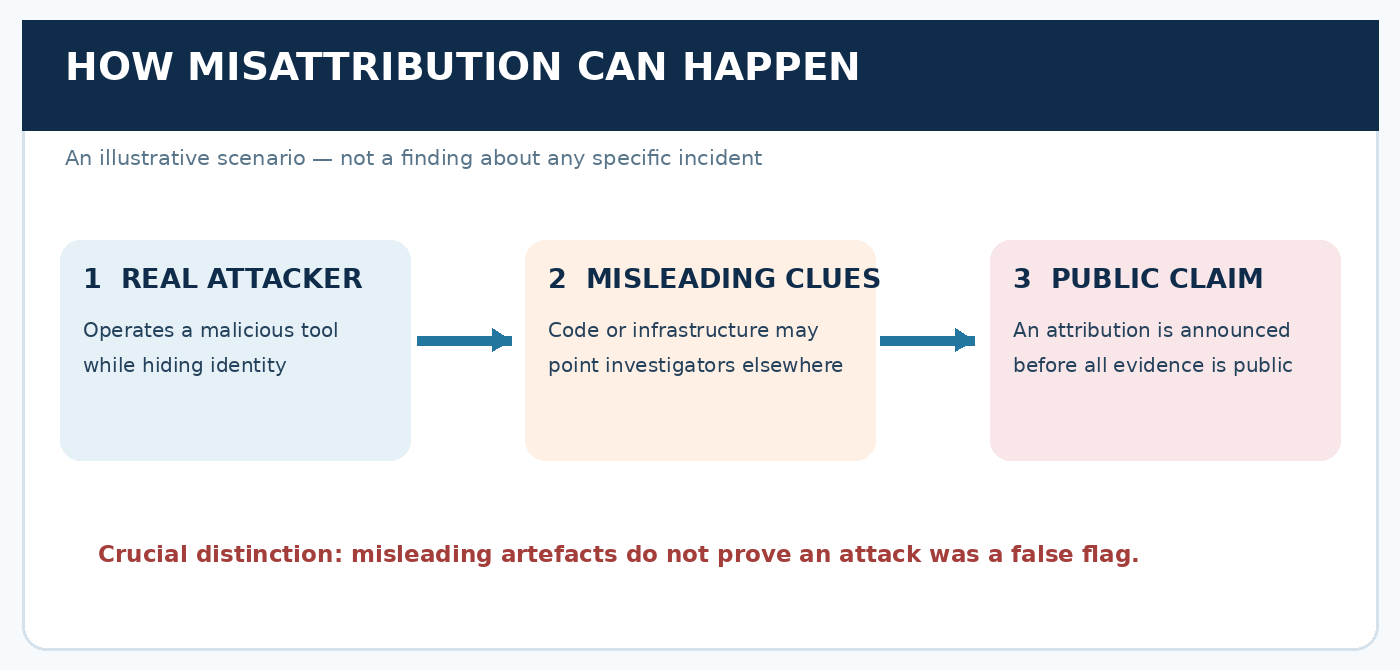
When a bank loses funds, a public agency suffers an intrusion or a critical system stops working, attention often turns quickly to the identity of the attacker. Russia, China, Iran and North Korea are frequently mentioned in public cyberwarfare debates. Yet investigators face a harder question: which traces identify the actual operator, and which traces could have been deliberately planted?
In a UK Column News Extra discussion, Tony Gosling highlighted the CIA documents released by WikiLeaks under the name Vault 7. Ben Timberley expanded the discussion to digital impersonation, network compromise and uncertainty surrounding attribution. Their central concern was that a confident public narrative does not always reveal the complete technical evidence behind it.
Joshua Schulte and the Vault 7 Leak
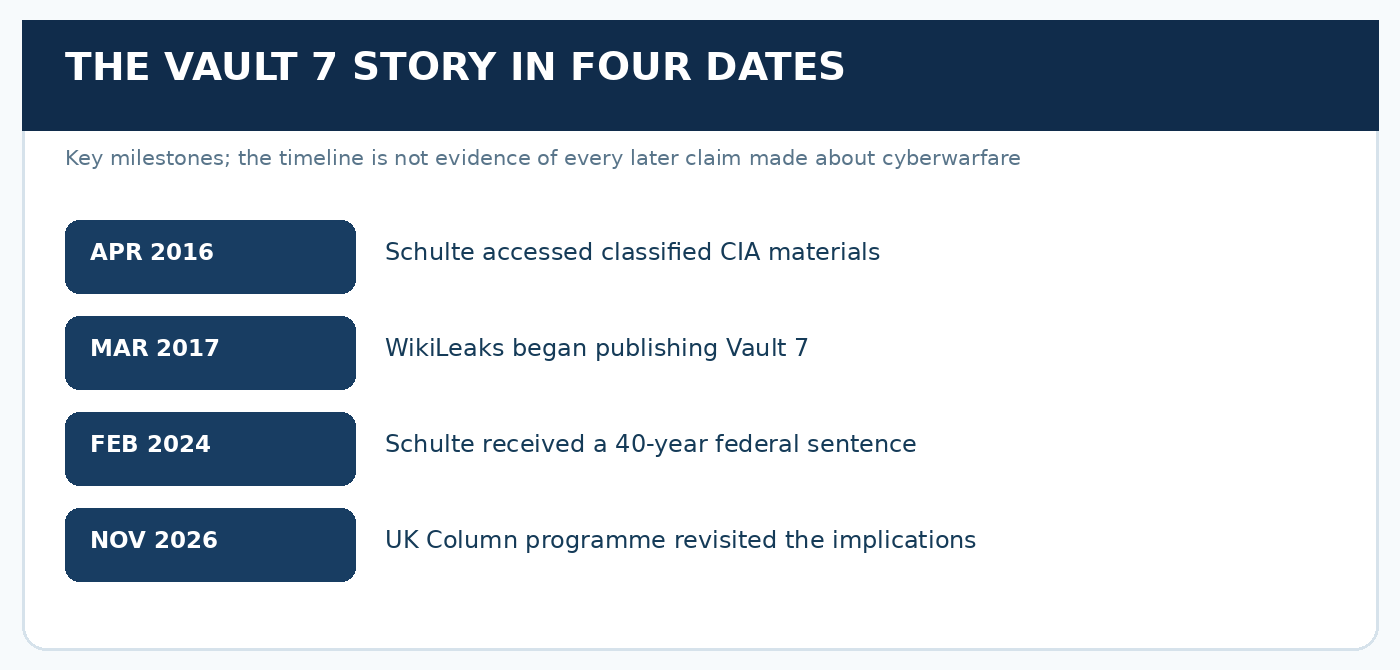
Joshua Adam Schulte was a software engineer at the CIA’s Center for Cyber Intelligence. US prosecutors said he stole classified cyber-tool development material in 2016 and provided it to WikiLeaks. The publisher began releasing Vault 7 documents in March 2017, offering an unusually detailed window into offensive intelligence software.
The disclosures described tools targeting computers, mobile devices, connected televisions and other technologies. In February 2024, Schulte was sentenced to 40 years in US federal prison for a group of offences that included espionage-related crimes and separate child-sexual-abuse-material offences. The legal record should not be reduced to a simple sentence for whistleblowing alone.
Gosling characterised the leak as historically important and compared its public implications with Edward Snowden’s revelations. That is his assessment of significance, not a legal equivalence between the two cases.
The Marble Framework: Can Digital Evidence Be Disguised?
One of the most widely discussed Vault 7 releases concerned Marble, a CIA obfuscation framework. Obfuscation changes how software appears to analysts and can make malicious code harder to understand or connect with known tools. WikiLeaks described language-related features that prompted speculation about whether forensic indicators could be made to resemble another origin.
Gosling argued that this matters because geopolitical claims about a cyberattack may have consequences ranging from public accusations to sanctions. Timberley similarly warned that code fragments, language clues and technical artefacts can be misleading. Their point raises a legitimate evidentiary problem: a trace found inside malware should not be treated as a national passport.
What Attribution Actually Requires
Cyber attribution is usually based on a combination of evidence: attack infrastructure, malware similarities, operational patterns, victim selection, human intelligence and other independently assessed information. A deceptive language marker alone rarely resolves responsibility. Equally, the discovery of obfuscation technology does not prove that any particular accusation against a government was false.
The strongest lesson from Marble is therefore methodological. Reporters should ask what evidence supports a specific attribution, which findings have been made public and what credible alternatives remain. Technical uncertainty is a reason for careful reporting, not for automatically reversing every official conclusion.
From Laptops to Trains, Cars and City Systems
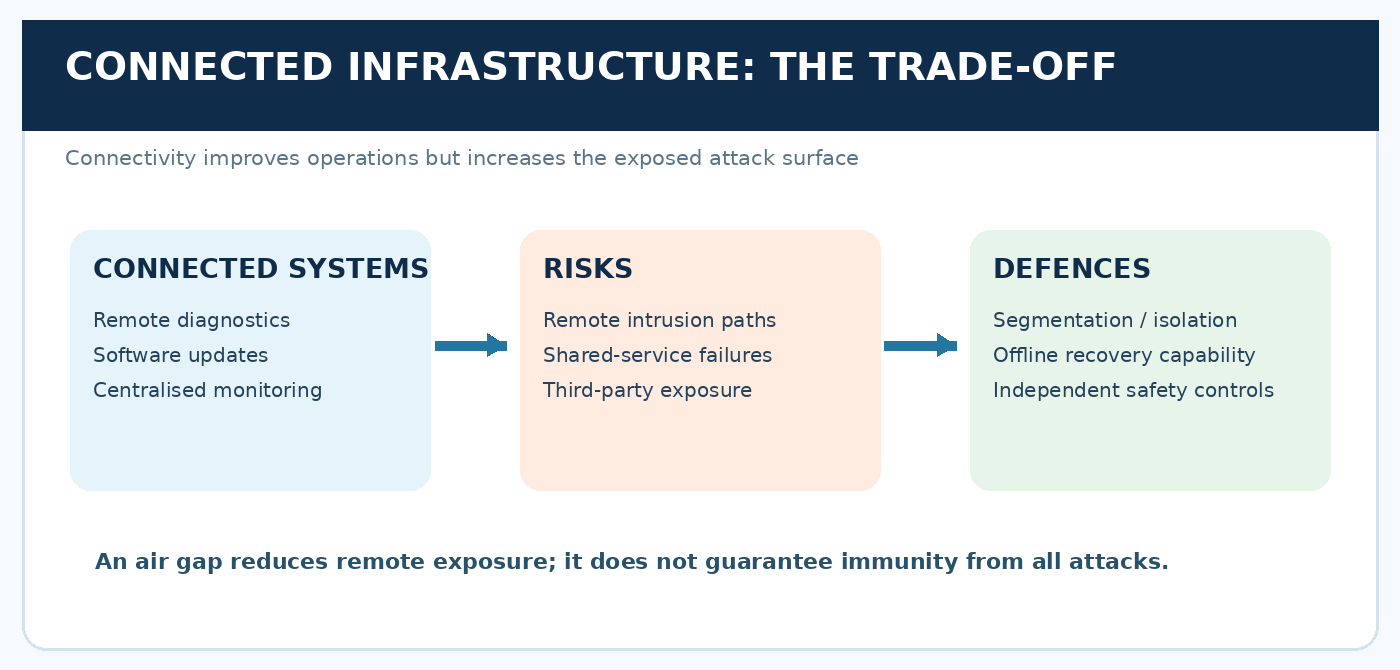
Gosling questioned why so many everyday devices and critical services need remote connectivity. The appeal of connected systems is clear: operators can monitor equipment, install software updates, coordinate transport and discover faults before they become dangerous. Those benefits come with a larger potential attack surface.
The UK Column conversation used planes, trains, cars, smart cities and even household appliances as examples of growing digital dependence. Vault 7 included references to vehicle-related technologies. However, those references do not establish that the CIA secretly took control of an aircraft or caused a specific transport incident. It is essential to separate interest in a capability, a laboratory demonstration and verified operational use.
Why Air Gaps and Offline Recovery Matter
An air-gapped system is separated from less trusted networks, which reduces opportunities for direct remote intrusion. Sensitive industrial networks may use isolation, restricted maintenance access and independent safety mechanisms. But separation is not invulnerability: removable drives, contractors, supply-chain software and compromised maintenance devices can still introduce risks.
For infrastructure that affects physical safety, the priority is layered defence. Software updates, limited privileges, segmented networks and rehearsed offline recovery can matter as much as any single cyber product. A system should be able to fail safely even when one digital component is compromised.
AI, Phishing and the Human Way Into a Network
The discussion also examined fears that artificial intelligence might make cyberattacks cheaper and faster. AI can help criminals generate convincing messages, automate analysis and experiment with potential software flaws. Nevertheless, it does not instantly defeat all encryption or render every password ineffective. Those outcomes depend on specific technical conditions.
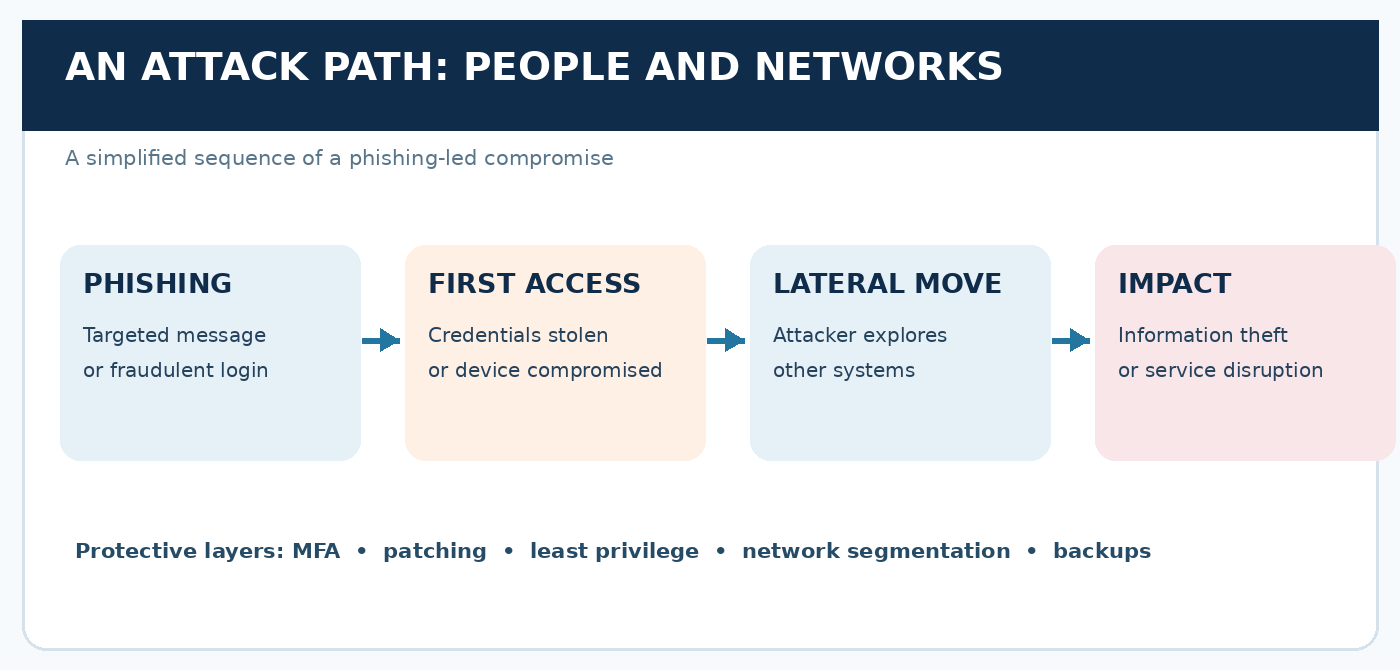
Timberley emphasised that a major compromise may begin with a person rather than a dramatic line of code. An employee can be deceived by a tailored email, fraudulent login page or convincing request. Once a valid account is stolen, an intruder may search for broader privileges and move between systems. This pattern is often called lateral movement.
Cryptocurrency and the Physical Risks of Digital Wealth
The participants discussed major cryptocurrency thefts and uncertainty about responsibility for high-value attacks. Some monetary figures in the spoken exchange were inconsistent, so they should not be repeated as verified figures. A large theft alone does not prove the identity of a government or organised criminal group.
A separate concern is more concrete: criminals can target the person who controls a wallet. Stolen credentials, fraudulent approvals, leaked personal information and even physical coercion can bypass otherwise sound security practices. Protecting digital assets therefore requires both technical safeguards and careful handling of personal identity and access.
Snowden, Pegasus and the Surveillance Question
The programme later connected Vault 7 to Edward Snowden’s disclosures about communications interception and to the controversy surrounding Pegasus spyware. The underlying concern is that the collection and exploitation of data can give governments and private technology providers considerable power over individuals.
But surveillance should not be confused with a universal defeat of cryptography. Strong end-to-end encryption can protect messages in transit. If spyware compromises a phone itself, the attacker may instead capture information before encryption or after it is displayed. Endpoint security and encryption solve related but different problems.
Politics, Technology Companies and Oversight
Gosling went on to argue that corporate networks, powerful technology executives and elite political organisations may exercise influence beyond ordinary democratic scrutiny. The discussion also ranged into historical claims about Bilderberg, political institutions and the origins of contemporary power. Those were interpretive arguments offered by speakers; this programme transcript did not establish the wider allegations as verified historical findings.
Timberley argued that scrutiny of surveillance and intelligence practices should cross conventional political divides. Whatever one’s political position, there is a practical question about public accountability: who authorises offensive cyber capabilities, who audits their use and what can citizens know when governments claim another state is responsible for a digital attack?
What Vault 7 Proves — and What It Does Not
Documented: Vault 7 publicly described CIA offensive cyber tools; the Marble material discussed obfuscation; Schulte was convicted and sentenced in a US federal case.
Technically plausible: An attacker can disguise some digital indicators, steal credentials through social engineering and exploit poorly secured connected systems.
Not established by this discussion: That a particular plane incident, rail disruption, cryptocurrency theft or state-attributed cyberattack was secretly caused by the CIA or any other named actor.
Conclusion: Who Can Verify the Digital Story?
Vault 7 remains important because it demonstrated how sophisticated offensive cyber capabilities can be developed inside intelligence organisations and how difficult their operations may be for outsiders to investigate. The disclosures sharpened questions about attribution, oversight and the dependency of public services on connected technology.
A useful response combines scepticism with evidence: do not accept an attribution without asking how it was reached; do not mistake a capability for proof that it was used; and do not assume that connected systems can be made secure by a single product. These lessons matter to journalists, policymakers and every organisation responsible for systems people rely upon.
Programme Attribution and Editorial Disclosure
Source programme: UK Column News Extra, a discussion featuring Charles Malet, Basil Valentine, Ben Timberley and guest journalist Tony Gosling. The source transcript supplied for this adaptation is approximately 39 minutes long. This article was prepared with AI assistance to organise and clarify the spoken discussion, with additional factual context supplied from public records. It is not a verbatim transcript or an endorsement by the programme participants.
Sources and Suggested Further Reading
- US Department of Justice (1 February 2024), Joshua Adam Schulte sentencing announcement: https://www.justice.gov/usao-sdny/pr/former-cia-officer-joshua-adam-schulte-sentenced-40-years-prison-espionage-and-child
- CIA (8 March 2017), public response to WikiLeaks claims: https://www.cia.gov/stories/story/cia-statement-on-claims-by-wikileaks
- WikiLeaks (March 2017), Vault 7 / Marble disclosures (primary-source material; assess with care).
- UK Column, UK Column News Extra cyber warfare tool leak programme: https://www.ukcolumn.org/extra/uk-column-news-extra-4th-november-2026
- US CISA, industrial control systems security resources: https://www.cisa.gov/topics/industrial-control-systems


Reader comments
Subscribers can join the conversationSign in to join the conversation. Comments are open to everyone with a free account.
Sign in or create accountLoading comments…