
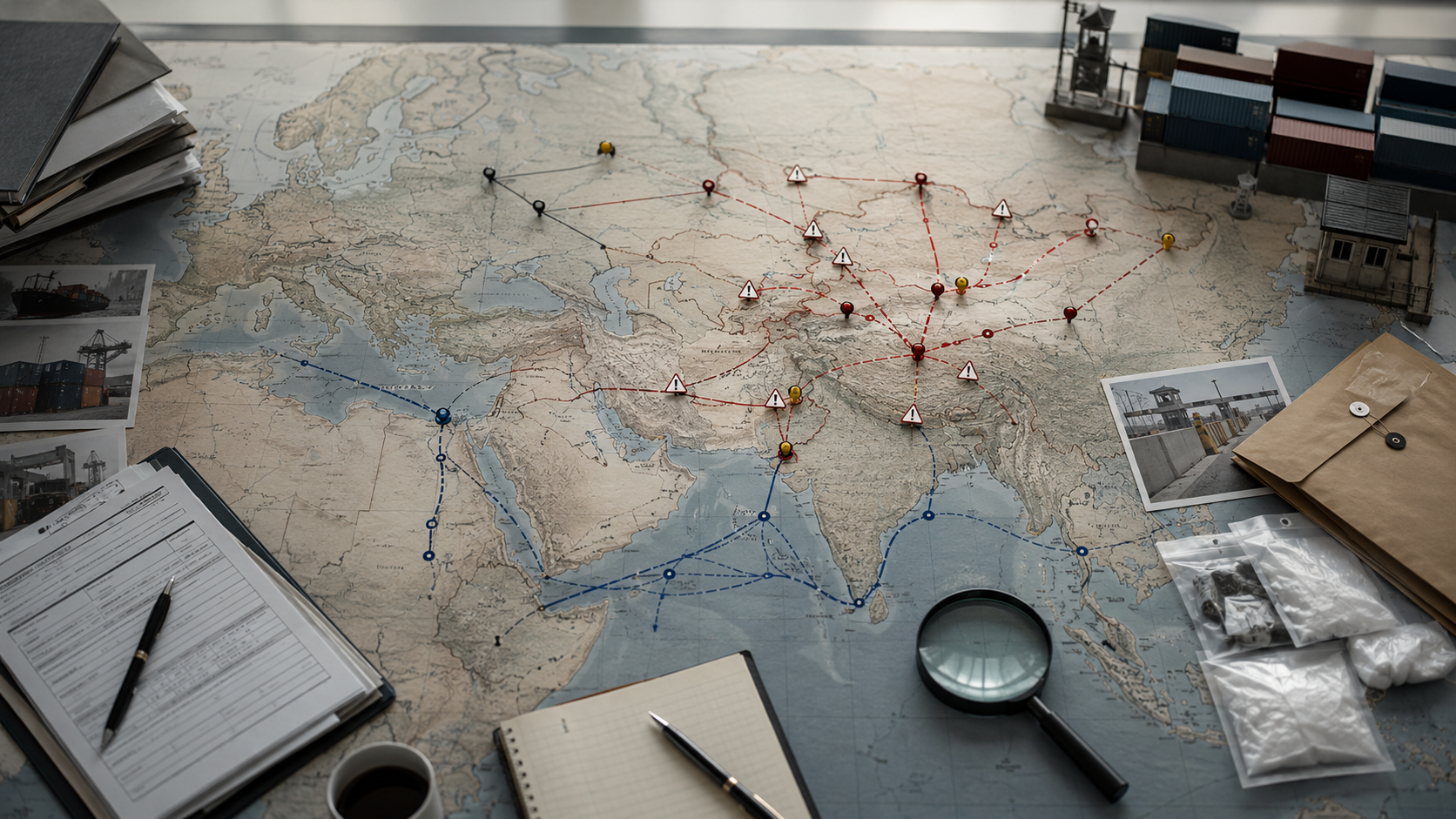
The publication of the United Nations Office on Drugs and Crime (UNODC) World Drug Report 2026 should serve as a wake-up call for policymakers across South and Central Asia.
While much of the international attention has focused on the rise of synthetic drugs, cocaine markets and fentanyl, the report also underscores a persistent reality: Afghanistan remains part to the global narcotics landscape, and Pakistan continues to occupy a critical central position as a transit corridor for illicit drugs destined for the Gulf, Africa and Europe.
Yet perhaps the most important lesson from this year's report is not simply about narcotics.
It is about policy failure.
For more than four years, the international community has largely chosen to isolate Afghanistan's de facto authorities.
Financial sanctions, frozen assets, diplomatic isolation and limited institutional engagement have severely constrained the country's ability to develop functioning state institutions capable of addressing complex transnational challenges, including narcotics trafficking.
At the same time, Pakistan has remained a major recipient of international security assistance, counter-narcotics cooperation and border management support over several decades.
Despite this extensive engagement, drug trafficking routes through Pakistan remain active, organised criminal networks continue to adapt, and the emergence of methamphetamine production in the region presents an entirely new challenge.
The contrast deserves serious examination.
Afghanistan's Constraints
Following the Taliban's return to power in August 2021, Afghanistan effectively became disconnected from much of the international financial system.
International recognition remains absent, sanctions continue to restrict economic activity, and many mechanisms of technical cooperation have either ceased or operate only on a limited humanitarian basis.
The Pakistani state has played a major role there with an intention to broker governance in Afghanistan and treat the country as a province, but the fiercely independent Afghans rejected all such endeavours by the Pakistani military led establishment.
However, these conditions inevitably affect the state's ability to police borders, investigate transnational criminal organisations, modernise customs systems, develop forensic capabilities and participate fully in international law enforcement cooperation.
Ironically, the same international community that expects Afghanistan to suppress one of the world's most sophisticated illicit economies has simultaneously restricted many of the tools that states normally require to combat organised crime.
This contradiction cannot be ignored.
Pakistan's Continuing Challenge
Pakistan, by contrast, has benefited for decades from extensive international cooperation in border security, customs modernisation, maritime surveillance, intelligence sharing and counter-narcotics programmes.
Pakistani military led Anti-Narcotics Force has received tens of millions in US Aid to fight drugs.
Nevertheless, the UNODC report indicates that trafficking networks continue to exploit routes leading through Pakistan towards the Arabian Sea and onward to international markets.
Meanwhile, the growth of methamphetamine production in the region demonstrates that criminal organisations are adapting faster than traditional enforcement mechanisms.
The report does not suggest that Pakistan is solely responsible for these trafficking networks, nor does it accuse Pakistani state institutions of complicity.
However, it does illustrate that decades of assistance have not eliminated Pakistan's strategic role in regional drug trafficking.
That raises an important policy question: if extensive international support has not fully addressed the problem in Pakistan, can continued isolation realistically be expected to solve it in Afghanistan?
From Heroin to Methamphetamine
Perhaps the most significant finding of the 2026 report is the changing nature of the narcotics economy.
Following the ban on poppy cultivation by the current Government of the Islamic Emirate of Afghanistan, opium production declined sharply.
However, stockpiles accumulated before the ban continue to feed international heroin markets, while traffickers have increasingly diversified into synthetic drugs, particularly methamphetamine.
Unlike heroin, methamphetamine production does not depend upon large-scale cultivation.
Small clandestine laboratories can be established rapidly, relocated easily and concealed more effectively.
This makes the emerging threat significantly more difficult to combat using traditional agricultural eradication strategies.
Addressing this challenge requires sophisticated intelligence sharing, precursor chemical controls, financial investigations and coordinated cross-border policing.
These are precisely the areas where international cooperation is indispensable.
A Regional Problem Requires Regional Solutions
Drug trafficking has never respected political boundaries.
Trafficking routes linking Afghanistan, Pakistan, Iran, Central Asia and the Arabian Sea operate as integrated transnational networks.
Criminal organisations exploit differences in governance, border controls and legal systems.
Attempting to isolate one of the principal countries within this regional system while expecting effective multinational enforcement is strategically inconsistent.
Whether governments recognise the current authorities in Kabul or not, they remain the de facto administration exercising control over Afghan territory.
Practical engagement on counter-narcotics, border management, customs cooperation and intelligence sharing need not imply political endorsement.
Rather, it reflects the reality that effective transnational crime prevention requires functioning counterparts on all sides of a border.
Towards a More Realistic Policy
The international community should therefore consider separating political recognition from functional cooperation.
This could include:
• expanding technical engagement between UNODC and Afghan institutions;
• supporting joint regional counter-narcotics initiatives involving Afghanistan, Pakistan and neighbouring states;
• strengthening mechanisms for precursor chemical monitoring;
• improving information sharing on organised criminal networks;
• enabling Afghanistan to participate more fully in international anti-narcotics frameworks.
Such engagement would not resolve broader political disagreements over governance or human rights.
Those issues remain important and should continue to be addressed through diplomatic channels.
However, narcotics trafficking is a shared security challenge.
Criminal organisations benefit when states are isolated from one another.
Conclusion
The UNODC World Drug Report 2026 demonstrates that the regional narcotics economy is evolving rather than disappearing.
Heroin stockpiles remain significant, methamphetamine is expanding, organised crime is becoming increasingly sophisticated, and trafficking networks continue to exploit regional instability.
These realities suggest that isolation alone is unlikely to produce better outcomes.
If the international community genuinely seeks to reduce narcotics production and trafficking, it should reconsider whether excluding Afghanistan from normal international counter-narcotics cooperation serves that objective.
Constructive engagement with Kabul's de facto authorities—focused specifically on technical cooperation, law enforcement coordination and regional security—may prove more effective than continued isolation.
The fight against transnational organised crime requires functioning partners on every side of a border.
Without that cooperation, criminal networks will continue to exploit the very political divisions that states have created.
Reader comments
Subscribers can join the conversationSign in to join the conversation. Comments are open to everyone with a free account.
Sign in or create accountLoading comments…