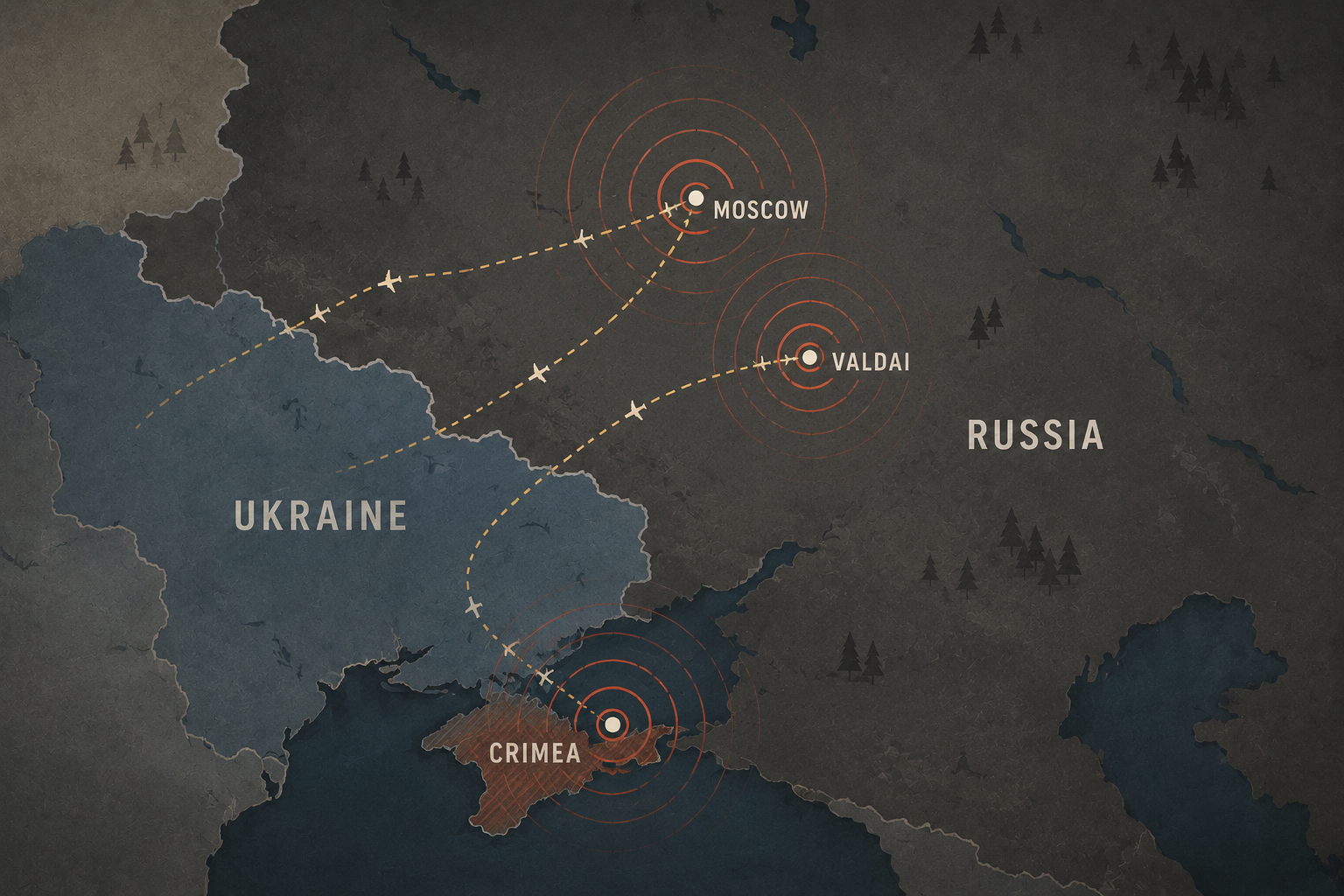
Ukraine says its deep-strike campaign inside Russia is forcing Moscow to move air defence systems away from other regions and concentrate them around politically sensitive sites including Moscow, Valdai and the Kerch Bridge.
President Volodymyr Zelenskyy made the claim in a statement published by his office on Thursday after a briefing from Ukraine's defence intelligence chief. He said Ukrainian strikes had reached gas facilities in the Orenburg region, military production facilities in Voronezh and Cheboksary, Baltic Fleet ammunition depots near St Petersburg, oil facilities and Russian military communications centres.
The most significant part of the statement was not only the list of targets, but Ukraine's assertion that the strikes are changing Russian defensive priorities. Zelenskyy said Moscow had amassed hundreds of launchers for S-400, S-500 and Pantsir systems in the Moscow region and moved nearly 90 launchers to Valdai, where President Vladimir Putin is known to have a residence.
Those figures cannot be independently verified from the public record. Russia has not confirmed the scale of any redeployment, and battlefield claims from either side often mix confirmed strikes with intelligence assessments and political messaging. But the statement gives a clear picture of how Kyiv wants the campaign understood: not as isolated attacks, but as a strategy designed to stretch Russian air defences, disrupt logistics and raise the cost of continuing the war.
If accurate, the redeployments would point to a central problem for Russia. The country has a vast territory, a large number of industrial and military sites, and a limited supply of advanced air-defence systems. Protecting Moscow, Putin-linked locations and the Kerch Bridge may leave energy facilities, logistics hubs and regional cities more exposed.
Ukraine has increasingly used long-range drones and missiles to attack oil, gas, arms-production and logistics targets far from the front line. Kyiv describes the strikes as a defensive response to Russia's missile and drone attacks on Ukrainian cities and energy infrastructure. Moscow routinely denounces such attacks and says it intercepts many Ukrainian drones, but Russian regional authorities have repeatedly reported fires, airport disruptions and emergency measures after Ukrainian strikes.
The strategic question is whether Ukraine can turn disruption into sustained military pressure. A temporary fire at a refinery or communications site may have limited effect. Repeated strikes that force Russia to reallocate scarce air defences, slow fuel movement, or protect elite locations at the expense of military logistics could matter more.


Reader comments
Subscribers can join the conversationSign in to join the conversation. Comments are open to everyone with a free account.
Sign in or create accountLoading comments…