
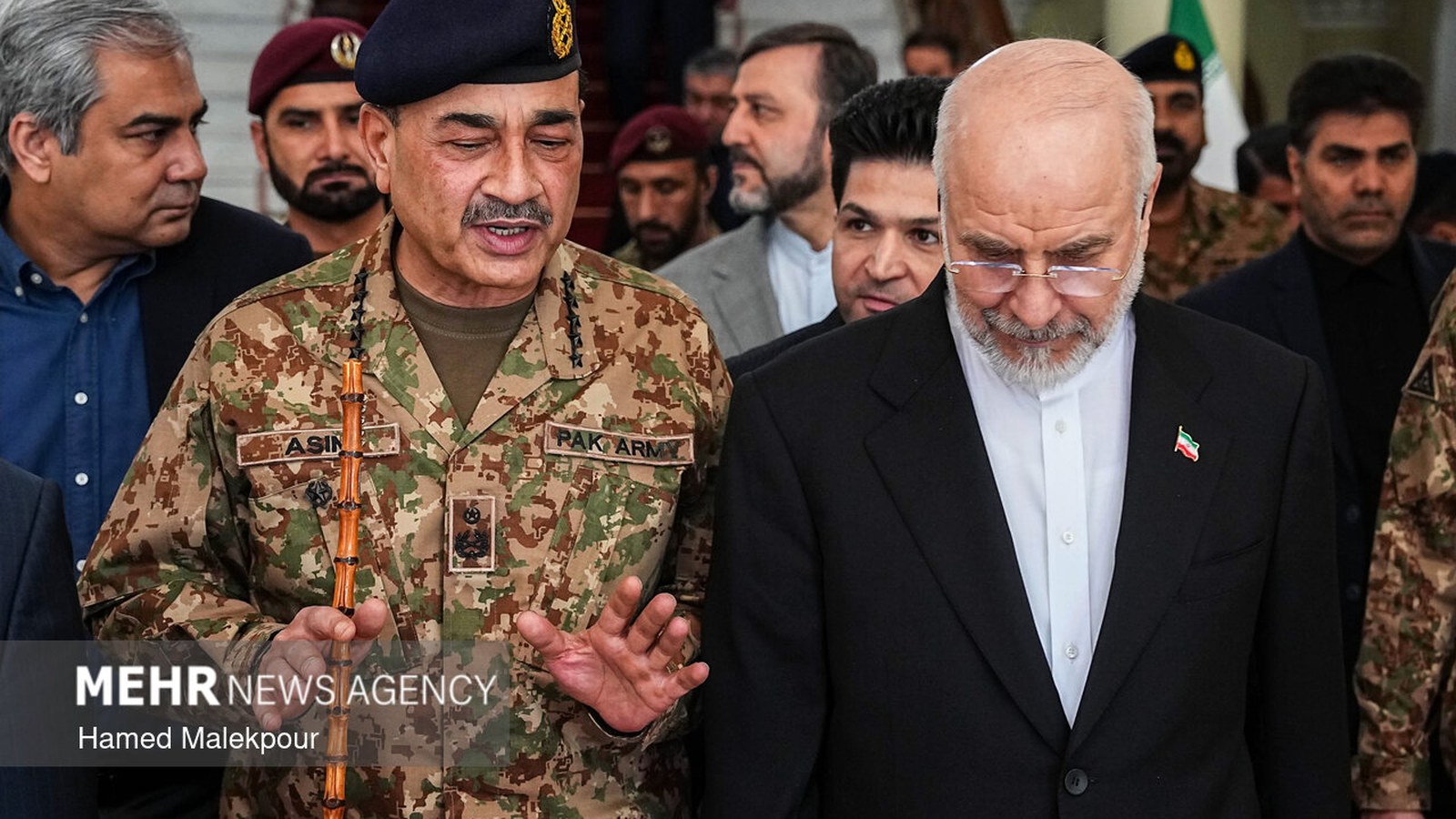
The most revealing feature of Field Marshal Asim Munir’s visit to Tehran may not be what appeared in the official communiqués. It may be what disappeared from them.
Before Munir arrived, Reuters reported, citing a Pakistani government source, that his discussions would cover not only the stalled American-Iranian peace process and President Donald Trump’s threatened sanctions, but also two exceptionally sensitive subjects: the recently concluded defense agreement among Pakistan, Saudi Arabia and Türkiye, and Iran’s relationship with the Houthis.
Yet neither subject appeared in the detailed Pakistani and Iranian accounts issued after the visit. Those statements concentrated almost exclusively on de-escalation, reopening the Strait of Hormuz and restoring the Islamabad memorandum between Washington and Tehran.
That omission does not prove the existence of a secret negotiation. But when an issue is specifically identified before a high-level mission and then entirely absent from the subsequent record, it merits scrutiny—particularly when that issue concerns a newly established military alliance whose first potential test may involve an Iran-aligned armed movement.
Munir’s visit was almost certainly operating on two levels.
The visible and immediate level concerned Trump, Iran and the threat of a wider war. Munir had spoken with Trump shortly before travelling to Tehran, according to Reuters. Washington was preparing its latest economic offensive against Iran, Tehran was threatening further disruption in the Persian Gulf, and the fragile Islamabad understanding had effectively stalled.
Munir therefore arrived as a recognized intermediary carrying access to both sides. This function was real. It should not be dismissed as a wholly manufactured pretext.
But it may not have been the complete mission.
The deeper level concerned the regional order that could emerge after the present conflict—and whether Iran would be contained by that order, accommodated within it or eventually invited to help shape it.
The chronology is striking.
On June 23, during an earlier meeting with Munir, Iranian President Masoud Pezeshkian publicly advocated the creation of a “powerful bloc” of major Muslim countries capable of confronting common threats. Iran’s official presidential account reported Munir responding that Pakistan believed no Muslim country should be allowed to suffer harm. Iranian Presidency
Less than seven weeks later, Saudi Arabia, Türkiye and Pakistan signed the Makkah Joint Defence Agreement.
The agreement created a potentially formidable strategic nucleus: Saudi financial power and geographic centrality; Türkiye’s large, NATO-trained military and expanding defense industry; and Pakistan’s armed forces, strategic location and nuclear capability. Its central provision declares that an armed attack against any one of the three states will be considered an attack against all. Pakistan Foreign Ministry
Turkish Foreign Minister Hakan Fidan subsequently disclosed that the arrangement would be supported by regular meetings of foreign ministers, defense ministers and military chiefs, together with a permanent secretariat in Saudi Arabia. Assistance could range from intelligence and logistics to the deployment of forces. Crucially, both Türkiye and Pakistan stated that the agreement was open to additional countries. Saudi Gazette
Three weeks after its creation, Pakistan’s most powerful military figure travelled to Tehran. He was accompanied not merely by diplomats but by Interior Minister Mohsin Naqvi, whose portfolio encompasses internal security, intelligence coordination and border-related threats. The composition of the delegation was suited as much to hard-security consultations as to conventional diplomacy.
The intriguing possibility is that Munir was not offering Iran immediate membership in the Makkah agreement. Such an offer would be almost impossible under present conditions.
Iran remains engaged in an unresolved conflict with the United States and Israel. Admitting Tehran into a pact declaring that an attack on one member is an attack on all could immediately oblige Saudi Arabia, Türkiye and Pakistan to confront Washington or Israel. It could also expose them to Iran’s confrontations through the Houthis and other aligned groups.
The more realistic objective would be to bind Iran gradually, without making it a full treaty member.
The first step would be strategic notification. Tehran would need to understand how the new alliance interprets Houthi attacks on Saudi territory, energy infrastructure and shipping. Such attacks could no longer be treated solely as an extension of the Saudi-Yemeni conflict. They could trigger consultations among three states, including two major military powers.
Munir may therefore have carried both an assurance and a warning: the pact is not inherently directed against Iran, but continued attacks by forces aligned with Tehran could transform it into precisely such an alliance.
The second step could involve an associated security arrangement rather than membership. Iran might be offered participation in a regional nonaggression framework, a crisis-management mechanism or selected consultations with the Makkah secretariat. In return, Tehran would be expected to restrain the Houthis and other aligned forces, respect agreed maritime rules and provide assurances against attacks on the pact’s members.
The third step would be to connect this political understanding with the Iran-Oman negotiations over Hormuz. Oman could manage the technical and navigational arrangements, while Pakistan linked those arrangements to the broader political and security framework. Reopening Hormuz would then become more than a commercial concession: it would be the maritime foundation of a new regional security compact.
Only after a durable ceasefire and verifiable restraint by Iran-aligned groups could Tehran contemplate a more formal association.
This possibility is not as improbable as it first appears. Iran’s initial response to the Makkah agreement was notably restrained. Some Iranian officials interpreted it less as an anti-Iranian coalition than as evidence of a declining American security monopoly in the region. Iranian analysts have acknowledged that Tehran’s future participation could become conceivable if the alliance evolved from a balancing coalition into a broader regional architecture. Al Jazeera
That ambiguity may be intentional. The pact can perform two opposite functions.
Against an unreconciled Iran, it provides Saudi Arabia with collective deterrence and raises the potential cost of attacks by Iran or its regional partners. With a cooperative Iran, it can become the nucleus of a wider Muslim security system—one capable of balancing not only Tehran, but also Israel and excessive dependence on the United States.
This is where Munir’s role becomes especially intricate.
Saudi Arabia could not easily approach Iran about joining or associating with an agreement partly inspired by Iranian-aligned attacks. Türkiye could conduct such discussions, but its NATO membership and regional ambitions produce their own suspicions. Pakistan, however, possesses military credibility with Saudi Arabia, deep ties with Türkiye, working relations with Tehran and unusual access to Trump.
Munir could therefore present different but not necessarily incompatible aspects of the same initiative to each capital. To Washington, the pact could be described as regional burden-sharing. To Riyadh, it is additional protection against Iran and the Houthis. To Ankara, it is the beginning of a more autonomous regional order. To Tehran, it could be presented as a choice between exclusion and carefully conditioned participation.
The deception—if that is the appropriate word—would not be that the American-Iranian mediation was fictitious. It would lie in presenting that mediation as the whole mission.
Trump may have believed he was dispatching or encouraging a trusted intermediary to deliver Washington’s expectations. Munir may simultaneously have been using that mandate to explore an architecture that could eventually move Washington farther from the center of regional security.
Publicly acknowledging such discussions would have been dangerous for everyone involved. Iranian hardliners would condemn engagement with a Sunni-led military bloc. Saudi constituencies would question any accommodation of the state associated with attacks on the kingdom. Washington would be wary of an autonomous security structure involving Iran. Israel would view an alignment connecting Iran, Türkiye and nuclear-armed Pakistan as a profound strategic challenge.
Strategic silence was therefore indispensable.
The available evidence does not establish that Iran was invited to become the pact’s fourth member. It does, however, support a more measured hypothesis: Munir’s Tehran mission explored how Iran might be deterred by, constrained through or eventually associated with the new trilateral framework.
The public negotiations concerned ending the present war. The concealed discussions may have concerned who will organize the peace that follows it.
If Iran eventually appears in consultations connected to the Makkah secretariat—perhaps initially through a nonaggression, maritime-security or observer arrangement—the significance of Munir’s one-day visit will have to be reassessed. It will not be remembered principally as another inconclusive diplomatic shuttle between Trump and Tehran.
It may instead be remembered as the first negotiation over Iran’s place in a new regional order.

Reader comments
Subscribers can join the conversationSign in to join the conversation. Comments are open to everyone with a free account.
Sign in or create accountLoading comments…