

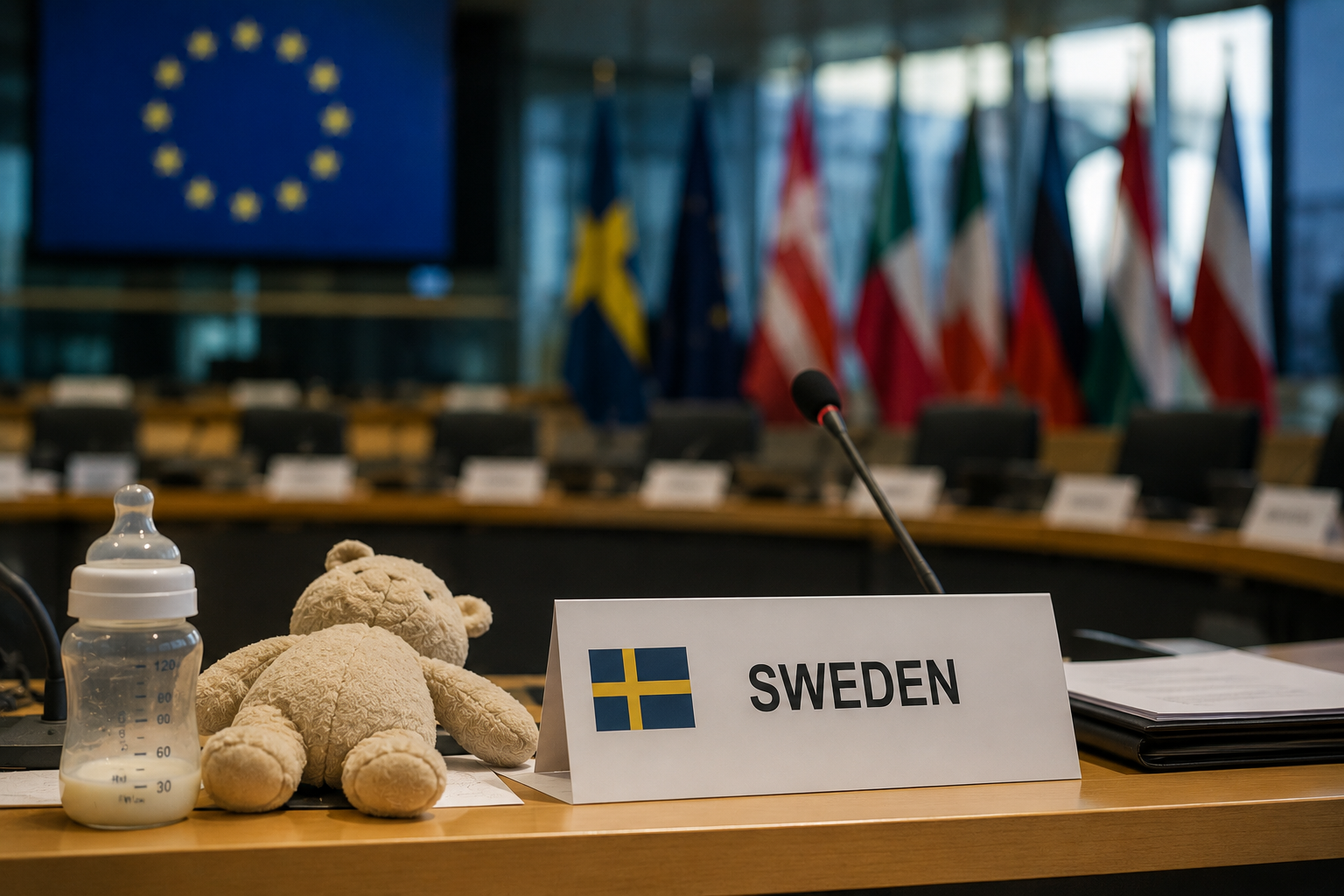
Sweden’s Climate and Environment Minister Romina Pourmokhtari has drawn international attention after attending a European Union ministers’ meeting in Luxembourg with her three-month-old son, Adam.
What might otherwise have been a routine gathering of environment and climate ministers became a symbolic moment in the debate over parental leave, workplace flexibility and the place of parents in high-level political life.
Pourmokhtari’s appearance with her baby was not only personal. It was political. By bringing her son into a formal EU setting, the Swedish minister placed one of Sweden’s most recognisable social policies — generous parental leave — at the centre of a European conversation about family, work and public leadership.
A Baby at the EU Table
The meeting in Luxembourg brought together ministers responsible for environment and climate issues from across the European Union. Pourmokhtari attended shortly after returning to her ministerial duties following a period of parental leave.
Her son’s presence quickly became the story.
Reports from the meeting described the moment as unusual, even historic, with an EU Council official reportedly saying it was the first known occasion on which a baby had attended a meeting of EU ministers.
For Pourmokhtari, the message was clear: parenthood and public office should not be treated as incompatible. Her decision was widely interpreted as a statement that women, including those in senior political roles, should not be forced to choose between professional responsibility and family life.
Sweden’s Parental Leave Model
The moment resonated partly because Sweden has long been associated with one of the world’s most generous parental leave systems.
Parents in Sweden are entitled to 480 days of parental benefit for one child. Most of those days are linked to income, while the remaining days are paid at a minimum level. The system is designed to allow families to share care responsibilities and to encourage both mothers and fathers to take time away from work after the birth of a child.
This model reflects a broader Swedish approach to family policy: childcare, parental leave and workplace participation are treated not as private burdens but as public questions that affect equality, economic life and social stability.
Pourmokhtari’s appearance in Luxembourg gave that policy a human face. Rather than discussing parental leave in the abstract, she demonstrated what political participation can look like when institutions allow space for family life.
A Wider Debate About Working Parents
The image of a minister carrying her infant into an EU meeting also touched a wider question facing governments, companies and public institutions across Europe: who gets to remain in leadership after becoming a parent?
For many women, motherhood still carries professional penalties. Careers can slow down, promotions can become harder, and assumptions about availability or commitment can shape how mothers are treated in the workplace. Fathers, too, can face pressure not to take parental leave, especially in political or corporate cultures where long hours are seen as proof of seriousness.
That is why the symbolism of the Luxembourg meeting mattered. Pourmokhtari was not simply attending with her child. She was challenging the idea that political leadership must be built around a model of work that assumes the absence of caregiving responsibilities.
Her appearance suggested a different standard: one in which institutions adapt to the realities of family life rather than expecting parents to disappear from public responsibility.
Politics, Symbolism and Criticism
The gesture was widely praised by supporters who saw it as a practical demonstration of gender equality and modern parental policy.
But it also triggered debate. Public reactions to such moments often reveal the cultural divide around parenthood and work. Some see a baby in a political setting as a powerful symbol of inclusion. Others argue that formal government meetings should remain separate from family life.
That tension is precisely why the moment attracted attention. It forced a public conversation about assumptions that often remain invisible: who is expected to care, who is allowed to lead, and what kinds of workplaces are considered “professional”.
In Sweden, where parental leave is deeply embedded in the welfare model, Pourmokhtari’s choice may appear less radical than it would in many other countries. Yet even there, the presence of a baby at an EU ministerial meeting challenged the formality of political institutions.
Europe’s Family Policy Challenge
Across Europe, governments are increasingly concerned about declining birth rates, ageing populations and the economic pressures facing young families. Policymakers often speak about the need to support parents, expand childcare and help women remain in the workforce.
Yet the lived reality for many families remains difficult. Paid leave, affordable childcare, flexible work and equal treatment for parents vary widely between countries and workplaces.
The Swedish example does not solve every problem. Sweden itself continues to debate gender equality, labour market pressures and the practical limits of family policy. But its parental leave system remains one of the clearest examples of how the state can reduce the conflict between work and caregiving.
Pourmokhtari’s appearance in Luxembourg turned that policy into a visible political message.
Why the Moment Matters
The significance of the episode lies less in the novelty of a baby entering a meeting room and more in what that image represents.
Politics is often presented as a space of total availability, where leaders are expected to operate as though family life does not exist. That expectation has historically made public life harder for parents, especially mothers.
By attending the EU meeting with her son, Pourmokhtari challenged that tradition. She showed that leadership and caregiving can coexist, provided institutions are willing to make room for both.
The moment also highlighted a broader truth: social policy is not only about laws written on paper. It is about whether those laws change the way people are able to live, work and participate in public life.
Conclusion
Romina Pourmokhtari’s decision to bring her baby to an EU ministers’ meeting was a small moment with a larger message.
It drew attention to Sweden’s parental leave system, but it also raised a wider question for Europe and beyond: are modern institutions genuinely built for working parents, or do they still expect family life to remain hidden outside the room?
For Sweden’s climate minister, the answer was visible in Luxembourg. Parenthood was not treated as an obstacle to public duty. It was part of the reality of leadership.
That is why the image travelled so far. It was not only about one minister and one child. It was about the kind of political culture societies choose to build — and whether power can make space for care.

Reader comments
Subscribers can join the conversationSign in to join the conversation. Comments are open to everyone with a free account.
Sign in or create accountLoading comments…