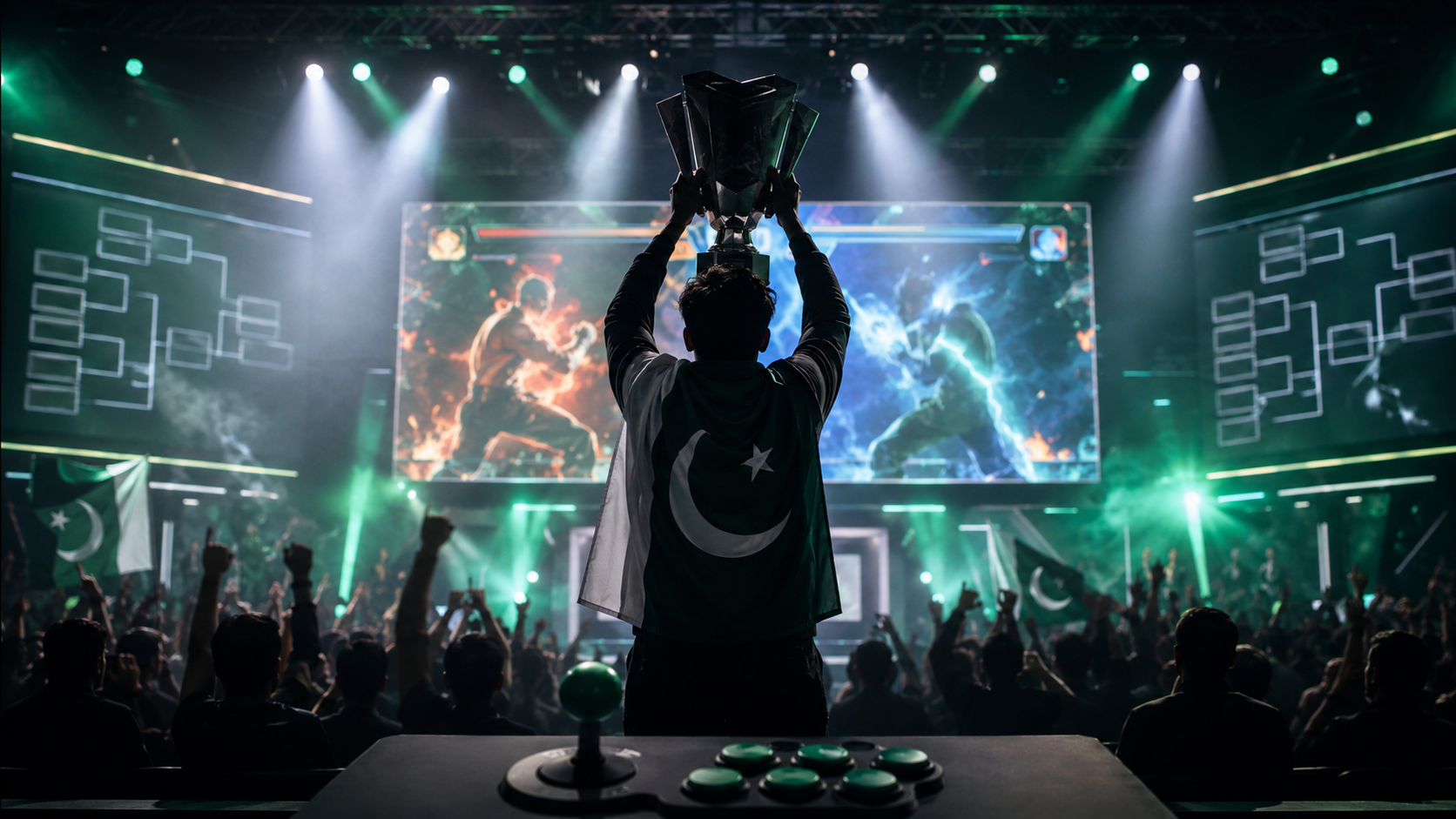
Pakistan’s Arslan Ash has added another landmark achievement to one of the most decorated careers in fighting-game history, winning the Tekken 8 title at Evo 2026 in Las Vegas and claiming the eighth Evolution Championship Series crown of his career.
The victory came against South Korea’s Rangchu in the grand final, giving Arslan another major international title and reinforcing his position as one of the defining players of modern competitive Tekken.
For Pakistan, the result is more than an individual sporting triumph. It is another reminder that the country has become one of the most important forces in global Tekken, producing elite players who now compete and win on the biggest stages in esports.
A Historic Eighth Evo Crown
Arslan Ash, whose full name is Arslan Siddique, has spent years building a reputation as one of the most disciplined and tactically intelligent players in the fighting-game community.
His latest victory at Evo 2026 strengthens that legacy.
Evo is widely regarded as one of the most prestigious events in fighting games. Winning once can define a player’s career. Winning repeatedly across different years, different versions of Tekken, and against changing generations of opponents places a player in a much smaller category.
Arslan’s eighth Evo title confirms that his dominance has not been limited to a single game cycle or a single moment in the competitive scene. He has remained at the top through the transition from Tekken 7 to Tekken 8, continuing to adapt as the game, its mechanics and its global competition have evolved.
Pakistan’s Esports Moment
Arslan’s rise has also changed how Pakistan is viewed within esports.
For years, Pakistan’s fighting-game scene developed largely outside the full glare of the international spotlight. Local arcades, community tournaments and regional rivalries produced a generation of players who were highly skilled but often underrepresented on the global stage.
Arslan helped change that.
His international success brought attention to Pakistan’s Tekken community and opened the door for wider recognition of players who had been competing at an elite level with fewer resources than many of their international rivals.
The latest Evo result continues that story. It shows that Pakistan’s success in Tekken is not a one-off phenomenon built around a single upset or breakthrough tournament. It is now part of the structure of the global game.
Another Pakistani player, Qasim Meer, also finished strongly at Evo 2026, underlining the depth of talent coming from the country’s competitive Tekken scene.
A Career Built on Adaptation
Part of Arslan’s greatness lies in his ability to adapt under pressure.
In high-level Tekken, success depends on more than speed or execution. Players must read patterns, manage spacing, understand risk, and adjust constantly during long tournament runs.
Arslan has become known for precisely that kind of control. His style often combines patience, defensive awareness and sharp decision-making, allowing him to slow matches down and force opponents into mistakes.
That approach has made him especially dangerous in grand finals, where mental discipline can matter as much as mechanical skill.
His win over Rangchu again showed why he remains so difficult to beat at the highest level. Against another elite player, Arslan was able to manage pressure, respond to momentum shifts and close out the tournament when the title was within reach.
Why This Win Matters
The significance of the victory goes beyond another trophy.
Arslan Ash is no longer simply a successful Pakistani esports player. He is now part of the broader conversation about the greatest fighting-game players of all time.
His record across Evo events places him among the most accomplished competitors in the history of the genre. More importantly, his success has helped shift the geography of competitive Tekken.
For a long time, Japan, South Korea, Europe and the United States were seen as the main centres of elite fighting-game competition. Pakistan’s emergence disrupted that map.
Arslan’s continued success has forced the wider esports world to recognise that talent can emerge from communities with limited infrastructure, limited sponsorship and fewer institutional pathways into professional gaming.
That is part of what makes his career so important. He has not only won titles. He has changed perceptions.
The Bigger Picture for Pakistani Gaming
Pakistan’s esports industry still faces major challenges.
Players often lack consistent funding, professional training facilities, travel support and long-term institutional backing. Many have had to rely on personal sacrifice, community support and international sponsors to compete at the highest level.
Yet results like Arslan’s eighth Evo title show what is possible when talent is given the chance to reach the global stage.
His success should strengthen calls for greater investment in esports infrastructure, including training spaces, tournament circuits, sponsorship opportunities and pathways for young players who see competitive gaming as more than a hobby.
Pakistan has already proved it can produce world-class Tekken players. The question now is whether the country can build the systems needed to support the next generation.
A Legacy Still Growing
Arslan Ash’s latest win adds another chapter to a career that has already reshaped competitive Tekken.
Eight Evo titles would be enough to secure any player’s legacy. But Arslan’s career still appears far from finished.
With Tekken 8 continuing to develop and the global competitive calendar growing, he remains one of the players every major rival must prepare for. His presence in any bracket changes expectations. His name carries pressure. His record demands respect.
For Pakistan, his victory in Las Vegas is another moment of international sporting pride.
For esports, it is further proof that the fighting-game world is no longer defined by old centres of power alone.
And for Arslan Ash, it is another reminder that greatness is not built through one victory, but through the ability to keep winning when the world already knows how dangerous you are.


Reader comments
Subscribers can join the conversationSign in to join the conversation. Comments are open to everyone with a free account.
Sign in or create accountLoading comments…