
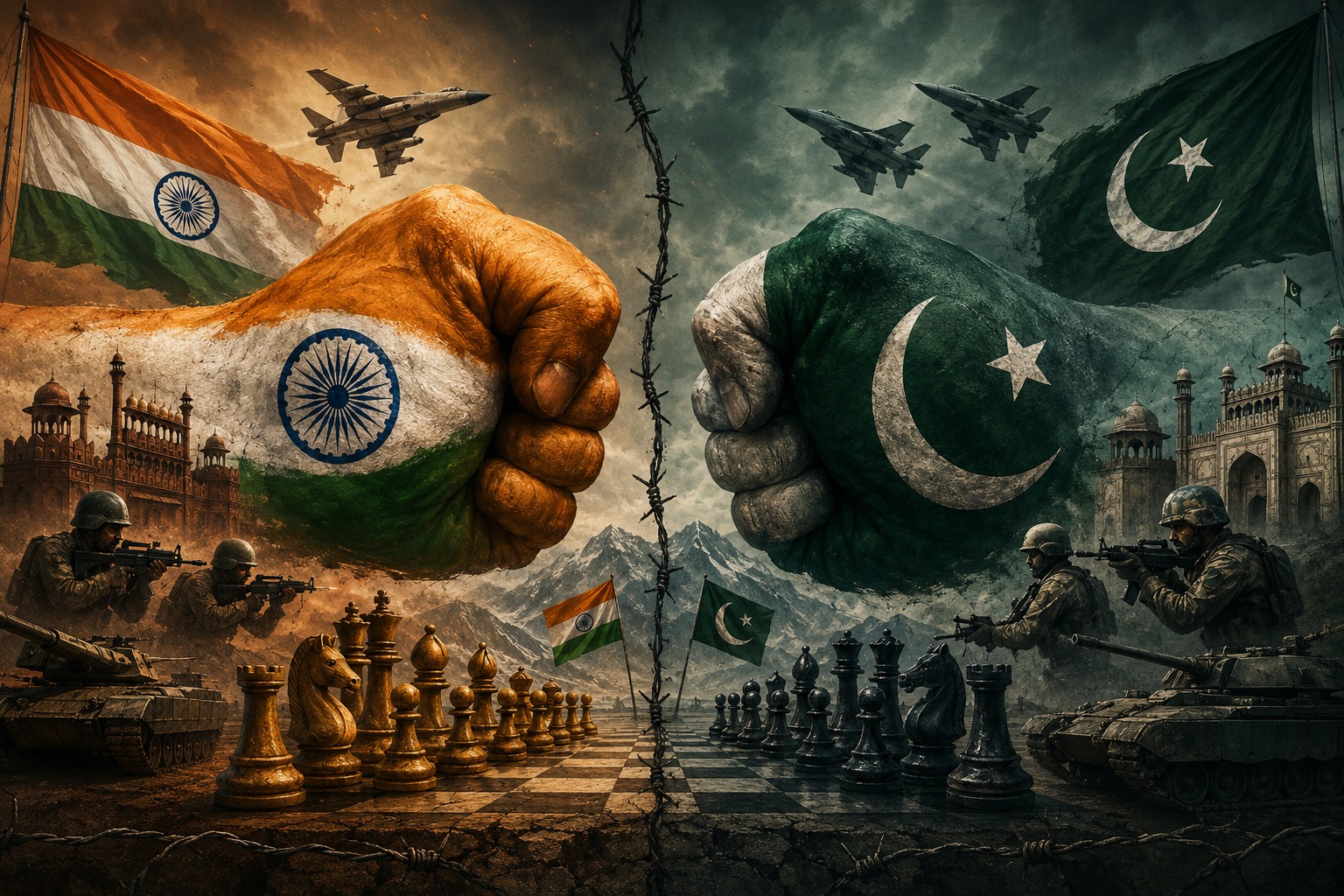
A diplomatic controversy has emerged following reports that senior Indian and Pakistani representatives participated in a closed-door Track-1.5 dialogue in Colombo under the auspices of the International Institute for Strategic Studies (IISS), only for elements of both sides to subsequently distance themselves from the meeting publicly.
While Pakistan's Foreign Office has reportedly stated it is unaware of any such India-Pakistan dialogue, and senior RSS leader Ram Madhav has rejected media portrayals of the event as a bilateral Track-2 initiative, information obtained by Parrhesia News from participants indicates that substantive India-Pakistan discussions did indeed take place on the sidelines of the wider IISS South Asia Dialogue.
An International Conference with a Bilateral Component
The IISS annual South Asia Dialogue, held at the Hilton Hotel in Colombo, brought together scholars, officials and former policymakers from India, Pakistan, Sri Lanka, Afghanistan, the United Kingdom and the United States.
According to multiple participants contacted by Parrhesia News:
• Day One Morning: Multilateral South Asia Dialogue involving all participating countries.
• Day One Afternoon: The conference shifted into a dedicated India-Pakistan Track-1.5 format.
• Day Two: Bilateral discussions continued throughout the day between Indian and Pakistani delegations.
This distinction is significant because it reconciles the apparently conflicting public statements.
Ram Madhav is correct that the overall event was not solely a bilateral Track-2 dialogue. It was an annual IISS regional conference attended by multiple countries.
However, participants maintain that a dedicated India-Pakistan Track-1.5 session did occur during the latter half of Day One and throughout Day Two.
Who Was Present?
Indian Delegation
According to participants:
• General Manoj Mukund Naravane, retired former Chief of Army Staff
• Ram Madhav, RSS
• Ambassador Ruchi Ghanshyam, former diplomat
Pakistani Delegation
Participants identify:
• Major General retired Isfandiyar Ali Khan Patudi, former DG-X, ISI
• Sajjad Haider Khan, serving Director General South Asia and SAARC, Ministry of Foreign Affairs
• Senator Sherry Rehman, Pakistan Peoples Party
The presence of a serving Director General from Pakistan's Ministry of Foreign Affairs is one reason observers describe the discussions as Track-1.5 diplomacy, combining serving officials with retired military officers and non-governmental participants rather than purely unofficial Track-2 engagement.
Track-1.5 dialogues typically bring together government officials in unofficial settings alongside former officials and experts.
Why Is Islamabad Denying It?
If a serving senior Foreign Ministry official participated, questions naturally arise over why Pakistan's official response has reportedly been that it is unaware of such a meeting.
Several explanations are possible.
One is bureaucratic compartmentalisation, where officials speaking publicly may not have been directly involved.
Another is political sensitivity.
Following months of heightened India-Pakistan tensions, acknowledging structured dialogue could expose the government to domestic criticism.
The Pakistani government has publicly maintained a hard line following recent military and diplomatic crises. Confirmation that discussions are quietly continuing would contrast with that public messaging.
At present, Pakistan has not publicly explained the apparent discrepancy.
Ram Madhav's Denial
Ram Madhav also issued a public clarification rejecting descriptions of the event as a Track-2 India-Pakistan dialogue.
His statement emphasised that:
• it was an annual IISS conference;
• numerous countries participated;
• he attended only one session before departing;
• media reports had exaggerated the nature of the event.
His clarification does not necessarily contradict accounts from participants.
Both can simultaneously be true:
• the conference itself was multilateral;
• a dedicated India-Pakistan Track-1.5 session took place during portions of the event.
Participants interviewed by Parrhesia News continue to maintain that bilateral discussions occurred after the broader regional sessions.
What Was Discussed?
According to participants familiar with the discussions, the agenda evolved over two days.
Day One
The opening bilateral conversations focused on:
• counter-terrorism cooperation;
• the Indus Waters Treaty;
• Afghanistan.
Participants say Pakistani representatives raised allegations that Indian humanitarian activities in Afghanistan were facilitating terrorism.
Indian participants strongly rejected those allegations.
Day Two: Water Dominated
The second day reportedly centred overwhelmingly on the Indus Waters Treaty.
According to participants:
• Pakistan presented data highlighting the potential impact of any prolonged suspension or restriction of treaty implementation.
• Participants discussed the possibility of Indus Water Commissioners resuming meetings.
• Water security became the central strategic issue.
Counter-Terrorism
Participants also describe extensive counter-terrorism discussions.
India reportedly presented a list of wanted militants, including:
• Dawood Ibrahim
• Hafiz Saeed
• Masood Azhar
Participants say Indian representatives argued that Pakistan's counter-terrorism case remained weak.
Parrhesia News has not independently verified the specific documents exchanged during the meeting.
Line of Control
A substantial portion of discussions reportedly focused on maintaining the ceasefire along the Line of Control.
Participants say:
• alleged ceasefire incidents from February to June 2026 were reviewed;
• Pakistan presented figures claiming India committed eleven ceasefire violations;
• India argued that many of those incidents were counter-terrorism operations, not conventional ceasefire violations.
General Naravane reportedly distinguished Indian counter-terrorist engagements from formal ceasefire breaches.
Participants say both sides discussed:
• avoiding artillery exchanges;
• reducing mortar fire;
• maintaining communications;
• strengthening DGMO contacts.
Sources indicate that the Directors General of Military Operations continue regular weekly contacts.
Humanitarian Issues
Among the more practical proposals discussed were:
• expanding Long-Term Visas for spouses;
• improving cross-border family travel;
• restoring more regular official contacts.
Participants say Pakistan proposed regular meetings between:
• India's Joint Secretary responsible for Pakistan and Afghanistan;
• Pakistan's Director General for South Asia.
Towards Track One?
Perhaps the most politically significant proposal reportedly emerged near the conclusion.
Participants say Pakistani representatives suggested gradually moving from Track-1.5 discussions toward formal diplomatic engagement.
Whether India is prepared for such a transition remains unclear.
Western Facilitation
Participants describe the dialogue as enjoying quiet support from Western partners.
According to those present:
• the United Kingdom played a facilitating role;
• American participation included officials and regional experts;
• U.S. Assistant Secretary of the Bureau of South and Central Asia Affairs at the State Department, S. Paul Kapur, attended one of the conference dinners.
Neither London nor Washington has publicly commented on the reported discussions.
A Changing Mood Inside the RSS?
The participation of Ram Madhav has attracted particular attention because recent public comments by senior RSS leaders suggest a more pragmatic approach towards engagement with Pakistan.
RSS General Secretary Dattatreya Hostable recently argued that communication channels with Pakistan should remain open.
RSS chief Mohan Bhagwat subsequently endorsed maintaining dialogue, signalling that sections of the organisation increasingly view sustained communication as strategically necessary rather than politically undesirable.
Recent Indian reporting has highlighted these remarks as evidence of evolving debate within the RSS about engagement with Pakistan.
This does not imply any shift in India's core positions on terrorism or security.
Rather, it suggests that influential voices within the broader ideological ecosystem of the BJP increasingly distinguish between maintaining pressure and maintaining communication.
A Difficult Political Environment
Despite these developments, domestic politics remain highly sensitive in both countries.
In India, any perception of concessions towards Pakistan can generate political controversy.
In Pakistan, publicly acknowledging structured dialogue while simultaneously maintaining confrontational rhetoric presents its own political challenges.
Those realities may explain why public messaging has differed from what participants say occurred behind closed doors.
Looking Ahead
Participants indicate that the Colombo meeting may not be an isolated event.
According to sources familiar with the process, discussions are already underway regarding a follow-up conference in London in October, with organisers exploring whether the process can be further institutionalised as a sustained Track-1.5 dialogue.
Whether these quiet diplomatic efforts eventually evolve into formal Track-1 engagement will depend not only on developments between New Delhi and Islamabad, but also on the wider regional security environment.
For now, Colombo appears to demonstrate a familiar feature of South Asian diplomacy: while public rhetoric remains confrontational, discreet channels of communication continue to operate behind closed doors.
Reader comments
Subscribers can join the conversationSign in to join the conversation. Comments are open to everyone with a free account.
Sign in or create accountLoading comments…