
PAKISTAN • SAUDI ARABIA • ENERGY SECURITY
Pakistan’s Saudi Gamble
When strategic ambition meets economic fragility
By Adil Raja | 11 September 2026
Pakistan’s latest Saudi outreach is being sold as strategic statecraft. The harder question is whether a country dependent on external financing can still convert military relevance into political leverage — or whether the leverage now runs in the opposite direction.
There is a habit in Islamabad of presenting every senior-level contact with Riyadh as proof of strategic depth. It is an attractive narrative: Pakistan supplies military experience, Saudi Arabia supplies diplomatic and financial support, and both sides describe the relationship as exceptional. Yet exceptional relationships are tested not by communiqués but by bargaining power.
My sources say Field Marshal Asim Munir has sought a meeting with Crown Prince Mohammed bin Salman at a moment when Pakistan wants two things from Saudi Arabia: fresh economic support and improved compensation for Pakistani troops already serving in the Kingdom. According to the same reporting, MBS has so far not agreed to the requested meeting. That claim cannot presently be independently verified from public Saudi or Pakistani statements, and should be read as source-based reporting rather than an official account.
If accurate, however, the episode matters because it strips away some of the theatre surrounding recent talk of a new Saudi-Pakistan security architecture. The real negotiation appears less romantic. Pakistan needs money. Riyadh knows it. And once that imbalance becomes visible, slogans about a ‘Makkah Pact’ or a putative ‘Muslim NATO’ begin to look very different from the transaction taking place behind closed doors.
The Yemen card
That is also the context in which talk of possible Pakistani air strikes in Yemen should be understood. Pakistan already has troops in Saudi Arabia; their presence is not a new strategic development. Nor does Riyadh lack air power, logistics or command capacity. Saudi Arabia operates a far more modern air fleet than Pakistan could meaningfully add to for a limited expeditionary role.
This is why I regard the Yemen discussion primarily as a bargaining instrument. The proposition is straightforward: Pakistan can signal a willingness to assume greater regional security risk, while seeking a better financial arrangement in return. My sources put the desired economic support at roughly $3bn, alongside a pay increase for Pakistani personnel in Saudi Arabia. The number, like the reported meeting request, has not been publicly confirmed by the governments concerned.
There is nothing inherently unusual about states trading security commitments for economic or diplomatic benefit. What is unusual is the weakness from which Pakistan is now bargaining. Islamabad is trying to monetise military utility at the same time as its domestic economy demonstrates how little external shock it can absorb.
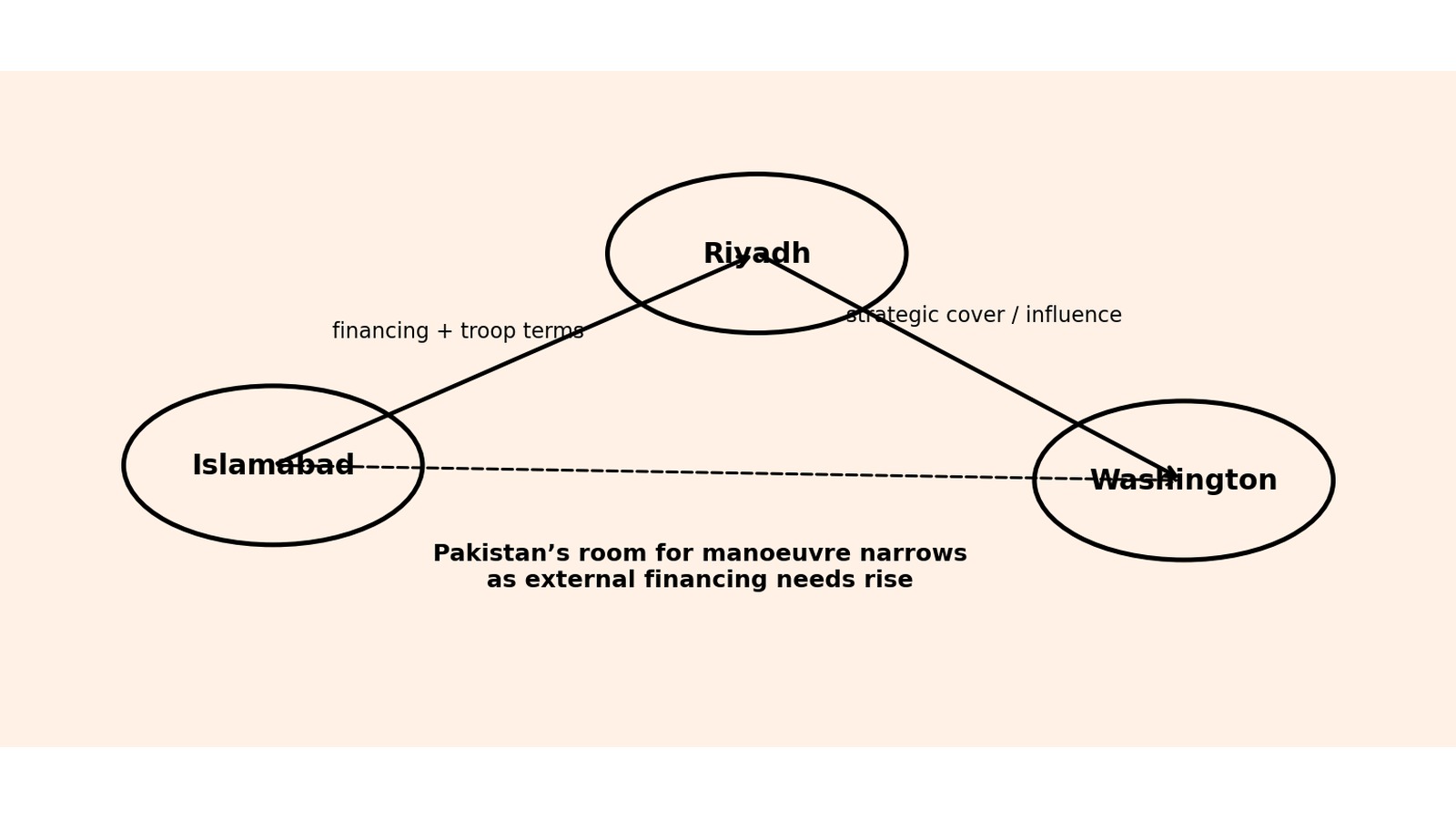
A three-cornered negotiation: Islamabad needs Riyadh; Riyadh still weighs Washington; and Pakistan’s dependence limits its freedom of action.
The petrol shock is the real strategic story
The strongest evidence of Pakistan’s vulnerability is not found in a palace in Riyadh. It is found at the petrol pump.
A research briefing prepared from Pakistan State Oil’s historical price archive, official petroleum notifications and contemporary reporting shows petrol at Rs266.17 a litre on 1 March 2026. Six days later it was Rs321.17. On 3 April it reached Rs458.41 — 72.2 per cent above the March baseline. A 50-litre fill that cost about Rs13,309 at the start of March cost roughly Rs22,921 at the peak.
The June reduction offered relief but not a reset. Petrol fell to Rs299.50 on 20 June, then moved higher again through July and August. By 8 September the notified price in the research series stood at Rs358.77 a litre — Rs92.60 above the 1 March level, or 34.8 per cent higher. For a 50-litre tank, that is an additional Rs4,630 compared with the pre-shock baseline.
Pakistan petrol price shock, 2026
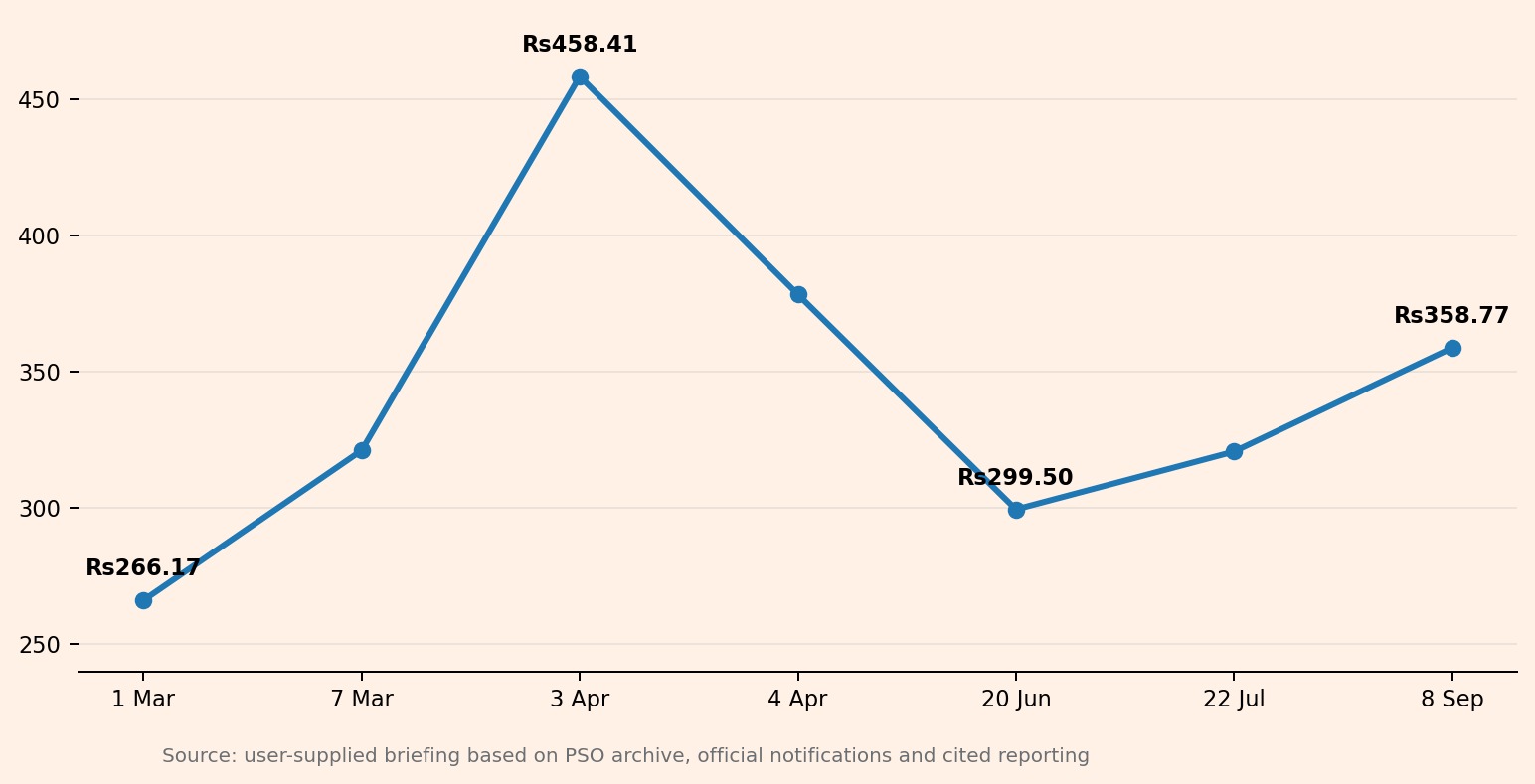
Source: user-supplied briefing based on PSO archive, official notifications and cited reporting
The point is not simply that petrol became expensive. It is the speed with which a geopolitical shock was transmitted into household costs.
Why diesel matters even more
Petrol attracts attention because motorists see the number every time they fill a tank. Diesel is the deeper transmission mechanism. Trucks, buses, tractors, generators and construction equipment pass higher fuel costs through the economy. Food, fares, building materials and basic services all become more expensive, including for families that do not own a car.
That is why the strategic argument cannot be separated from the household argument. A country whose transport and food systems remain acutely exposed to imported fuel has less freedom to posture abroad. Every additional regional commitment carries not only a military cost but a foreign-exchange cost.
The myth of cost-free strategic relevance
Pakistan’s military relationship with Saudi Arabia is real and longstanding. But deployment should not be confused with strategic indispensability. Riyadh has its own capabilities, its own alliances and its own calculus. Pakistan enters that relationship with useful military experience but also with a balance-of-payments problem that is impossible to hide.
This is why the reported Saudi hesitation over a meeting — if borne out — would be more than a protocol story. It would be a measure of the direction in which leverage is moving. Islamabad may believe it is offering security. Riyadh may see a partner asking to be paid more for a role that already exists, while simultaneously seeking another financial lifeline.
The suggestion that MBS is also looking to Donald Trump for help or political cover adds another layer. It places Pakistan inside a wider triangle in which Saudi Arabia’s relationship with Washington still matters more than any rhetorical architecture of Muslim collective security. ‘Muslim NATO’ makes a compelling television phrase. It is not, by itself, a balance sheet.
A foreign policy constrained by the pump
The uncomfortable conclusion is that Pakistan cannot sustainably conduct foreign policy as if economics were a separate department. The two are now inseparable. A state that repeatedly requires emergency external financing cannot bargain abroad with the same freedom as a state that can fund its own energy needs, defence commitments and currency stability.
The lesson is not that Pakistan should abandon Saudi Arabia, Washington or any other partner. It is that those relationships become healthier when Pakistan needs less from them. Energy resilience, transparent fuel pricing, more efficient freight, strategic stocks, mass transit and a reduction in imported-fuel dependence are not technocratic side issues. They are instruments of national power.
If a conflict near Hormuz can rewrite a household budget in Lahore, Karachi or Multan within days, then energy resilience is not an environmental luxury. It is a national-security requirement.
And if Pakistan wants to be treated as a strategic partner rather than a cash-strapped client, the route does not begin with another slogan, another pact or another speculative military commitment. It begins with an economy strong enough to say no.
SOURCE NOTE
Fuel-price figures are drawn from the user-supplied briefing “When a Distant War Reaches Pakistan’s Pump”, which cites the PSO historical POL price archive, Petroleum Division notifications, OGRA and contemporary reporting. Claims concerning MBS, Asim Munir, troop compensation and the reported $3bn request are presented as source-based reporting and are not described as independently verified official statements.


Reader comments
Subscribers can join the conversationSign in to join the conversation. Comments are open to everyone with a free account.
Sign in or create accountLoading comments…