
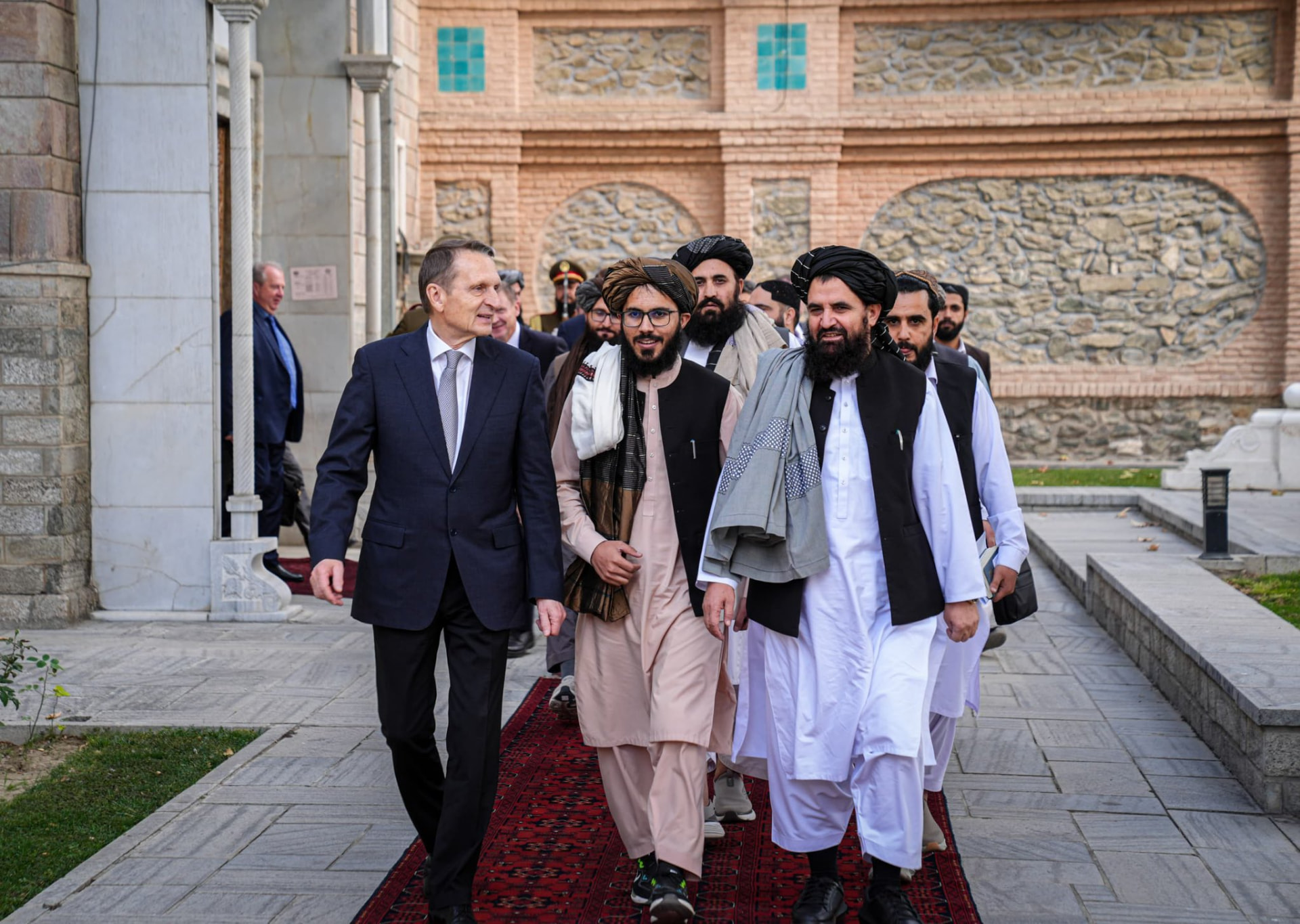
Naryshkin in Kabul: Moscow’s Intelligence-Level Bet on the Taliban
For Afghan families living under the threat of cross-border bombardment, the question raised by Sergei Naryshkin’s reported visit to Kabul is more immediate than diplomatic recognition: can a relationship with Russia make their country less vulnerable to attack?
The reported arrival of the head of Russia’s Foreign Intelligence Service has moved Moscow’s relationship with the Taliban into a more sensitive register. Afghanistan International and 8AM Media reported that Naryshkin travelled to Kabul and met Abdul Haq Wasiq, the Taliban’s intelligence chief. Neither side disclosed a detailed agenda. A report carried by TOOS, citing a source in Kabul and referencing the BBC, said discussions included bilateral relations, intelligence exchanges and joint security cooperation. Those details have not been set out in a public Russian or Taliban communique.
The absence of a published agenda matters. It prevents the meeting from being treated as proof of a weapons delivery, a joint operation or a Russian promise to defend Afghanistan. But it should not erase the Afghan security concerns that give such a meeting its importance. Kabul is looking for partners in a region where Pakistan’s military pressure has repeatedly reached across the border, with civilians paying a documented price.
The Afghan view: sovereignty is not an abstraction
An account framed only around Pakistan’s demand that the Taliban curb militancy misses what military pressure means on the Afghan side of the frontier. For people whose homes are struck, sovereignty is not merely a claim made by officials. It is the difference between a border that offers protection and one across which armed force can arrive.
The civilian harm is not solely an allegation from the Taliban. On 26 December 2024, UN News reported that the United Nations Assistance Mission in Afghanistan, UNAMA, had received credible reports of dozens of civilians, including women and children, killed in Pakistani military airstrikes in Paktika on 24 December. UNICEF expressed concern over reports that at least 20 children were among the dead. These were reports of casualties, not an independently established final death toll. UNAMA called for an investigation to uphold victims’ rights, ensure accountability and prevent recurrence, and stressed the obligation to distinguish civilians from combatants.
The subsequent record is more firmly quantified. In its February 2026 report on the final three months of 2025, UNAMA documented 70 civilian deaths and 478 injuries in Afghanistan attributed to Pakistani military forces. Of those, 47 deaths and 456 injuries occurred between 10 and 17 October. Its verification standard required clear and convincing information, supported by at least three different and independent types of sources; the allegations were presented to both Kabul’s de facto authorities and Pakistan. This is a documented civilian-protection problem, not simply an exchange of competing official narratives. 1
The harm continued into 2026. On 6 March, UNAMA said it had verified 56 civilians killed and 129 injured in Afghanistan from late 26 February to 5 March through indirect fire and aerial attacks during cross-border clashes. Women and children accounted for 55 per cent of the recorded casualties. In one airstrike incident in Paktika’s Barmal district on 27 February, it recorded 14 civilians killed, including four women, two girls and five boys. These figures cover that specified period, not a cumulative total for the conflict. 2
Pakistan’s security case must also be stated accurately. Islamabad accuses the Taliban authorities of sheltering Tehrik-e-Taliban Pakistan, the Pakistani Taliban, whose attacks have killed Pakistani security personnel and civilians. Kabul denies harbouring the group. After the March 2024 strikes, Pakistan described its action as intelligence-based counterterrorism operations; the Afghan authorities said civilian homes had been hit and eight women and children killed. Reuters reported that casualty figure as the Taliban’s account, not as an independently verified finding.
Pakistan’s experience of militant violence does not cancel the obligation to protect civilians in Afghanistan. Equally, defending Afghan civilians does not require treating every Taliban denial as established fact. Both questions deserve scrutiny: whether armed groups use Afghan territory, and whether Pakistan’s response unlawfully or indiscriminately harms people who have no part in those attacks. Afghan civilians should not disappear from the argument merely because their government remains internationally isolated.
From recognition to practical security support
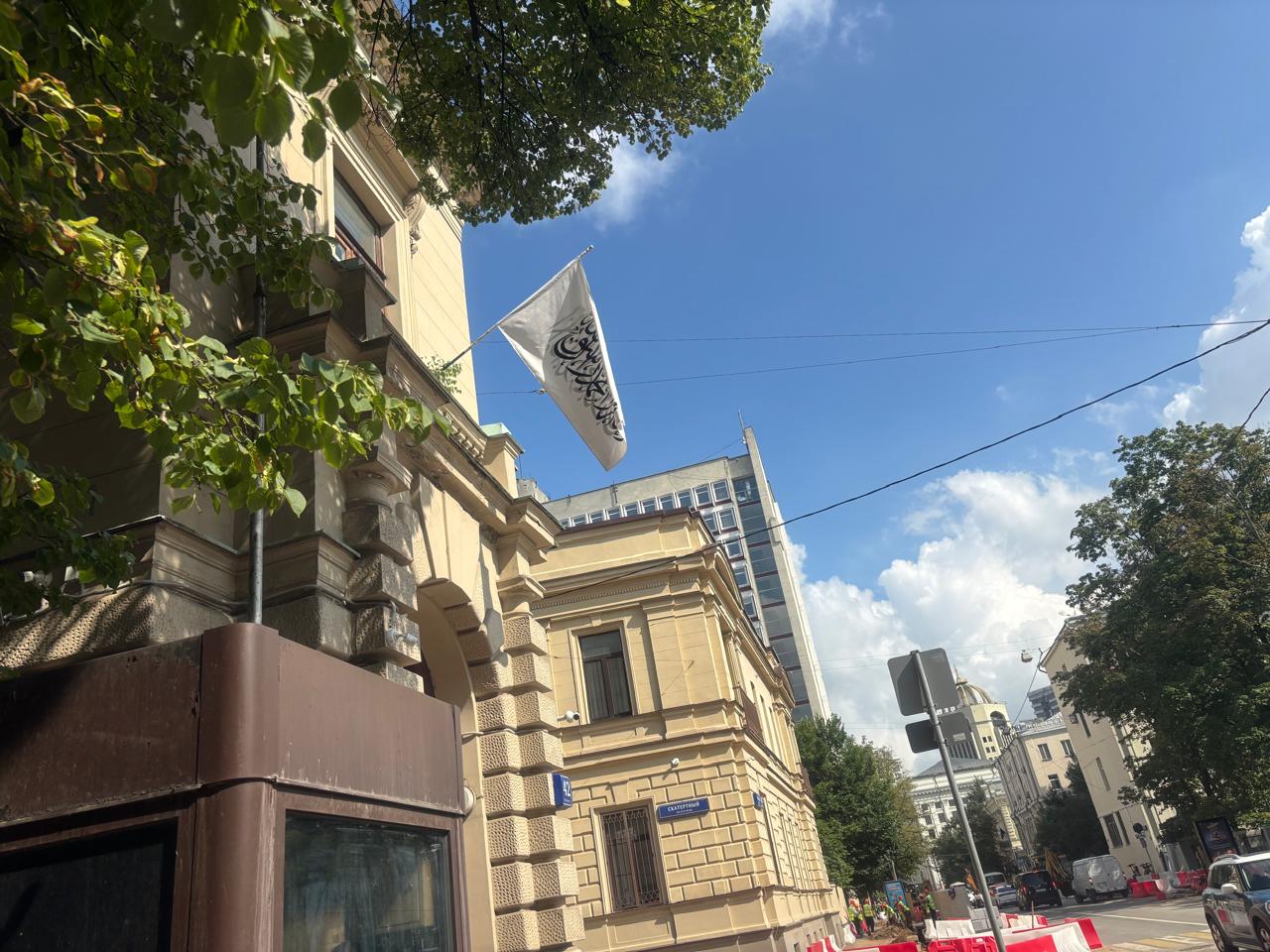
Russia became the first government to formally recognise the Taliban administration in July 2025. That step gave Kabul an interlocutor prepared to move beyond informal engagement. Moscow’s interest is practical: containing Islamic State Khorasan Province, limiting threats to Central Asia and preserving influence in Afghanistan after the Western withdrawal.
There is already a military relationship to examine, rather than a blank space onto which any imagined deal can be projected. RFE/RL reported that Russian Security Council Secretary Sergei Shoigu and Taliban defence minister Mohammad Yaqoob signed a military-technical cooperation agreement on 27 May 2026. Its full text has not been published. In reporting published on 15 October, RFE/RL said Yaqoob had described its focus as repairing and maintaining Russian-made military equipment already in Afghanistan. He also stressed that it was not a mutual-defence pact.
That distinction does not make maintenance inconsequential. Keeping existing helicopters and armoured vehicles serviceable can matter to a government with limited resources. But maintaining an inherited arsenal is different from obtaining new systems capable of deterring or intercepting cross-border attacks.
Could Russian weapons help Afghanistan defend itself?
From Kabul’s perspective, the attraction is clear: Russian support could reduce dependence on the goodwill of a neighbour that has repeatedly used military force inside Afghanistan. A stronger defensive capability could give Afghan authorities more room to resist Pakistani pressure and protect their territory. Whether that would actually protect civilians would depend on the equipment, its use and the political terms attached to it.
RFE/RL’s 15 October reporting said Taliban authorities were seeking Russian military hardware, including drones, to counterbalance Pakistan and strengthen their defences against Pakistani airstrikes. That is evidence of Kabul’s interest, not proof that Moscow has agreed to supply the requested equipment. The same report noted that Russia had not indicated it was supplying drone technology to the Taliban or helping develop it.
Air-defence equipment, surveillance capabilities and technical assistance are therefore possibilities to assess, not deliveries to announce. If Russia provided suitable defensive systems, training and sustained support, it could make Afghan territory less exposed to attack. Weapons alone, however, would not automatically create effective protection, and equipment used for retaliation could intensify the conflict rather than spare civilians.
There are substantial constraints. Russia’s war in Ukraine and sanctions limit its resources; Afghanistan’s ability to finance a major arms purchase is also restricted. Experts quoted by RFE/RL in May judged maintenance, coordination and training more likely than major arms deliveries. Moscow also retains a relationship with Islamabad: Russian Interior Minister Vladimir Kolokoltsev’s visit to Pakistan this week underlines that engagement with Kabul is not equivalent to joining an anti-Pakistan alliance.
Naryshkin’s reported meeting should consequently be read as a possible channel for deeper security cooperation, not as confirmation of a Russian weapons package. The important question is whether Moscow will translate recognition and access into practical assistance that improves Afghan security — and whether it can do so without encouraging another round of cross-border escalation.
Afghan protection is not the same as Taliban impunity
The Taliban administration’s search for external legitimacy and the Afghan population’s need for protection overlap, but they are not identical. Opposition to Pakistani attacks that kill civilians must not become a reason to overlook the Taliban’s restrictions on women or its treatment of political opponents. Nor should those abuses be used to make Afghan civilian lives count for less.
Any Russian security assistance deserves scrutiny for that reason. Equipment presented as national defence could also strengthen the authorities’ coercive power inside Afghanistan. A credible security partnership would need to be judged by its effects on people: fewer civilians killed, greater restraint at the border and safeguards against domestic repression, not simply a larger arsenal or another high-level visit.
For Moscow, the wager is that cooperation with the authority controlling Afghanistan can contain threats and extend Russian influence. For Kabul, the opportunity is to obtain diplomatic support and potentially practical means of defending Afghan territory against Pakistani military pressure. For Afghan civilians, the test is more demanding than either government’s preferred narrative: does this relationship make their lives safer?
Naryshkin’s visit is best understood as a marker of direction rather than a finished agreement. The civilian cost of cross-border attacks explains why stronger defensive capacity matters to Afghanistan. Whether Russia will provide it, on what terms, and with what consequences remains the question that neither an undisclosed intelligence meeting nor diplomatic recognition can answer on its own.

Reader comments
Subscribers can join the conversationSign in to join the conversation. Comments are open to everyone with a free account.
Sign in or create accountLoading comments…