Disclaimer:
This report is based on a leaked extract from a Pakistani Joint Investigation Team (JIT) concerning Uzair Baloch, together with information provided by intelligence sources familiar with the investigation. The document contains allegations and statements reportedly attributed to the accused. Parrhesia News has not independently verified every aspect of the material. Iranian authorities have consistently denied supporting militant activity in Pakistan.
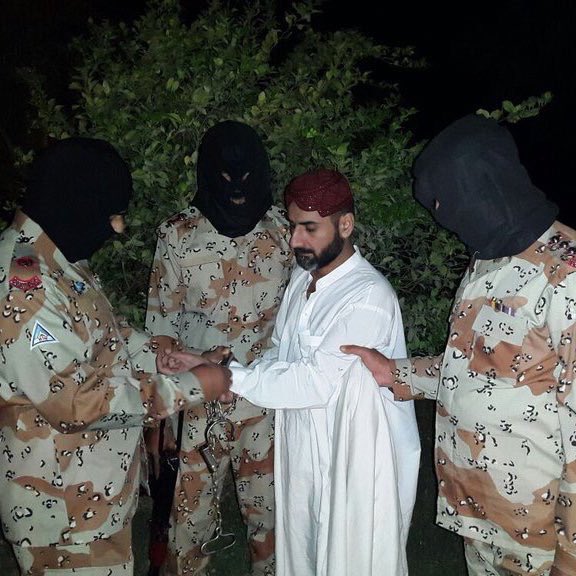
A leaked Pakistani Joint Investigation Team (JIT) document into jailed Karachi crime boss Uzair Baloch has resurfaced with a significant new development.
Multiple Pakistani intelligence sources have told Parrhesia News that the findings recorded in the Uzair Baloch JIT were independently corroborated by an earlier Pakistani intelligence investigation into alleged Indian intelligence operative Kulbhushan Jadhav.
If accurate, the disclosure suggests that two separate Pakistani intelligence investigations—conducted years apart and involving unrelated individuals—arrived at similar intelligence assessments regarding alleged contacts involving Iranian intelligence personnel.
The revelation represents the latest twist in one of South Asia's least understood intelligence theatres.
From a 2020 Leak to a Fresh Intelligence Scoop
The JIT document itself is not entirely new.
It first entered the public domain in 2020, when extracts were circulated through several online platforms widely regarded by analysts as being aligned with Pakistan's Military Intelligence information ecosystem.
At the time, attention largely focused on the explosive allegations concerning Uzair Baloch's reported links with India's Research and Analysis Wing (RAW).
Far less scrutiny was given to another section of the investigation—one dealing with alleged contacts between Uzair Baloch and Iranian intelligence officers.
That chapter has now acquired renewed significance following information obtained independently by Parrhesia News.
According to intelligence sources familiar with the investigations, Pakistani agencies did not regard the Iranian angle as an isolated claim emerging solely from Uzair Baloch's statements.
Instead, the sources say, similar intelligence reportedly emerged during the investigation of Kulbhushan Jadhav, whom Pakistan convicted on espionage charges in 2017. India has consistently maintained that Jadhav was kidnapped from Iran and denied that he was operating as an intelligence officer inside Pakistan.
Parrhesia News has not independently reviewed the classified Jadhav investigation files referenced by the sources.
What the Leaked JIT Says
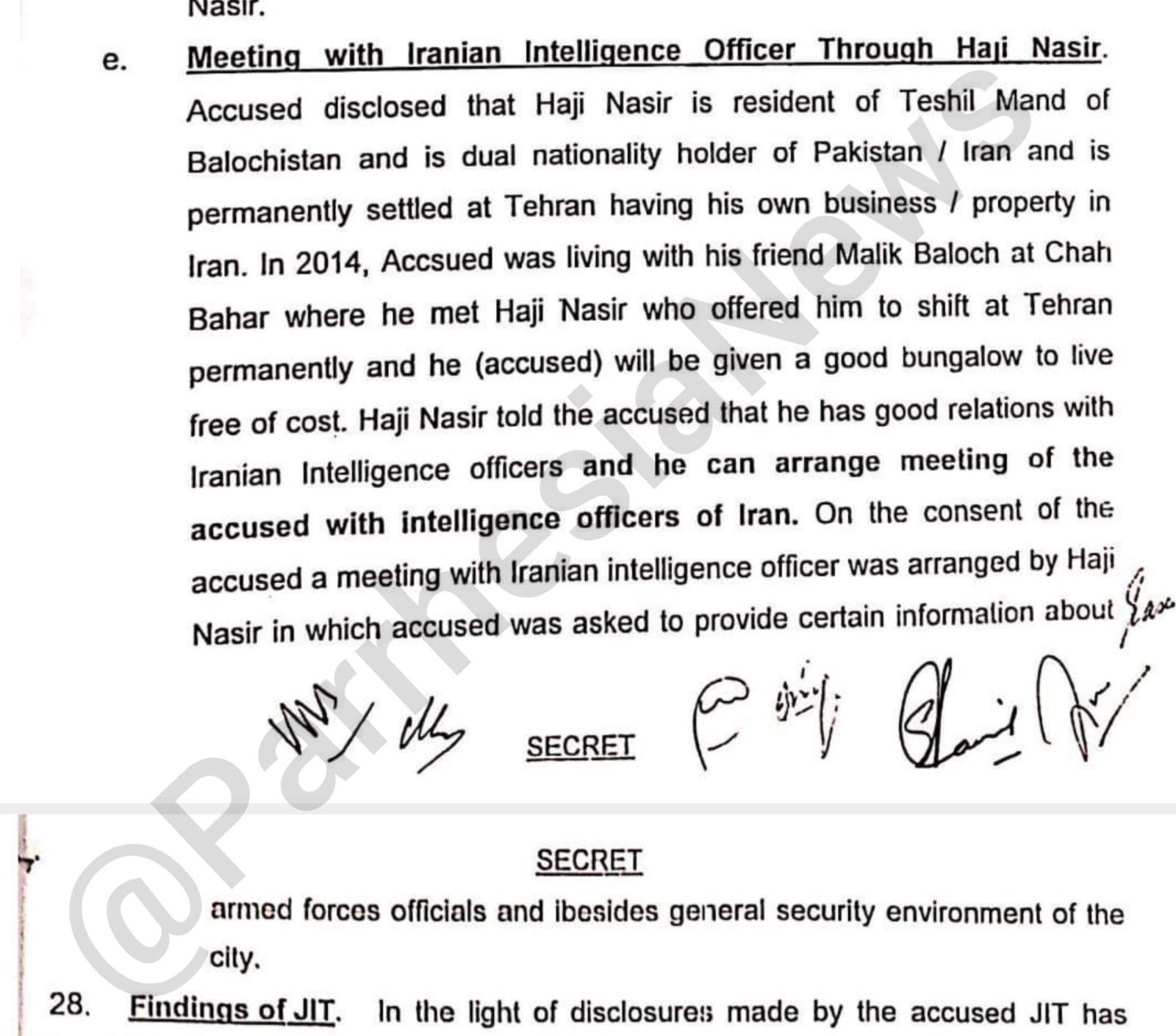
The leaked extract contains a section entitled:
"Meeting with Iranian Intelligence Officer Through Haji Nasir."
According to the document, Uzair Baloch allegedly told investigators that while living in Chabahar in 2014 he met a man identified as Haji Nasir, described as a dual Pakistani-Iranian national originally from Mand in Balochistan but permanently settled in Tehran.
The statement alleges that Haji Nasir offered to relocate Uzair Baloch to Tehran, provide him accommodation, and arrange meetings with Iranian intelligence officers.
The document further records that, following such an introduction, Uzair Baloch allegedly met an Iranian intelligence officer who sought information concerning Pakistan's armed forces and the wider security environment.
These remain allegations recorded in an investigative file and should not be interpreted as established findings of fact.
Why the New Intelligence Matters
The significance of the latest information lies not in the document itself, but in what Pakistani intelligence sources now claim about it.
According to the officials who spoke to Parrhesia News, investigators considered the Iranian intelligence angle credible because it reportedly overlapped with intelligence obtained independently during the Kulbhushan Jadhav investigation.
The sources declined to describe the precise nature of that corroboration, citing the classified status of the material.
If their account is accurate, it would indicate that Pakistani investigators identified a recurring intelligence pattern rather than an isolated allegation arising from a single suspect.
That would represent a substantially stronger intelligence assessment than has previously entered the public domain.
A Complex Intelligence Battlefield
Balochistan has become an increasingly congested intelligence arena. While Pakistan has long accused India of supporting Baloch separatist organisations, the Baloch leaders claim the separatist movement as an organic enterprise, arising out of decades of neglect and persecution of the Baloch people.
Iran, meanwhile, has battled armed insurgent groups operating in Sistan-Baluchestan and has itself suffered repeated attacks attributed to militant organisations active along the border.
Relations between Tehran and Islamabad have periodically deteriorated amid mutual accusations that militants exploit territory on both sides of the frontier.
Against this backdrop, intelligence services from several regional powers inevitably maintain significant interest in developments across the border region.
Whether that extends to operational relationships with criminal intermediaries or insurgent actors remains a matter requiring careful evidential assessment.
Intelligence Versus Evidence
The fresh information obtained by Parrhesia News does not establish Iranian state responsibility for the insurgency in Balochistan.
Nor does it prove that Iranian intelligence directed or supported militant organisations operating against Pakistan.
Instead, it suggests that Pakistani intelligence agencies may themselves have regarded alleged Iranian intelligence contacts as sufficiently credible to appear independently in more than one major counter-intelligence investigation.
That distinction is important.
Intelligence assessments are not judicial findings. They often combine human intelligence, interrogations, surveillance and analytical judgments that require corroboration through additional evidence.
An Unanswered Question
Perhaps the most intriguing aspect of the story is why this alleged Iranian dimension received so little public attention when the JIT first surfaced in 2020.
At the time, official and media discussion overwhelmingly centred on India and RAW.
The references to alleged Iranian intelligence contacts remained largely overlooked despite appearing in the same investigation.
With Pakistani intelligence sources now indicating that investigators viewed the Iranian angle as being consistent with findings from the Kulbhushan Jadhav investigation, those passages merit renewed scrutiny.
Whether future disclosures will shed further light on the extent—if any—of Iranian intelligence activity connected to Balochistan remains to be seen.
For now, the resurfaced JIT and the fresh intelligence claims provide another reminder that the security landscape in Balochistan is likely far more complex than the binary narratives that have often dominated public debate.
Editor's Note: Parrhesia News has approached the matter from the perspective of public-interest journalism. The intelligence-source claims reported above have not been independently verified through access to the underlying classified Jadhav investigation. We will continue to investigate this story and invite responses from the relevant Pakistani and Iranian authorities should they wish to comment.

Reader comments
Subscribers can join the conversationSign in to join the conversation. Comments are open to everyone with a free account.
Sign in or create accountLoading comments…