
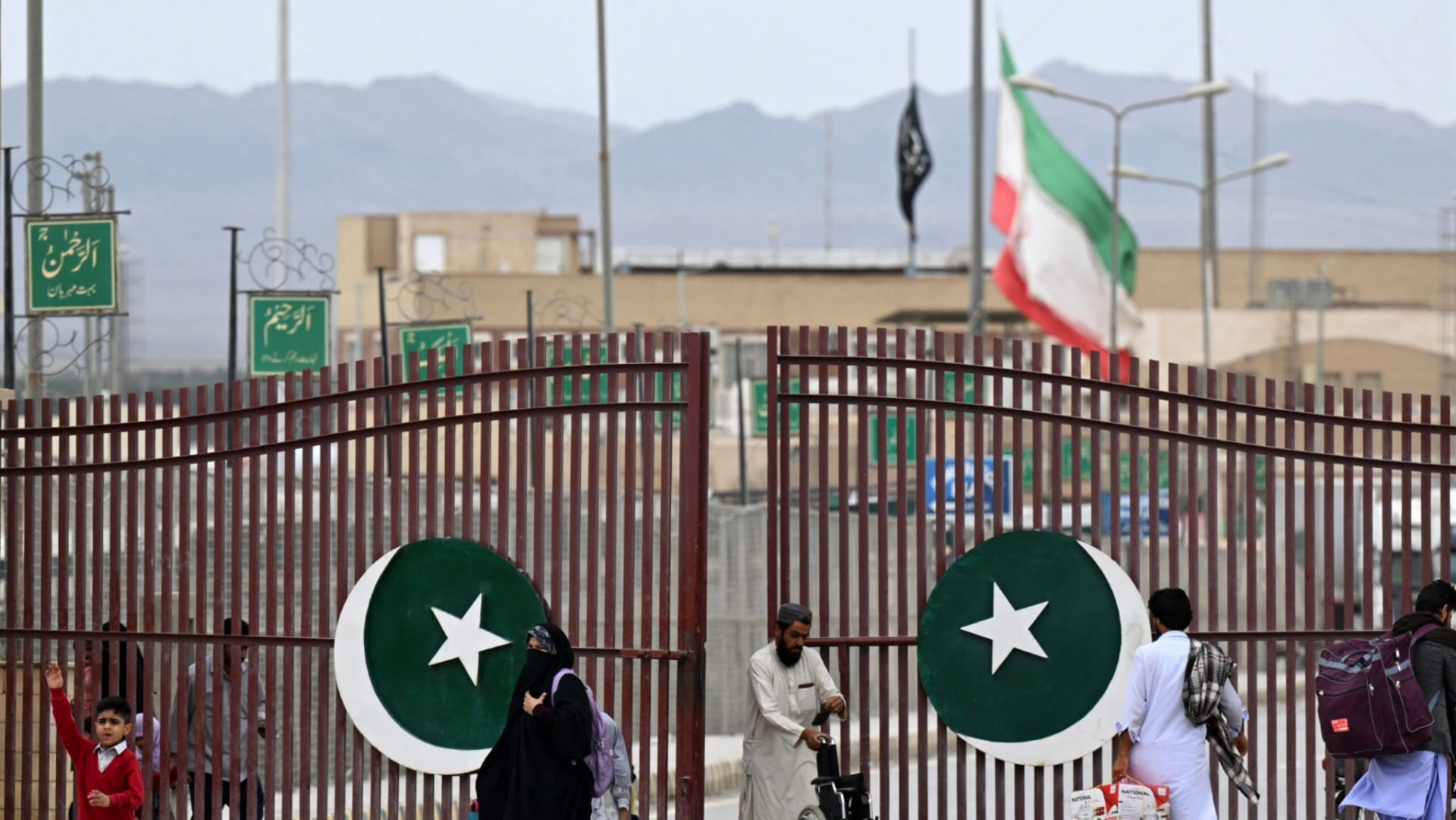
Asim Munir arrived in Tehran on October 20 to discuss mediation with President Masoud Pezeshkian, bringing an assurance about a problem his own government had helped create. According to Iranian readouts, the field marshal said the difficulties at the Pakistan–Iran border had been resolved and the crossings reopened that morning. Having suspended commercial traffic, Islamabad could now present its restoration as reassurance. Few sequences could better capture the contradictions of Pakistan’s regional policy: presenting itself as an indispensable intermediary while making decisions that unsettle one of the parties it proposes to reconcile. The suspension of commercial traffic at Taftan and Gabd-Rimdan had left approximately 2,000 trucks stranded, according to the Quetta Chamber of Commerce and Industry. Pakistani officials invoked security, smuggling and improved border management. Tehran preferred technical difficulties and precautionary measures. The reopening offers welcome relief, but neither the original explanations nor Munir’s assurances adequately address the political significance of interrupting these routes while Iran’s maritime commerce remains constrained by the American blockade. That significance does not establish that Washington ordered the closure, or that Islamabad is preparing to facilitate another military campaign. It does, however, expose the increasingly narrow space between Pakistan’s diplomatic ambitions, its Saudi commitments and its vulnerability to American economic pressure. A border decision can serve several purposes without any government volunteering to explain their relative importance. For Iran, the Pakistani crossings have acquired a value that ordinary bilateral trade figures cannot convey. Before the war, trade between the neighbours was modest, constrained by sanctions, banking restrictions and inadequate infrastructure. But under blockade, the importance of a route depends less on its previous turnover than on the alternatives still available. Roads cannot replace major ports. They can nevertheless preserve supplies, sustain businesses and make economic isolation less complete. Pakistan understood this when it authorised third-country goods to transit towards Iran through designated land routes in April. Those arrangements gave Islamabad both a practical role in alleviating Iranian isolation and another reason for Tehran to maintain relations with it. Their interruption produced the opposite effect. Whatever the immediate administrative justification, closing commercial crossings reinforced the pressure generated by the blockade. Their reopening removes that additional restriction; it does not erase the demonstration that access can be withdrawn. The sanctions question therefore deserves more attention than the reassuring vocabulary of temporary disruption. Earlier this month, Pakistan’s Foreign Office said the country would comply with applicable sanctions regimes without specifying which. Such ambiguity leaves unresolved whether Islamabad is referring to binding international obligations or accommodating Washington’s wider campaign against commerce with Iran. For transport companies, banks and traders, the distinction has immediate consequences. For Tehran, it concerns the reliability of a neighbour whose cooperation has become more valuable precisely because other routes have narrowed. Munir’s meetings also exposed the limits of what restoring border access could achieve. Iranian officials reiterated that negotiations with Washington would not resume until Tehran’s demands were met, including an end to the blockade, the lifting of sanctions on oil exports and an end to regional hostilities. Security chief Mohsen Rezaei separately insisted that Iran’s enriched nuclear material would remain in the country. Restoring a commercial route was useful bilateral repair. It did not produce an Iranian concession on the central disputes. Pakistan’s Saudi commitment makes that uncertainty harder to contain. The activation of the Mecca defence agreement on October 5 placed Islamabad more visibly inside Riyadh’s security arrangements as Houthi attacks intensified. On October 19, the day before Munir’s Tehran visit, Pakistan’s military announced that he and the new Saudi ambassador had expressed satisfaction with progress under the agreement and discussed stronger defence collaboration and strategic coordination. Reassurance to Tehran was thus accompanied by renewed reassurance to Riyadh. Pakistani officials maintain that their forces in Saudi Arabia have a defensive mission and will not cross into Yemen. That stated limitation matters: defending Saudi territory does not establish Pakistani participation in an offensive against Iran, nor does it make such participation inevitable. Nevertheless, Tehran has reasons to scrutinise what Pakistan’s commitments may become under pressure. An alliance activated against an Iranian partner in Yemen inevitably affects Iran’s calculations, even when its members describe their purpose as defensive. Islamabad can explain that it is protecting Saudi Arabia while preserving dialogue with Iran. It cannot require Tehran to treat those activities as unrelated. Nor does mediation require complete neutrality. Governments with interests, alliances and influence often make effective intermediaries. The difficulty arises when their competing commitments make their assurances uncertain. Pakistan can offer access to Washington and familiarity with Riyadh. To retain Iranian confidence, it also needs to demonstrate that its own territory and economic decisions will not become additional instruments of coercion. Reopening the commercial border helps. Keeping access predictable would help considerably more. The possibility of renewed American attacks gives these developments a more ominous context, but a trade suspension is insufficient evidence of an invasion plan. Even a verified reinforcement of the frontier would require interpretation: forces could be preparing for displacement, infiltration, unrest or retaliation rather than an offensive. The more defensible concern is that Pakistan anticipates deterioration in the regional security environment and is making preparations whose purpose remains opaque. That opacity encourages suspicion on both sides. Balochistan supplies ample insecurity of its own. Pakistani forces face a persistent nationalist insurgency, while Iranian security personnel have suffered repeated attacks across the border. The reciprocal strikes of January 2024 demonstrated how quickly accusations about armed groups can become military action between the two states. Neither government needs to invent its concerns. But the existence of violence does not make every restriction an effective response. The secular nationalist organisations fighting Pakistan and the Sunni armed groups attacking Iranian forces have different political projects. Treating them as a single cross-border problem obscures those differences and encourages the familiar assumption that the frontier itself explains rebellions rooted in each state’s treatment of its Baloch population. Closing recognised commercial routes also imposes its most immediate costs on people whose activities are visible and regulated. Truck drivers wait, fruit deteriorates, transport charges accumulate and traders lose customers. Pakistan risks disruption to LPG supplies as well as export earnings. Reopening allows commerce to resume, but it cannot recover every lost sale or remove the costs already incurred. In communities where employment is scarce, the border is an economic necessity. Officials promise that better management will eventually improve local livelihoods; local businesses are expected to finance the interval. There is a wider political consequence. Islamabad presents regional connectivity as a national asset while repeatedly demonstrating how quickly access can be withdrawn. Traders already exposed to disruptions along the Afghan frontier now face uncertainty on another western route. A corridor whose operation depends on unexplained decisions cannot provide the predictability that commerce requires. Announcing that a problem has been resolved is easier than persuading businesses that it will not recur. For the military leadership, diplomatic prominence and security commitments bring international recognition. The costs of reconciling them fall elsewhere: on civilian businesses, border communities and a province already governed too often through the language of emergency. Balochistan is expected to accommodate Pakistan’s strategic geography while receiving little authority over the decisions that make that geography dangerous. The central question is therefore larger than when the trucks will move again. Pakistan is playing its familiar shell game: trying to preserve Iranian trust, satisfy Saudi expectations and avoid American displeasure while managing an insurgency along the same frontier through which it promises connectivity. Those objectives are becoming harder to reconcile. Munir may still carry messages between capitals, but mediation ultimately depends on confidence in what the messenger will do when the interests of his partners collide. At Taftan and Gabd-Rimdan, reopening the gates was the easy part. But ttrust does not move alongside the cargo.
World · Pakistan / IranAnalysis
Pakistan’s troubled Border and the Limits of Playing Both Sides
Asim Munir arrived in Tehran on October 20 to discuss mediation with President Masoud Pezeshkian, bringing an assurance about a problem his own government had helped create.
More on this story
Related Coverage


The Daily Briefing
The world, before your coffee.
Our editors hand-pick the morning's essential stories — 5 minutes, six days a week, delivered at 06:00 UTC.
Reader comments
Subscribers can join the conversationSign in to join the conversation. Comments are open to everyone with a free account.
Sign in or create accountLoading comments…