
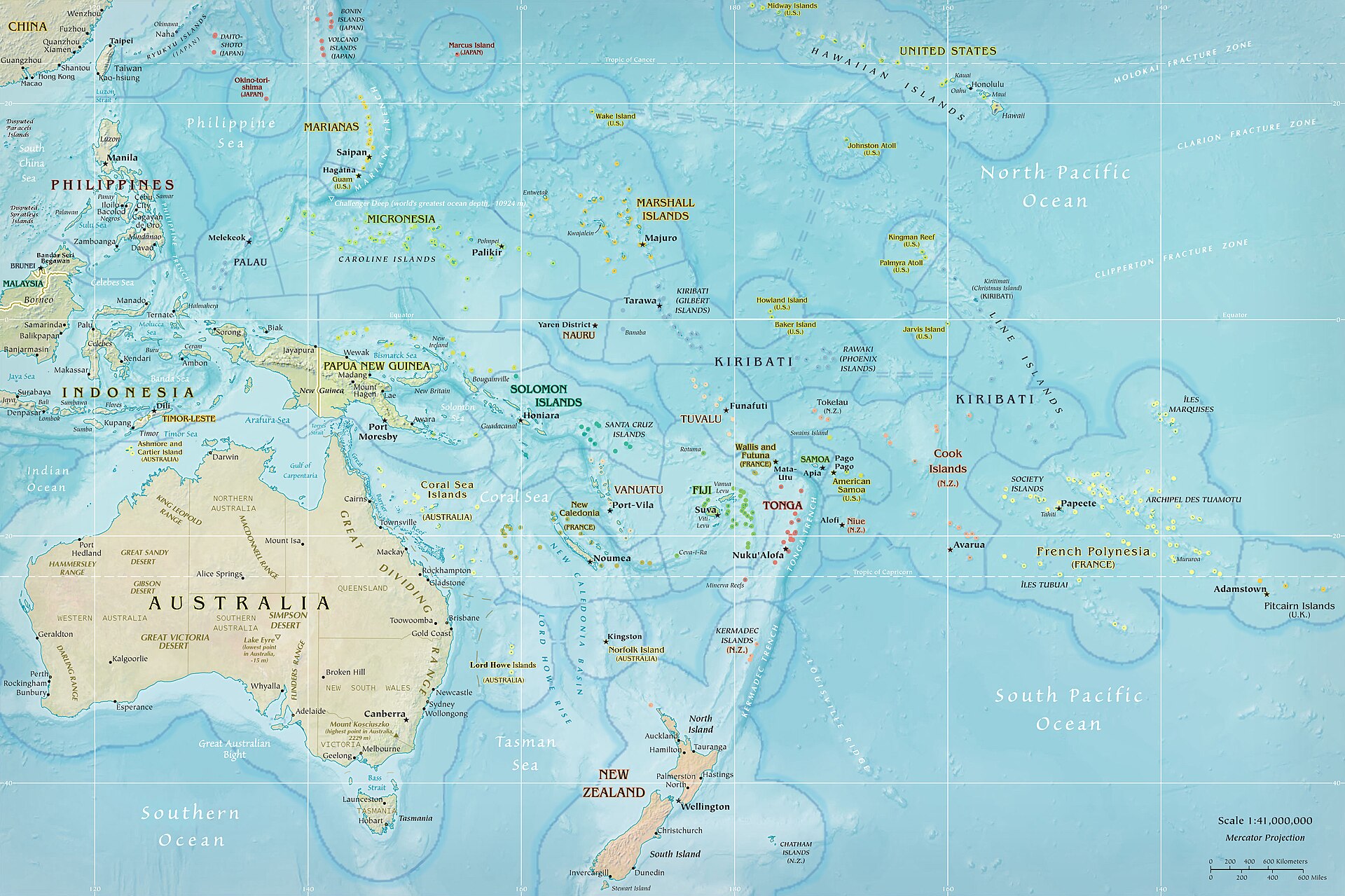
China’s latest missile test in the Pacific is not an isolated military event. It is a message fired across one of the world’s most strategically important oceans. Beijing described the launch as routine, safe and not aimed at any country. But for Pacific Island states, Australia, New Zealand, Japan, the United States, and other Indo-Pacific powers, the meaning was hard to ignore; China is no longer only trying to shape the Pacific through roads, ports, police training, telecom systems and diplomatic pressure. It is now openly demonstrating long-range military power in a region that has spent decades trying to keep nuclear weapons and great-power rivalry away from its waters.
On 6 July 2026, China test-launched a long-range ballistic missile from a nuclear-powered submarine into the Pacific. Chinese state media said the missile carried a dummy warhead and landed in designated high seas. Beijing’s foreign ministry spokesperson Mao Ning said it was part of “routine” annual military training, complied with international law and practice, and was “not directed against any specific country or target.” She also said relevant countries were notified in advance and urged them not to “over-interpret” the test.
But the reaction in the region showed that very few countries saw it as routine. Australian Prime Minister Anthony Albanese called the launch “provocative” and said it destabilized the region. He stressed that this was a nuclear-capable intercontinental ballistic missile fired from a nuclear-powered submarine, and that such a weapon could cause “considerable damage” if weaponised. Solomon Islands Prime Minister Matthew Wale was even more direct. He said China was a friend of Solomon Islands, but “this is not something a friend does,” adding that Pacific states did not want China, the United States, or anyone else testing intercontinental ballistic missiles in their region.
The concern is not just emotional. It is strategic, legal, and historical. The South Pacific carries the memory of nuclear testing by outside powers. The Treaty of Rarotonga, opened for signature in 1985 and in force since 1986, created the South Pacific Nuclear-Free Zone. It prohibits nuclear explosive devices in the region and reflects a long Pacific effort to stop the ocean from being treated as a testing ground by powerful states. Although China says its missile carried a dummy warhead, the symbolism of a nuclear-capable missile test in or near Pacific waters is deeply sensitive. For island nations, the issue is not only whether a warhead was live. The issue is whether big powers are again normalising military demonstrations in their ocean.
From a maritime perspective, the test is especially important because it was launched from a submarine. A land-based missile launch is serious, but it is easier to track, easier to attribute, and easier to understand within fixed geography. A submarine-launched ballistic missile is different. It tells the world that China is strengthening its sea-based nuclear deterrent. Nuclear-powered ballistic-missile submarines are designed to hide, survive a first strike, and retaliate from the sea. In military terms, this is called second-strike capability. In simple language, it means China wants a nuclear force that cannot be easily destroyed even in a major war.
This matters far beyond the Pacific Islands. A stronger Chinese sea-based nuclear force affects the United States, Japan, Australia, India, and every country that depends on open Indo-Pacific Sea lanes. Pertinently, the Pacific connects Asia, North America, Australia, and the wider global economy. Undersea cables, shipping lanes, fisheries, military routes, and satellite-tracking geography all pass through or depend on this space. When China fires a nuclear-capable missile from a submarine into the Pacific, it is not only testing a weapon. It is testing how far the region will tolerate China’s expanding strategic reach.
The timing made the test even more sensitive. It came as Australia was signing a major new treaty with Fiji. On 6 July 2026, Australia and Fiji signed the Vuvale Union and the Ocean of Peace Alliance in Suva. Australia described the agreements as historic, with Prime Minister Anthony Albanese and Fiji’s Prime Minister Sitiveni Rabuka signing them alongside senior Australian defence and Pacific ministers. The Ocean of Peace idea is politically important because Fiji has long argued that the Pacific should remain a zone of peace, not a playground for military competition. China’s missile launch on the same day was therefore read by many as a signal, even if Beijing insists it was planned as routine training.
Australia has also moved quickly with Vanuatu. On 29 June 2026, Australia and Vanuatu signed the Nakamal Agreement in Canberra. The treaty deepens cooperation in policing, maritime security, infrastructure, intelligence, cyber support and development. Crucially, Vanuatu committed that it would not allow any foreign military base or foreign military infrastructure on its territory and would keep its critical infrastructure free from militarisation, foreign interference or unauthorised access. That line is clearly aimed at the central fear in Canberra, Wellington, Washington and Tokyo: that China could turn influence in a Pacific Island state into permanent strategic access.
This fear did not appear overnight. It has been building since at least 2022, when Solomon Islands signed a security pact with China. That agreement alarmed Australia, the United States, Japan and New Zealand because it raised the possibility of Chinese security forces gaining a foothold in a strategically located island country northeast of Australia. Reuters reported that China’s 2022 push went even further: Beijing sought a region-wide agreement with almost a dozen Pacific Island countries covering policing, security, data communications, cyber security, smart customs systems and even police training.
Pacific leaders did not simply accept that proposal. In May 2022, China and Pacific Island foreign ministers failed to reach consensus on the sweeping regional pact. Several island states wanted more time, and the Pacific Islands Forum secretary general urged China to work through the region’s own priorities and mechanisms, especially climate change and recovery from COVID-19. This was an important moment. It showed that Pacific countries are not passive pawns. They want development and partnerships, but they do not want external powers writing regional security rules over their heads.
Still, China did not step back. It shifted from one big regional package to deeper bilateral moves. In Kiribati, Reuters reported in 2024 that Chinese police were working with local police on community policing and a crime database Programme. Kiribati is small in population, but it controls one of the world’s largest Exclusive Economic Zones and sits relatively close to Hawaii, making it strategically valuable. In Solomon Islands, Reuters reported in 2025 that Chinese police had promoted the “Fengqiao Experience,” a Chinese model of grassroots social control, in local villages. Critics inside Solomon Islands warned that such systems could clash with traditional community structures and move the country closer to authoritarian-style surveillance.
This is how China’s Pacific strategy works: it mixes development language with security access. The Chinese phrase often used is (“共同发展”) — common development. On paper, this sounds harmless and attractive. Beijing offers infrastructure, policing support, trade, scholarships, technology and diplomatic attention. But the deeper pattern is more complex. Ports can become logistics points. Police training can create dependency. Telecom systems can create data risks. Elite-level deals can weaken transparency. Security cooperation can open doors that are difficult to close later.
Solomon Islands now shows the limits of that approach. In June 2026, new Prime Minister Matthew Wale said his government would review the 2022 security agreement with China and negotiate a comprehensive strategic treaty with Australia. He cited a lack of transparency and said he had only recently seen the full China agreement after fighting for access. That is a serious political signal. It does not mean Solomon Islands is abandoning China. But it does mean that secrecy around Chinese security deals has become a domestic issue, not only a foreign-policy concern.
For the wider world, the Pacific matters because it is where three major issues meet: nuclear stability, maritime access, and sovereign choice. If China can normalise missile testing and security deployments in the Pacific, it changes the balance of power across the Indo-Pacific. It pressures Australia from the northeast. It complicates U.S. military planning across Guam, Hawaii and the wider Pacific. It worries Japan because Chinese long-range missiles and naval forces are tied to the same military modernisation that affects the East China Sea and Taiwan. It also concerns India because Chinese naval reach is expanding across both ends of the Indo-Pacific - from the western Pacific to the Indian Ocean.
The missile test also raises a larger arms-control problem. The United States said China’s rapid and opaque nuclear build-up is a concern for the region and the world, and called for regular notification arrangements for intercontinental-range ballistic missile and space launches. This is important because nuclear risk is not only about how many weapons a country has. It is also about communication, transparency and predictability. When countries receive only limited notice before a major missile test, the chance of misunderstanding increases. In a crisis, misunderstanding can become escalation.
Pacific Island nations have their own view of security, and it is often different from the view of outside powers. For them, climate change remains the central threat. The 2018 Boe Declaration by Pacific leaders reaffirmed that climate change is the single greatest threat to the livelihoods, security, and wellbeing of Pacific people. This is why island governments often resist being treated only as pieces on a chessboard between China, Australia, and the United States. They want sea walls, disaster response, fisheries protection, health systems, education, jobs and climate finance. They do not want lectures from big powers while their coastlines disappear.
That is exactly why China’s missile test may hurt Beijing diplomatically. China has tried to present itself as a partner of the Global South and a friend of small island states. But a nuclear-capable missile launched into Pacific waters sends the opposite message. It reminds Pacific communities of an older pattern: powerful countries making decisions about their ocean without fully respecting the people who live there.
The Pacific is entering a dangerous phase. Australia is building tighter defence and policing networks with Fiji, Vanuatu, Solomon Islands, and Papua New Guinea. The United States is pushing for more strategic coordination. Japan and New Zealand are watching China’s military movements closely. China, meanwhile, is combining diplomacy, policing, infrastructure, technology and now visible nuclear-capable military signalling.
The world should be concerned because the Pacific is no longer a distant theatre. It is becoming one of the main stages of twenty-first-century power politics. If the region is militarised, global shipping, nuclear stability, undersea communications and the sovereignty of small island states will all be affected. The real question is not whether China has the right to modernize its military. The real question is whether Beijing’s rise will respect the security choices of smaller nations or whether the Pacific will again be forced to carry the costs of great-power ambition.


Reader comments
Subscribers can join the conversationSign in to join the conversation. Comments are open to everyone with a free account.
Sign in or create accountLoading comments…