
A newly published dossier by the European Strategic Policy Forum (ESPF) has delivered one of the most comprehensive external assessments yet of Pakistan's military performance during General (now Field Marshal) Asim Munir's tenure. Covering the period from January 2023 to May 2026, the report examines casualty reporting, operational effectiveness, force protection, intelligence performance and institutional accountability. Its conclusion is stark: Pakistan's military leadership faces a growing crisis of transparency and credibility.
Titled "Unworthy of the Uniform? Casualty Concealment, Command Failure and the Hollow Claim to Professionalism in the Pakistan Army", the 23-page study draws upon publicly available material, including official ISPR statements, Pakistan's leading independent security research organisations—CRSS, PICSS and PIPS—as well as ACLED, the South Asia Terrorism Portal (SATP), parliamentary records and international human rights reporting. Rather than relying on a single source, the authors describe their methodology as one of "triangulation," comparing official figures with independent conflict-monitoring databases.
A Widening Casualty Gap
The report's most striking claim concerns the disparity between official casualty figures and independent estimates.
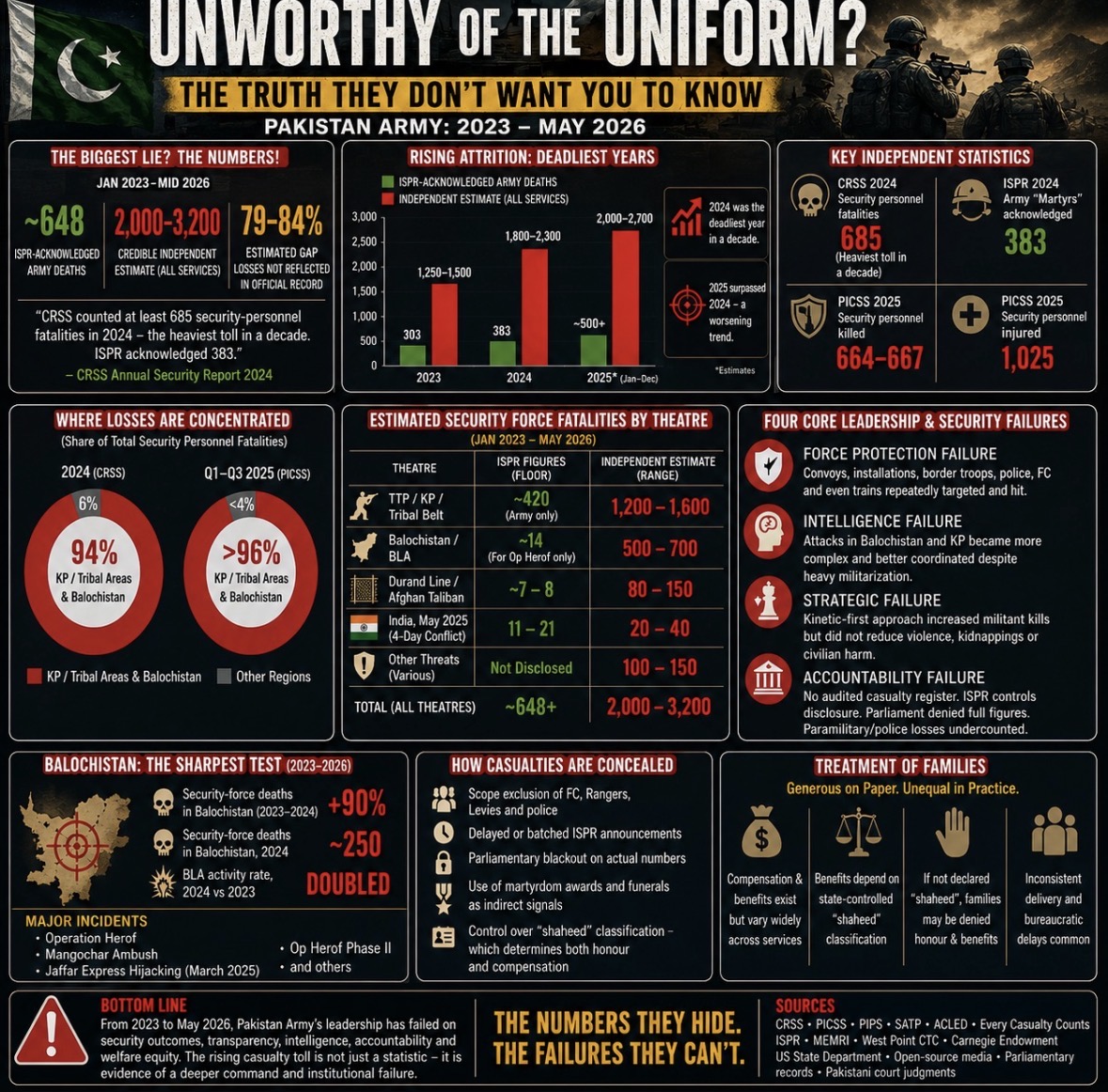
According to the dossier, ISPR acknowledged approximately 648 army deaths between January 2023 and mid-2026. However, after comparing multiple independent datasets, the authors estimate that total security-force fatalities—including the military, Frontier Corps, Rangers and police—likely fall within a range of 2,000 to 3,200 personnel, suggesting that official disclosures capture only part of the overall toll.
The report argues that this gap is not necessarily evidence of fabrication, but rather the result of institutional reporting practices. It notes that official announcements primarily concern regular army personnel, while losses among Frontier Corps, Rangers, Levies and provincial police are often reported separately or not consolidated into a single national casualty register. Pakistan, the report observes, lacks an independent, state-managed database of conflict casualties.
2024: The Deadliest Year in a Decade
Independent Pakistani security monitors cited in the report describe 2024 as the deadliest year for security personnel in more than ten years.
The Centre for Research and Security Studies (CRSS) recorded 685 security personnel fatalities during 2024, compared with 383 army "martyrs" acknowledged by ISPR for the same period. Meanwhile, the Pakistan Institute for Conflict and Security Studies (PICSS) reported that security personnel deaths continued to increase during 2025, accompanied by sharp rises in injuries, civilian casualties and kidnappings.
Rather than interpreting these figures simply as the cost of conflict, the ESPF authors argue that casualty trends are a performance indicator. Sustained increases, they contend, raise questions about force protection, intelligence effectiveness and strategic adaptation.
The Balochistan Test
Nowhere are those concerns more evident, according to the report, than in Balochistan.
Despite remaining one of Pakistan's most heavily militarised provinces, Balochistan experienced a significant escalation in insurgent activity during the review period. The report highlights data indicating approximately a 90 per cent increase in security-force fatalities between 2023 and 2024, alongside a marked rise in the operational sophistication of Baloch separatist groups.
Several major incidents—including Operation Herof, the Mangochar ambush and the Jaffar Express hijacking—are presented as examples of increasingly complex attacks occurring despite extensive military deployment.
Regarding the Jaffar Express incident, the report stops short of endorsing casualty claims made by either Pakistani authorities or the Baloch Liberation Army (BLA). Instead, it argues that the absence of an independently verifiable casualty register makes it impossible to establish an authoritative figure, leaving competing narratives to dominate public understanding.
Why Transparency Matters
The dossier devotes considerable attention to the mechanisms through which casualty reporting is managed.
It argues that the military's public communications are largely monopolised by ISPR, which simultaneously acts as the institution responsible for releasing operational information and for shaping the public narrative surrounding military operations.
The report identifies several structural factors contributing to limited transparency:
the absence of an independent national casualty register;
reporting focused primarily on regular army personnel;
delayed or aggregated casualty announcements;
parliamentary restrictions on detailed casualty disclosure;
reliance on honours and martyrdom announcements as indirect indicators of losses.
According to the authors, these practices collectively create what they describe as a "managed lower bound" of reported casualties.
Families of the Fallen
Contrary to some popular narratives, the report does not argue that families of fallen personnel receive no support.
Instead, it concludes that Pakistan maintains a generous compensation framework on paper but that implementation varies significantly across institutions and provinces. Benefits, it notes, often depend upon the official classification of a death as "shahadat" (martyrdom), with that designation determining eligibility for financial compensation, employment opportunities, housing benefits and educational assistance.
The report also cites court cases involving Frontier Corps personnel, Levies and police officers whose families sought legal intervention after promised compensation failed to materialise or was significantly delayed.
Assessing Professionalism
Perhaps the dossier's most controversial section is its assessment of military professionalism.
Rather than measuring professionalism solely through battlefield capability, the report evaluates four institutional dimensions:
transparency and accountability;
civilian oversight;
lawful conduct;
force protection and adaptation.
On transparency, civilian subordination and lawful conduct, the report concludes that the Pakistan Army fails to meet the standards it sets out, while judging force protection as incomplete due to the sustained rise in operational casualties.
The authors argue that professionalism cannot be separated from institutional accountability and that military effectiveness must be judged not only by tactical successes but also by openness, civilian oversight and respect for legal norms.
A Challenge for Policymakers
Although focused on Pakistan, the report is addressed primarily to European policymakers.
It recommends that governments and international institutions avoid relying exclusively on official Pakistani casualty figures when conducting policy analysis or assessing security assistance. Instead, it urges systematic comparison with independent Pakistani security monitors and international conflict databases.
The report also recommends treating casualty transparency itself as a measurable indicator of institutional accountability.
Beyond Numbers
Whether one agrees with every conclusion contained in the dossier or not, "Unworthy of the Uniform?" raises questions that extend beyond casualty statistics.
At its core, the report argues that modern military professionalism is inseparable from transparency, accountability and public trust. Casualty figures are therefore not simply numbers to be managed but indicators of strategic effectiveness, institutional culture and the relationship between a military establishment and the society it serves.
For Pakistan, where security institutions occupy a uniquely influential position within the state, these questions are likely to remain central to debates over governance, civil-military relations and national security long after the publication of this report.

Reader comments
Subscribers can join the conversationSign in to join the conversation. Comments are open to everyone with a free account.
Sign in or create accountLoading comments…