
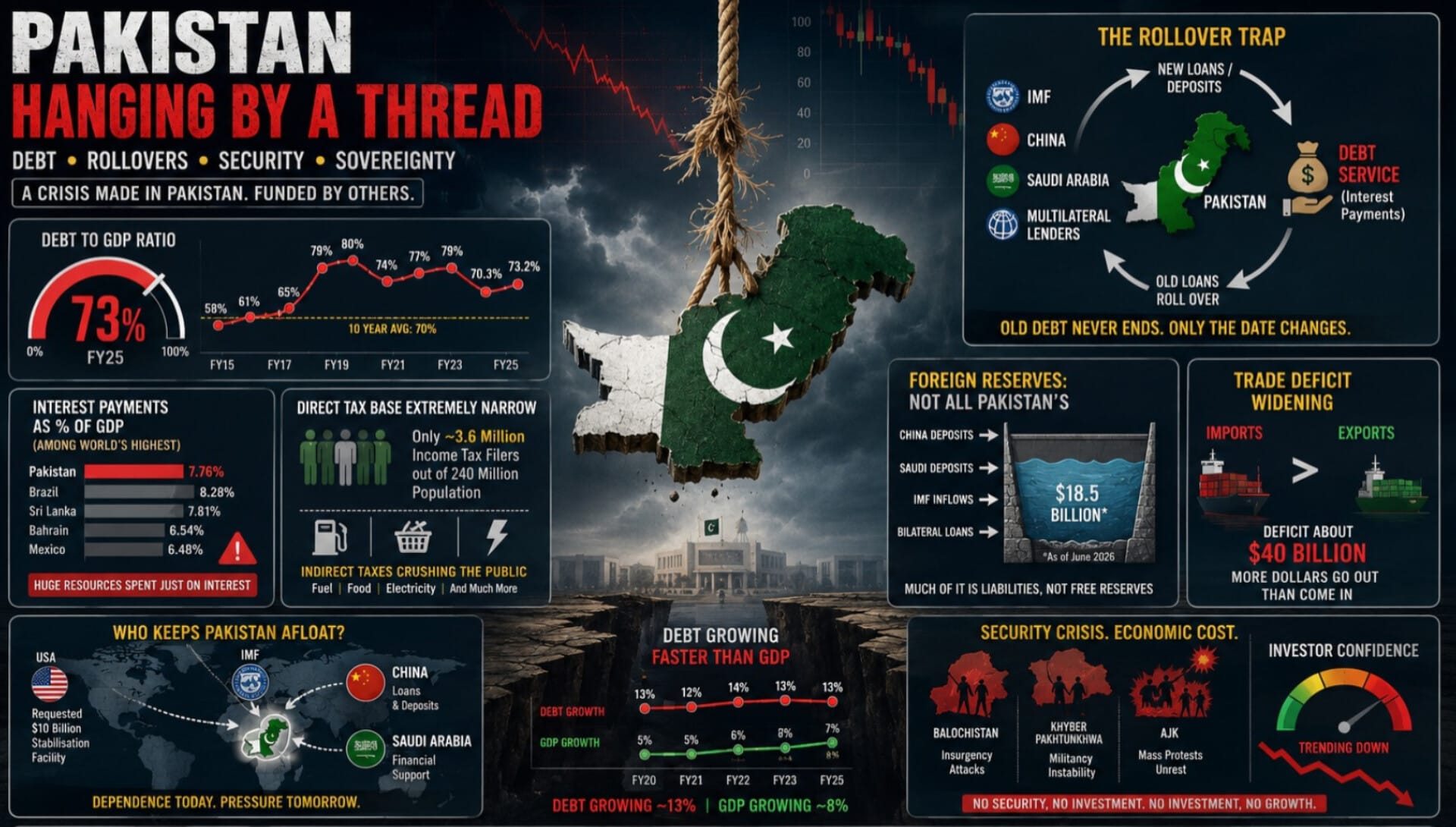
Pakistan's economic crisis is no longer simply about inflation, debt or another IMF bailout. It has evolved into a geopolitical struggle in which every diplomatic move is increasingly viewed through the prism of financial survival.
According to recent reports, Islamabad is seeking a US$10 billion currency stabilisation facility from the United States, a request that reportedly followed Pakistan's attempt to position itself as a diplomatic intermediary during the recent Iran-Israel crisis. Yet the effort to present itself as a regional peacemaker appears to have produced little tangible diplomatic success, raising questions about whether Pakistan's foreign policy is increasingly being driven by economic desperation rather than strategic vision.
If true, the request would underline a deeper reality: Pakistan's economy is becoming increasingly dependent on external powers simply to maintain macroeconomic stability.
An Economy Living on Borrowed Time
Pakistan's public debt has now climbed to approximately 73% of GDP, compared with around 58% a decade ago.
More worrying is the underlying trend.
Debt has consistently grown faster than the economy itself.
Interest payments alone consume one of the highest shares of GDP anywhere in the world, leaving progressively less fiscal space for healthcare, education, infrastructure and productive investment.
Rather than paying down debt, Islamabad increasingly survives by rolling over existing obligations.
China renews deposits.
Saudi Arabia extends financial facilities.
The IMF provides periodic programmes.
Commercial creditors refinance earlier loans.
Old debt is therefore replaced with new debt.
The liability never truly disappears.
Economists describe this as refinancing.
Critics increasingly describe it as financial life support.
Foreign Reserves That Are Not Entirely Pakistan's
Pakistan's foreign exchange reserves have recovered significantly since the crisis of 2023.
However, much of this improvement reflects external deposits and official financing rather than organically generated export earnings.
Chinese SAFE deposits.
Saudi deposits.
IMF disbursements.
Multilateral borrowing.
While these strengthen headline reserve figures, they also represent obligations that remain dependent on continued political goodwill from external partners.
The Trade Deficit Remains Unresolved
Pakistan continues importing substantially more than it exports.
Industrial machinery.
Petroleum.
Chemicals.
Edible oil.
Meanwhile exports remain concentrated in textiles and other relatively low-value sectors.
The resulting dollar shortage continues to be financed primarily through:
external borrowing,
workers' remittances,
IMF programmes,
bilateral financial support.
Without structural reforms, this cycle becomes increasingly difficult to sustain.
Security Deterioration Carries an Economic Cost
Pakistan's financial challenges coincide with one of the country's most serious internal security environments in years.
Militant attacks in Balochistan and Khyber Pakhtunkhwa continue to impose heavy pressure on security forces.
Political instability remains unresolved.
The prolonged unrest in Pakistan-administered Kashmir (AJK) has added another dimension to domestic uncertainty.
Whether viewed through the lens of sovereign risk or foreign direct investment, prolonged instability increases financing costs and weakens investor confidence.
Economic confidence and national security are becoming inseparable.
Washington: Pakistan's New Financial Hope?
The reported request for a US$10 billion American stabilisation facility illustrates an important geopolitical shift.
For years Islamabad relied primarily upon Beijing, Riyadh and the IMF.
Now, according to these reports, Washington itself may once again be viewed as an indispensable financial backstop.
The timing is significant.
Pakistan recently attempted to present itself as a diplomatic intermediary regarding Iran.
Yet that initiative produced little measurable diplomatic breakthrough.
If Islamabad expected geopolitical goodwill to translate into financial assistance, the strategy appears, so far, to have delivered limited results.
Saudi Arabia's Reported Reluctance
An additional development, which Parrhesia News has not independently verified, comes from Pakistani intelligence sources familiar with discussions surrounding Gulf financing.
According to these sources, Saudi Arabia has declined to support or facilitate an approximately US$8 billion financing arrangement sought by Pakistan, complicating Islamabad's search for external liquidity.
These claims remain unverified and should therefore be treated with appropriate caution.
Nevertheless, if accurate, they would represent a significant departure from Riyadh's historical role as one of Pakistan's principal financial supporters.
A Dangerous Strategic Dilemma
The same intelligence sources allege another potentially significant development.
They claim that Pakistan's existing defence commitments with Saudi Arabia could eventually require Islamabad to provide military support should conflict expand into Yemen.
Such a scenario would carry profound strategic consequences.
Pakistan shares a long border with Iran.
Military involvement against Iranian-aligned forces in Yemen would inevitably place Islamabad in an exceptionally delicate regional position.
Whether such military commitments would actually materialise remains entirely speculative.
No official confirmation exists.
Nevertheless, the possibility illustrates the growing risks faced by countries whose economic dependence increasingly intersects with geopolitical obligations.
The Nuclear Question
Another strategic question looms quietly in the background.
As Pakistan's fiscal vulnerabilities deepen, international pressure surrounding its strategic capabilities may also intensify.
Various analysts have long debated whether external financial dependence could gradually translate into increased leverage over Pakistan's strategic decision-making.
No evidence currently suggests any imminent requirement concerning Pakistan's nuclear arsenal.
However, heavy external dependence inevitably reduces policy flexibility.
History demonstrates that creditors often acquire influence extending well beyond economics.
The Political Dimension
Against this backdrop, Pakistan remains politically polarised.
Former Prime Minister Imran Khan remains imprisoned, while his supporters argue that meaningful economic reform cannot occur without political stability and institutional legitimacy.
Others disagree.
What is increasingly difficult to dispute is that prolonged political confrontation adds another layer of uncertainty to an already fragile investment environment.
An Economy Hanging by a Thread
Pakistan is not facing inevitable collapse.
Neither is bankruptcy unavoidable.
However, the country's economic model increasingly rests upon five fragile pillars:
continued IMF engagement,
annual bilateral loan rollovers,
sustained remittance inflows,
access to external financing,
and the avoidance of a major geopolitical or domestic shock.
Remove several simultaneously, and macroeconomic stability could deteriorate rapidly.
The central question is therefore no longer whether Pakistan requires another bailout.
It is whether repeated bailouts can continue indefinitely without addressing the structural weaknesses that created the crisis in the first place.
As long as economic survival depends more upon diplomatic bargaining than domestic productivity, Pakistan's sovereignty will remain constrained not only by its creditors, but also by the geopolitical expectations that increasingly accompany financial support.
The thread holding Pakistan's economy together has not yet snapped.
But it appears thinner than at any point in recent decades.


Reader comments
Subscribers can join the conversationSign in to join the conversation. Comments are open to everyone with a free account.
Sign in or create accountLoading comments…