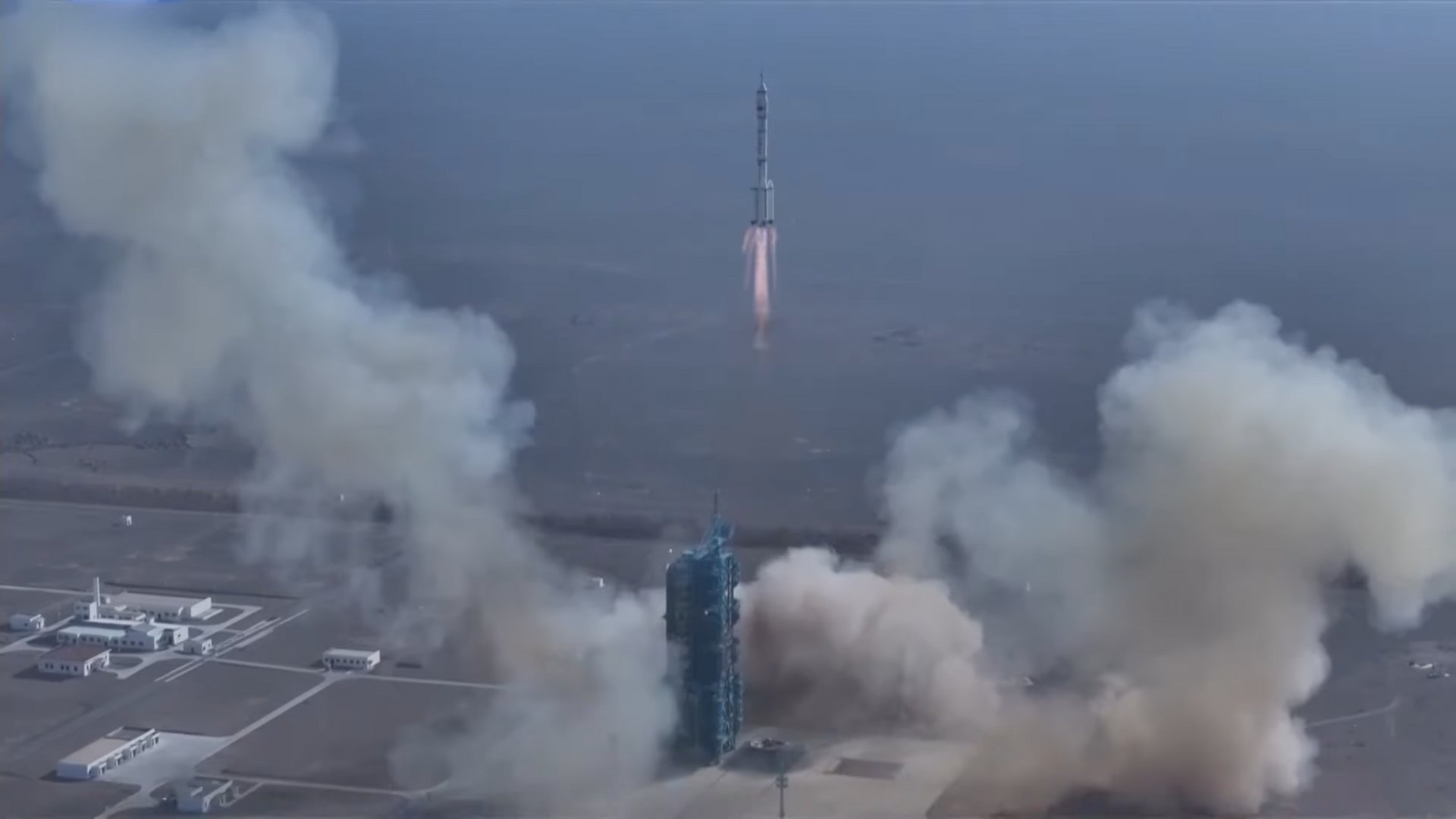
Pakistani astronaut Muhammad Zeeshan Ali became the first foreign national to board China’s Tiangong space station on Wednesday, marking a milestone for Pakistan’s space ambitions and Beijing’s effort to internationalise its orbital outpost.
The Shenzhou-24 spacecraft lifted off aboard a Long March-2F rocket at 08:18 Beijing time (00:18 GMT) from the Jiuquan Satellite Launch Centre in northwestern China, carrying Chinese commander Tang Hongbo, flight engineer Wu Yi and Ali, who is serving as a payload specialist. The China Manned Space Agency (CMSA) said the outgoing Shenzhou-23 crew opened the station’s hatch at 14:35 Beijing time (06:35 GMT) to welcome the trio in the first “space handshake” between Chinese and foreign astronauts.
Ali, a 40-year-old former fighter pilot, is the first Pakistani to reach orbit. He trained for months in China, including studying Mandarin, under a bilateral space-cooperation agreement signed in February 2025. Before launch, he told reporters at Jiuquan that he was carrying “the name of Pakistan on my shoulder”.
Unlike Tang and Wu — who are scheduled to remain aboard Tiangong for roughly six months alongside Shenzhou-23 astronaut Zhu Yangzhu as Zhu completes a year-long orbital stay experiment — Ali will conduct a shorter flight lasting five to ten days, according to CMSA and wire reports. His work focuses on joint China-Pakistan experiments, including studies of bacterial photosynthesis and the effects of radiation and microgravity on seeds, before he returns to Earth aboard the Shenzhou-23 capsule with two outgoing Chinese astronauts.
Political leaders in both capitals highlighted the diplomatic symbolism of the mission. Pakistani Prime Minister Shehbaz Sharif wrote on X that the flight was “living proof of the ironclad friendship between Pakistan and China”, while Chinese President Xi Jinping exchanged congratulatory messages with Pakistani President Asif Ali Zardari. For Beijing, hosting a foreign payload specialist supports its push to position Tiangong as an international research platform alongside its broader goal of landing Chinese astronauts on the Moon before 2030.

Reader comments
Subscribers can join the conversationSign in to join the conversation. Comments are open to everyone with a free account.
Sign in or create accountLoading comments…