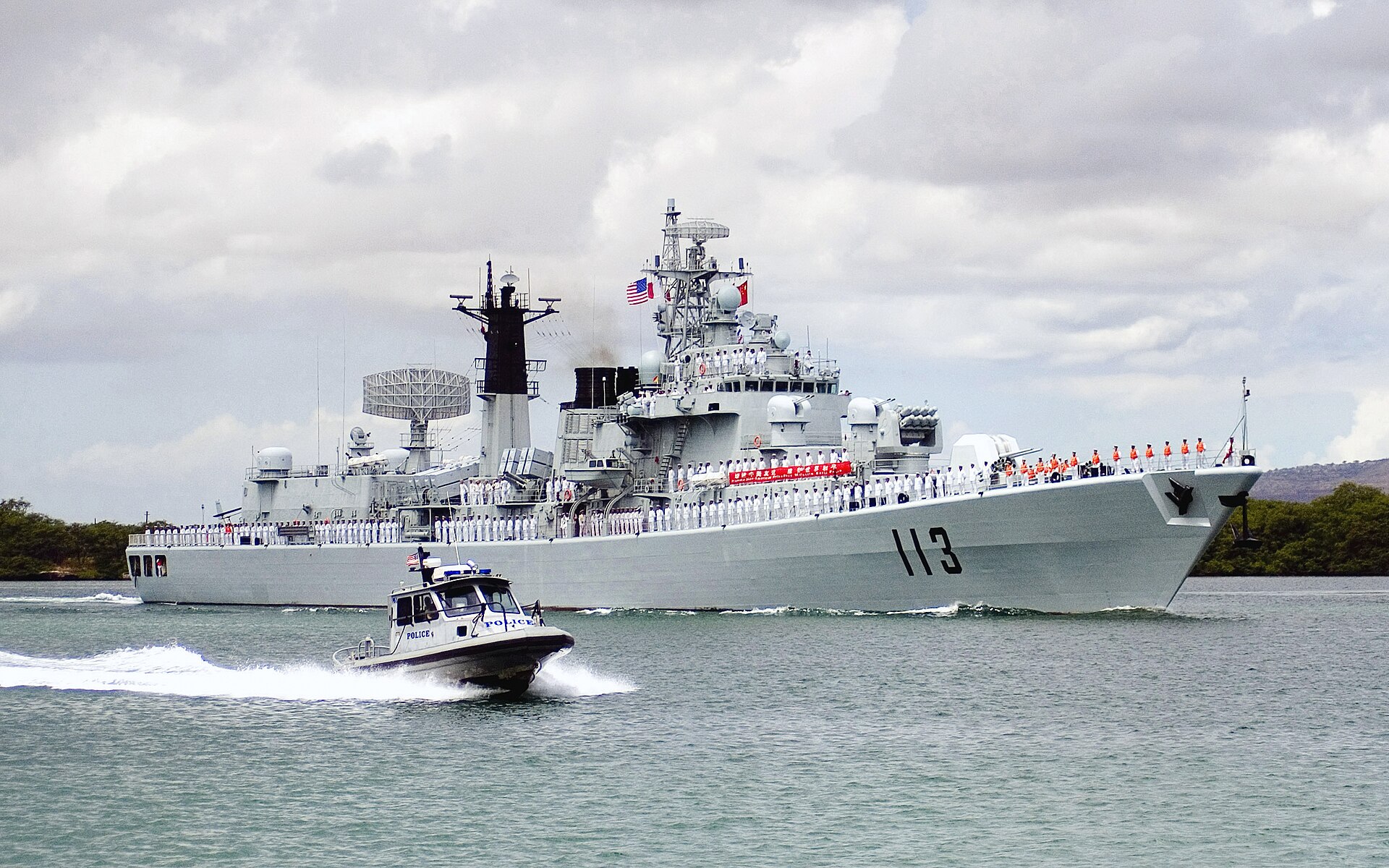
Japan has raised a formal safety concern after a Chinese guided-missile destroyer conducted a live-fire exercise inside an area Tokyo claims as its exclusive economic zone in the Pacific.
The drill took place on Sunday about 180 kilometres southwest of Okinotori, Japan’s southernmost island, according to the Japanese Joint Staff. The Luyang III-class destroyer was operating alongside two other Chinese warships and a Russian frigate as part of wider China-Russia naval activity.
Japanese officials said ships in the area received notice only shortly before the firing began. Chief Cabinet Secretary Minoru Kihara said Tokyo had conveyed concern that the exercise could have endangered nearby vessels and promised continued monitoring of Chinese and Russian operations around Japan.
The incident is significant less because live firing in an exclusive economic zone is automatically unlawful — Japanese officials acknowledged that it was not a breach of international law — than because it reflects a pattern of increasingly visible Chinese and Russian military activity close to Japan.
Defence Minister Shinjiro Koizumi said the exercise demonstrated deepening military cooperation between Beijing and Moscow. He also pointed to China’s recent submarine-launched ballistic missile test and repeated joint bomber flights by the two countries around Japan.
China rejected the criticism. Foreign Ministry spokesperson Lin Jian accused Japan of exaggerating external threats to justify its own military expansion. Beijing also disputes Japan’s claim to an exclusive economic zone around Okinotori, arguing that the remote feature is a rock rather than an island capable of generating full maritime rights.
That legal disagreement matters because an exclusive economic zone gives a coastal state rights over natural resources, but not the same sovereign control it has in territorial waters. Foreign military vessels generally retain navigation rights, making advance notification, safety and political signalling central to the dispute.
Japan said this was the first time it had publicly disclosed detecting a Chinese live-fire drill within its claimed EEZ. The same group of Chinese and Russian ships had earlier sailed between Okinawa and Miyako, another passage closely watched by Japanese defence planners.
Tokyo has become increasingly concerned about China’s ability to operate farther into the Pacific. Chinese aircraft carriers were seen near Iwo Jima last year, and the latest exercise follows a broader expansion of Beijing’s naval, missile and submarine activity.
The dispute is not only about one firing exercise. It is about whose rules, warnings and strategic presence will shape the western Pacific as China and Russia deepen cooperation and Japan accelerates its own defence preparations.


Reader comments
Subscribers can join the conversationSign in to join the conversation. Comments are open to everyone with a free account.
Sign in or create accountLoading comments…