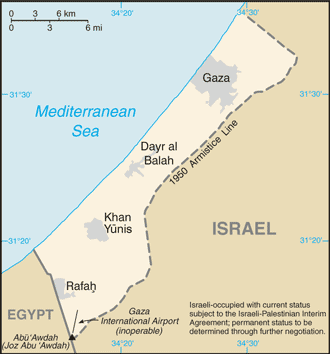
The Israeli military is building more than 23 kilometres of earthen barriers inside the Gaza Strip, reinforcing a ceasefire line that was originally presented as temporary.
Satellite imagery analysed by the Associated Press shows construction running through areas controlled by Israel and across Palestinian communities that have largely been demolished. The barrier already extends for more than half the length of the coastal enclave.
Israel's military confirmed that it has built a physical barrier around the so-called yellow line, the boundary to which its forces withdrew under an October ceasefire agreement with Hamas.
The line was intended to mark an interim division while negotiations moved toward a fuller Israeli withdrawal. With the political process stalled, the scale and speed of construction have intensified Palestinian fears that the line is becoming a permanent border.
The military says the barrier is part of a wider security zone equipped with surveillance, intelligence and technological systems. It says the aim is to prevent infiltration, protect Israeli troops and defend communities near Gaza.
The military has not disclosed the full planned route or how far construction will extend. Satellite images show major stretches in central and southern Gaza, including sections near Rafah and Khan Younis, as well as separate earthworks in the north.
One southern section expanded by almost two kilometres within two weeks, illustrating how quickly the project is advancing. If connected to the existing network, it would deepen the physical separation between the coastal area where most Palestinians now live and the eastern territory controlled by Israel.
Gaza's population has been pushed largely west of the yellow line, many into overcrowded tent camps and areas dependent on humanitarian assistance. On the Israeli-controlled side, satellite imagery shows extensive demolition, new military roads and bases built across the ruins of towns and neighbourhoods.
Israel says it is destroying tunnels, weapons sites and other infrastructure used by Hamas. Palestinians and human-rights organisations argue that the scale of destruction is reshaping Gaza's geography and making the return of displaced communities increasingly difficult.
The yellow line has never been precisely defined in public documents or consistently marked on the ground. That ambiguity has already proved deadly. Israeli forces have shot Palestinians who approached or crossed the boundary, while the military says it targets people considered a threat to troops.
The new barrier may make the line more visible, but it also gives a temporary military arrangement a more durable physical form.
That has implications for ceasefire negotiations, reconstruction and the future governance of Gaza. Any permanent division would raise major legal and political questions over territory, displacement and the possibility of a viable Palestinian administration.
Neither the US-led bodies responsible for monitoring the ceasefire nor the wider international framework for Gaza's future has offered a detailed public response to the earthworks.
A temporary military line is acquiring the physical features of a border.
The immediate question is how far the barrier will extend. The larger question is whether the division of Gaza is now being established on the ground faster than diplomacy can reverse it.


Reader comments
Subscribers can join the conversationSign in to join the conversation. Comments are open to everyone with a free account.
Sign in or create accountLoading comments…