
For decades, the power brokers running Pakistan’s security and foreign policy apparatus have operated within a calculated dichotomy, using the broader nation as a shield while protecting proxy networks. On international platforms, spokespeople for the Shehbaz Sharif government and the military establishment maintain a carefully rehearsed posture of denial. Whenever foreign governments or international observers present evidence of militant launchpads or state-backed proxy networks, the script from Islamabad remains fixed: disavow non-state actors, dismiss accusations as hostile rhetoric, and demand concrete proof.
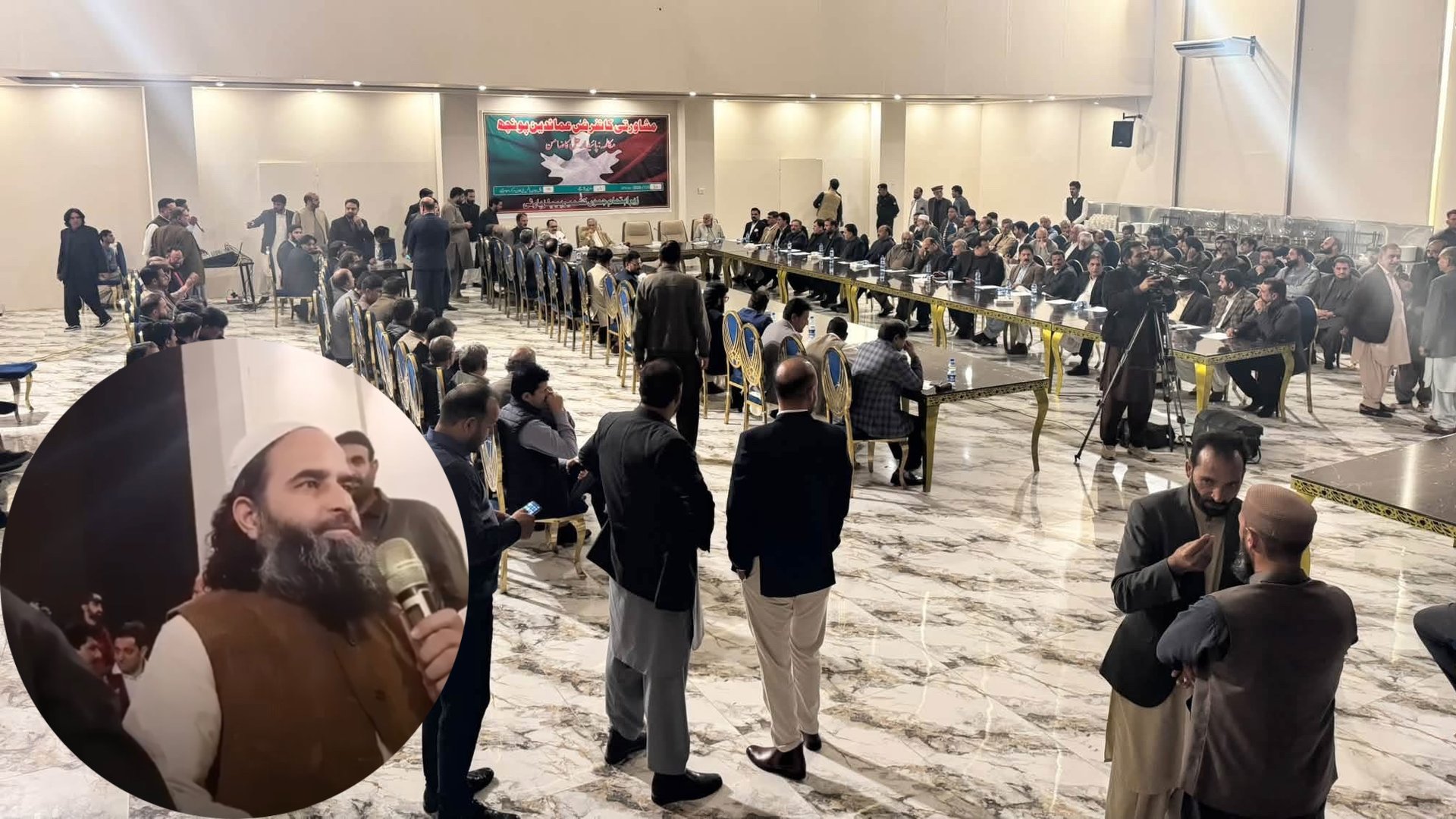
This posture was displayed once again at the SCO Civilizational Dialogue, where Federal Minister for Climate Change and Environmental Coordination Musadik Malik (Musadik Masood Malik) reiterated the standard line to media, calling for evidence-based exchanges rather than acknowledging state-linked proxy infrastructure. Yet, as a counter-terrorism analyst observing domestic security dynamics, the disconnect between official diplomatic spin and ground reality under Shehbaz Sharif and Army Chief Asim Munir has reached a breaking point. The collapse of that official posture did not occur through a foreign intelligence dossier or covert leak; it happened openly, on camera, inside a political conference in Pakistan’s federal capital Islamabad on 23rd November 2026.
The AJK Uprising : A Crisis of Governance
To understand how a proscribed militant leader came to address a political summit in Islamabad, one must analyze the ongoing civil rebellion in Pakistan-administered Jammu and Kashmir (PaJK)/Azad Jammu Kashmir (AJK). For over five and a half months, the region has experienced an unprecedented public revolt led by the Joint Awami Action Committee (JAAC). What began as economic agitation against rising wheat prices, slashed subsidies, steep electricity tariffs, and political grievances over representation rapidly morphed into a structural challenge to the federal administration led by Shehbaz Sharif and General Asim Munir.
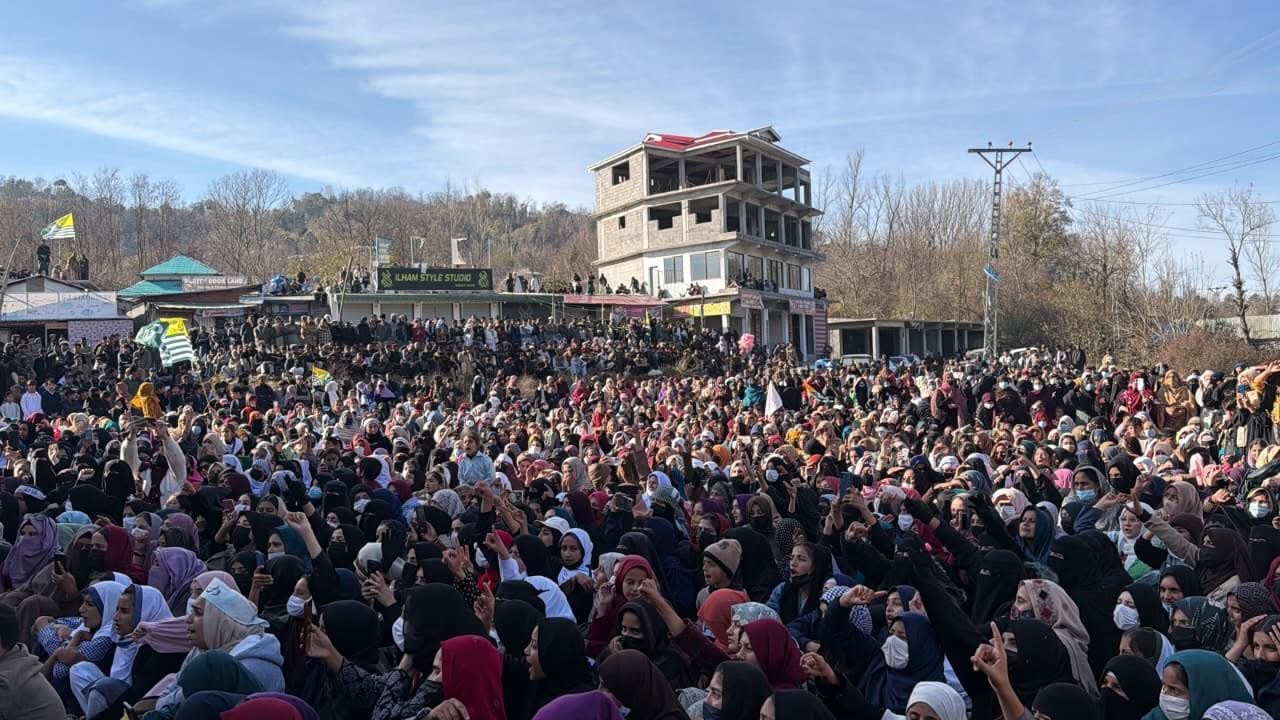
From Muzaffarabad to Mirpur, trade unions, student groups, and local activists paralyzed regional infrastructure, with Rawalakot in the Poonch district becoming the tactical core of the uprising. Rather than addressing civilian grievances through accountable governance, the Shehbaz-Munir security apparatus responded with heavy-handed coercion: invoking the Anti-Terrorism Act (ATA) against civilian organizers, imposing blanket internet blackouts, proscribing the protest committee, and deploying paramilitary forces and security operations to enforce order. Instead of restoring calm, aggressive crackdowns escalated street clashes, resulting in civilian fatalities and deepening alienation across the region. Security forces found themselves tactically overextended and locally delegitimized, and the breakdown of civil authority reached a point where movement organizers openly challenged the heavy-handed military posture of the regime.
The Islamabad Summit and the On-Camera Confession
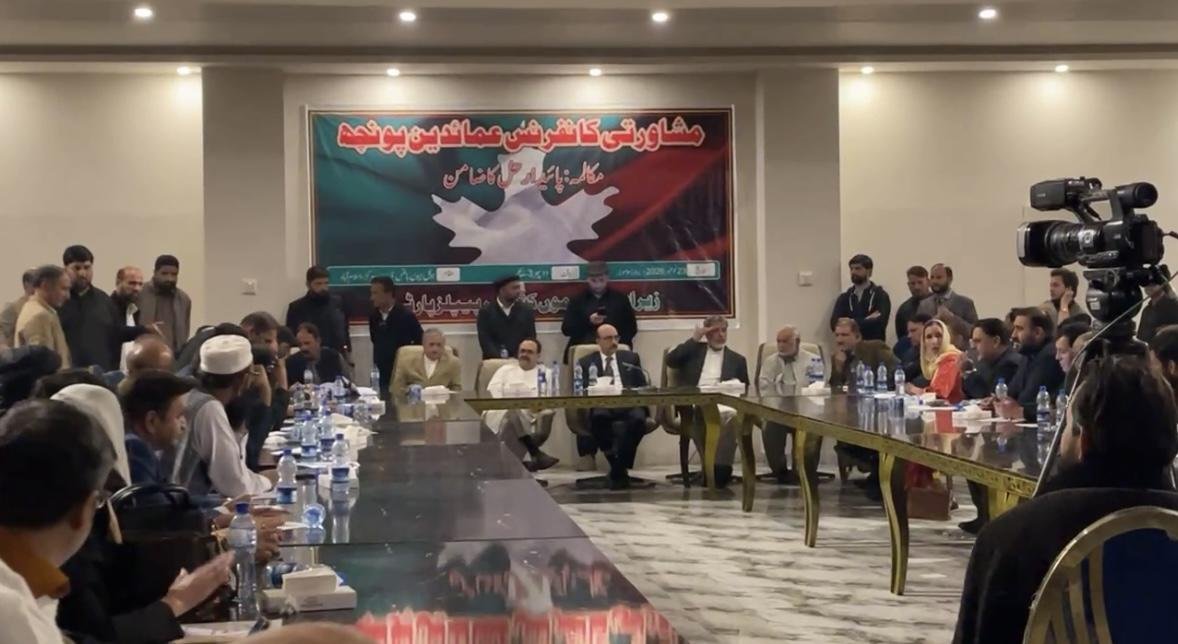
Facing administrative paralysis in AJK/PaJK, pro-establishment political parties, intellectuals and religious groups convened an emergency consultation titled the "Umaideen-e-Poonch" conference in Islamabad to broker a political compromise. Lacking grassroots legitimacy among the protesters, organizers turned to informal power brokers embedded within the state's security orbit.
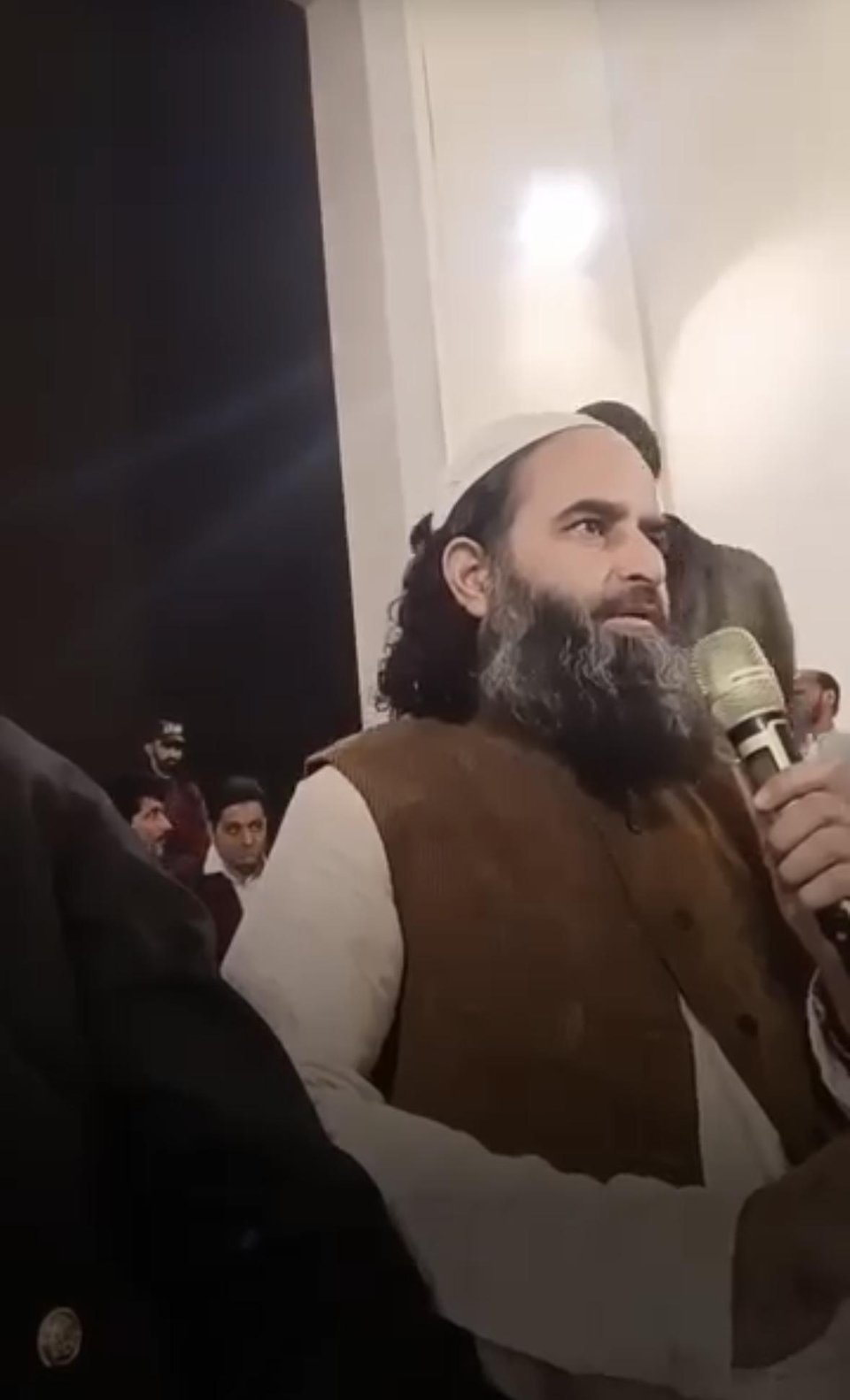
The microphone was handed to Masood Ilyas (alias Abu Mohammad / Mufti Masood Ilyas), a senior commander within the command council of Jaish-e-Mohammed (JeM) an organization formally proscribed under domestic law and listed under United Nations Security Council (UNSC) terror frameworks. Masood Ilyas is also a designated individual terrorist under India’s Unlawful Activities (Prevention) Act (UAPA) and a key target on the National Investigation Agency's (NIA) wanted list for cross-border terror plots, including the April 2022 Sunjwan attack in Jammu.
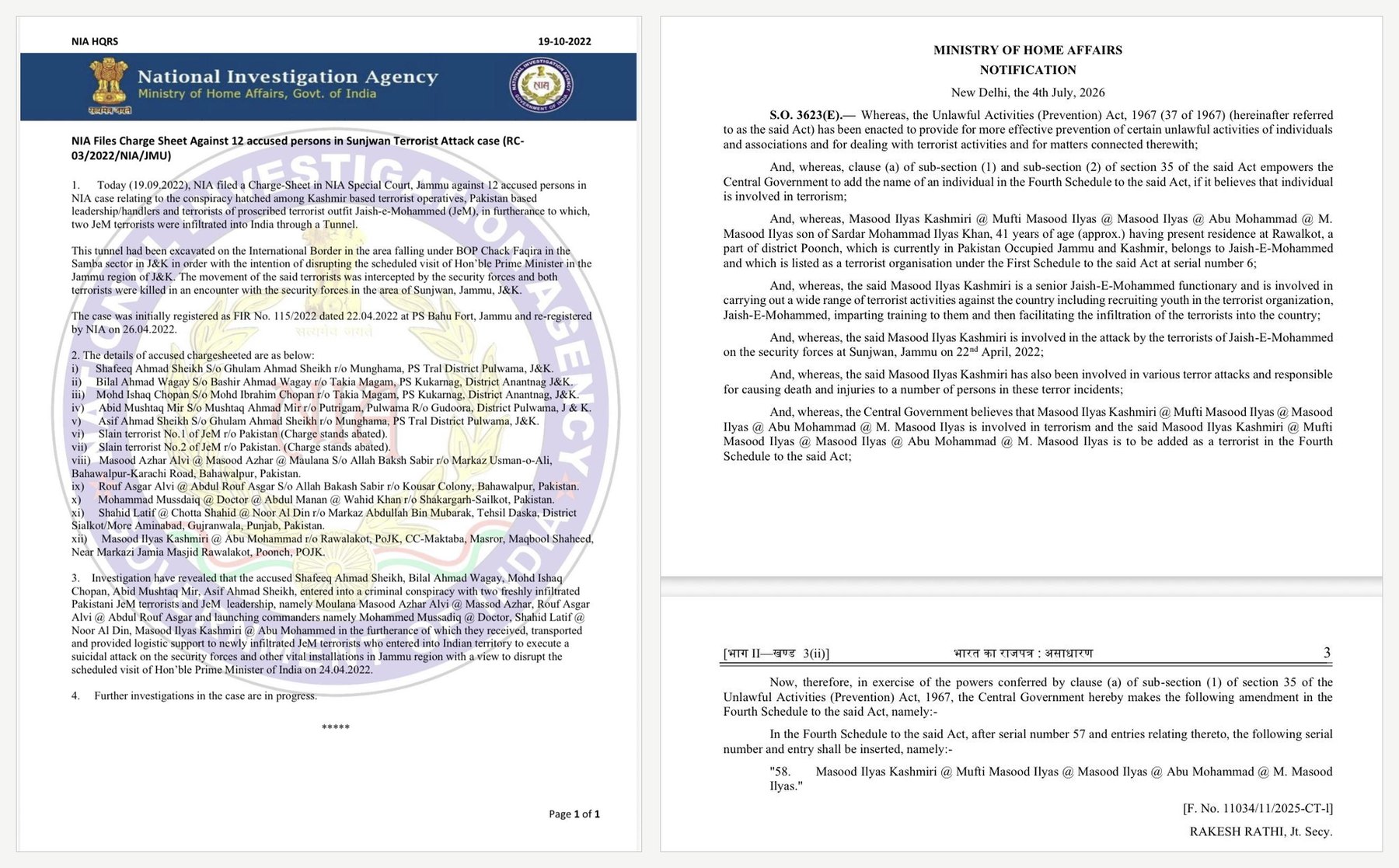
Addressing the assembly, Masood Ilyas delivered statements that shattered official denials by the Shehbaz-Munir administration and the Inter-Services Intelligence (ISI). He explicitly confirmed that Jaish-e-Mohammed maintains active operational infrastructure in PaJK, naming a primary launchpad base in Rawalakot and a regional command center (markaz) in the Dharamsal area of Poonch district. He disclosed that senior ISI officers met with him in Islamabad and handed him an intelligence list containing 22 names of active Rawalakot protesters suspected of being JeM operatives.
Masood Ilyas assured the political gathering that his commandos were trained and deployed exclusively for cross-border infiltration into Indian-administered Jammu and Kashmir, asserting they were not tasked with joining domestic riots or besieging local politicians' homes. He further revealed holding five separate meetings with JAAC representatives to mediate the conflict, proposing that JeM provide armed security details for political delegations traveling to Rawalakot.
The Institutional Nexus : The Roles of the ISI and Military Command
Masood Ilyas’s admission brings into sharp focus the operational mechanics of the state-proxy nexus managed by the ISI and Pakistan's military command under Asim Munir, operating alongside the political cover provided by the Shehbaz Sharif government. Within this architecture, the ISI particularly its specialized intelligence and covert action branches serves as the primary administrative bridge between Rawalpindi’s military command and militant networks like Jaish-e-Mohammed.
Rather than functioning as rogue outfits beyond state reach, these networks rely on institutional coordination for logistics, combat training, infiltration routing along the Line of Control (LoC), and intelligence sharing. Masood Ilyas’s disclosure that ISI officers handed him a surveillance dossier of 22 suspected operatives during an ongoing domestic crisis shows that ISI handlers treat designated terror leaders as active operational interlocutors. When civilian governance falters as seen in AJK/PaJK the Shehbaz-Munir security apparatus leans on proxy commanders to conduct shadow mediation, track dissent, and preserve strategic leverage when coercive policing fails.
Legal Arbitrage : Schedule 4 Hits on Dissidents, Activists, and Exile Targets
From an institutional and legal standpoint, Masood Ilyas’s public presence in Islamabad exposes a glaring double standard in how the Shehbaz-Munir regime enforces Pakistan's own anti-terrorism laws. Under Section 11EE of Pakistan’s Anti-Terrorism Act (ATA), Schedule 4 is designed as a strict watch-list mechanism for individuals linked to proscribed organizations, legally requiring watch-listed individuals to report regularly to local police precincts, submit to asset freezes and financial audits, surrender travel documents, remain listed on the Exit Control List (ECL) to prevent foreign travel, and refrain from attending public gatherings or issuing media statements. In practice, a stark dual standard governs enforcement under the current regime.
Commanders of UNSC-designated outfits like Jaish-e-Mohammed including Masood Ilyas operate under paper-only constraints, traveling freely, interfacing directly with ISI officers, and addressing political assemblies in the capital without law enforcement interference. By contrast, Schedule 4 watch-listing, ATA charges, and ECL travel bans hit peaceful political dissidents, civil rights activists, and movement organizers with severe legal force. Across PaJK, rights defenders and community leaders such as Shaukat Nawaz Mir, Sardar Umar Nazir, and Sardar Aman Khan of the Joint Awami Action Committee alongside diaspora advocates like Amjad Ayub Mirza have faced state crackdowns, arrests, and legal pressure, while wider civil society and rights figures across Pakistan including Baloch rights advocate Mahrang Baloch, Pashtun rights leader Manzoor Pashteen, and Former Military Officials and commentators such as Adil Raja, Haider Mehdi have encountered anti-terrorism proceedings, watchlist or travel restrictions, and relentless state pressure.
Even more troubling for international security is how this selective enforcement extends abroad: while UNSC-listed militant commanders enjoy sanctuary and operational latitude at home, exiled dissidents, former officers, and political critics living overseas—including figures such as Adil Raja and Haider Mehdi, alongside exiled activists and journalists who have faced intimidation, surveillance, abductions of relatives, or plots abroad, including Sajid Hussain and Ahmad Waqass Goraya have been targeted through transnational repression networks linked to ISI and state intelligence channels.
Friction Over Proxies, the Rift with Asim Munir, and Political Retribution Against Imran Khan
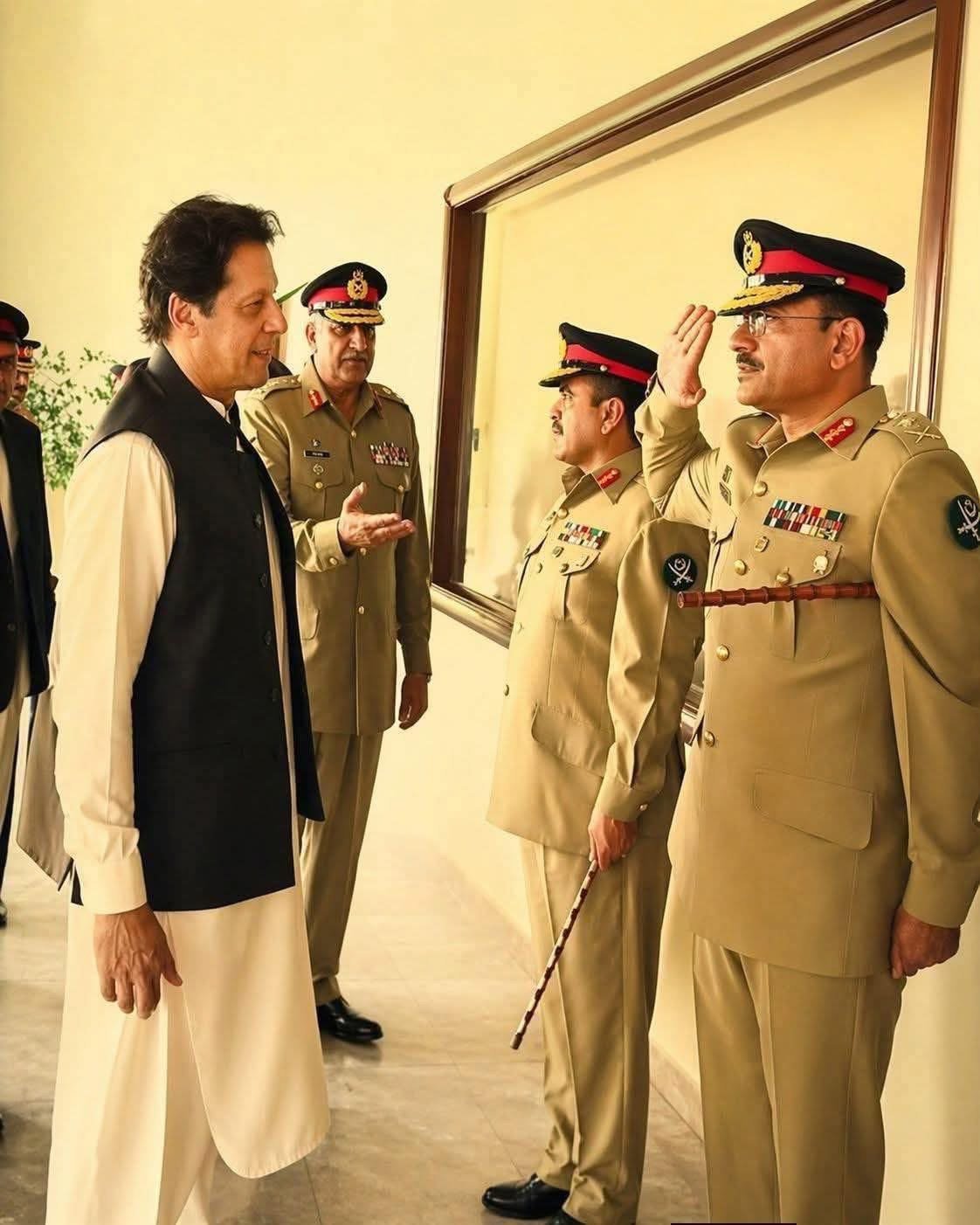
The resurgence of overt proxy influence and coercive state control under Asim Munir also points back to a deeper institutional fault line over how Pakistan manages militant networks and state security. During his time in government, former Prime Minister Imran Khan repeatedly framed Pakistan's national security around economic stabilization, regional connectivity, and curbing unregulated militant sanctuaries or Financial Action Task Force (FATF) compliance pressures, while pushing for civilian oversight and institutional alignment that clashed with entrenched intelligence prerogatives.
Friction with Asim Munir who had previously headed the ISI before his abrupt removal during Khan's tenure deepened sharply once Munir rose to become Chief of Army Staff in late November 2022, reversing or sidelining approaches favored by Khan and consolidating military dominance over security, foreign policy, and internal order. Following Khan's ouster in 2022 and the ensuing political confrontation, the rift turned into an all-out struggle: Khan openly accused Munir and the security establishment of orchestrating a crackdown against his party, while severe legal cases, imprisonment, restricted detention conditions, and aggressive state action against his political movement followed. From a counter-terrorism viewpoint, Khan's prolonged incarceration and the sidelining of civilian pushback against unchecked security-proxy power illustrate how institutional resistance to traditional intelligence methods in Pakistan can trigger fierce political and legal retaliation from those who control the coercive apparatus.
The Strategic and Economic Blowback on Ordinary Citizens
The decision by Shehbaz Sharif, Asim Munir, and the ISI to harbor and manage non-state proxies inflicts severe strategic and economic blowback not on the generals or ruling elites, but on ordinary citizens who are forced to foot the bill. Decades of international financial scrutiny, capital flight, and depressed Foreign Direct Investment (FDI) have cost the national economy over $150 billion, eroding living standards while leaving strategic elites insulated.
Recurrent austerity measures and structural adjustments tied to international bailout programs including subsidy removals, higher indirect taxes, and steep electricity tariff hikes squeeze everyday households to keep a security-heavy state budget afloat. The economic pressures that fueled the PaJK uprising stem directly from governance and fiscal priorities that privilege military and intelligence power over public health, education, and local development. Furthermore, the militant infrastructure cultivated for external proxy operations has repeatedly fractured, feeding domestic violence that claims the lives of ordinary civilians and frontline personnel alike.
The events at the "Umaideen-e-Poonch” conference represent a clear breakdown in the Shehbaz-Munir regime's and ISI's strategic narrative. When a proscribed commander listed under international counter-terrorism frameworks can publicly detail active operational bases and ISI intelligence briefings from the federal capital, domestic legal frameworks lose their institutional credibility. Lasting economic recovery and internal stability require ending the ISI-proxy nexus, eliminating legal double standards under Schedule 4 and the ATA, and holding the Shehbaz-Munir establishment accountable to civilian law and public welfare rather than covert warfare.

Reader comments
Subscribers can join the conversationSign in to join the conversation. Comments are open to everyone with a free account.
Sign in or create accountLoading comments…