
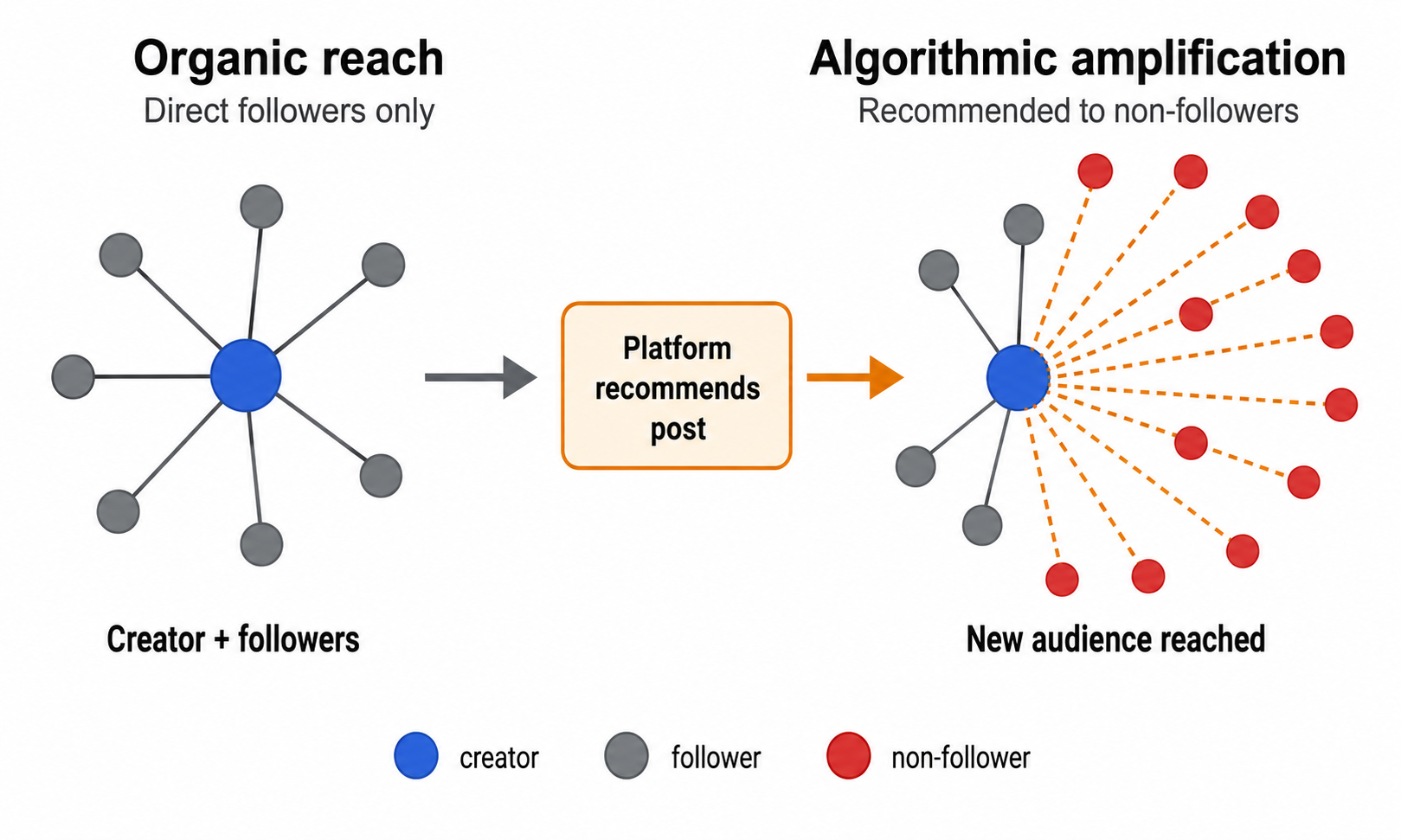
The old media gatekeeper decided whether a story would be printed or broadcast. The new gatekeeper is more diffuse. It is a collection of ranking systems, recommendation engines, advertising rules, trust signals and automated moderation tools that decide what appears first, what travels widely and what becomes difficult to find.
This power is easy to underestimate because content can remain technically available. A political video may not be removed, yet a recommendation system may stop offering it to new viewers. A news page may still exist, but search results may rank it beneath institutional sources. A creator may retain an account while losing advertising access or the ability to appear in trends. Each decision can be defended as product design. Together they structure the public sphere.
Why recommendation matters
Most users do not navigate the internet by typing exact addresses. They follow feeds, search results and suggested videos. Ofcom's research notes that recommender systems match creators with audiences but can also spread illegal or harmful material depending on design choices. The same architecture that can accelerate harmful content can also suppress lawful content if risk models are crude, opaque or over-cautious.
The problem is not that algorithms make choices. Any feed must rank. The problem is that the criteria are commercially and politically consequential while largely invisible. Engagement-based systems may favour outrage because it holds attention. Safety systems may downgrade controversial reporting because automated classifiers cannot distinguish documentation from endorsement. "Authoritative source" preferences may reduce fabricated claims while entrenching large institutions that have themselves made serious errors.
Regulation is moving toward transparency
The European Union's Digital Services Act transparency framework requires major platforms to disclose information about moderation, recommender parameters, advertising and systemic risks. Harmonised reporting rules now seek comparable data on removals, account restrictions and automated systems. The European Commission has also used its powers to request detailed information about how prominent services design recommendations and address risks to civic discourse.
In Britain, Ofcom's Online Safety Act codes and guidance address content moderation, search moderation, recommender systems, complaints and transparency. These measures are primarily designed to reduce harm, not to guarantee political neutrality. Yet the reporting and audit tools they create could also expose whether lawful political speech is being restricted inconsistently.
The danger of equating safety with consensus
Platforms face genuine obligations to tackle terrorism, threats, fraud, child abuse and other illegal content. The difficulty comes when rules expand from illegal material to broad categories such as misinformation, borderline content or harmful narratives. Those labels often require contextual judgment. During wars, elections and public-health emergencies, facts develop quickly and official accounts can change. A system that treats current institutional consensus as permanent truth may punish accurate dissent before evidence catches up.
Transparency should answer four questions: What action was taken? Under which rule? Was automation involved? How can a user challenge the decision?
Meaningful due process
An appeal button is not enough if the user receives a generic answer. Platforms should provide a specific statement of reasons, identify whether the decision concerns illegality, safety, advertising or recommendation, and reveal whether a human reviewed it. Appeals should be resolved by a team independent of the initial decision, with access to the actual content and context.
Researchers also need secure access to platform data. Individual anecdotes can reveal problems but cannot establish systematic bias. Independent audits should examine error rates across political viewpoints, languages and regions, while protecting personal data and trade secrets. Regulators should require platforms to test not merely whether harmful content is removed, but whether lawful journalism, satire, documentation and counterspeech are mistakenly restricted.
User choice as a democratic safeguard
One of the strongest reforms is to give users control over ranking. The DSA requires certain large platforms to offer at least one recommender option not based on profiling. That principle could go further. Users should be able to choose chronological feeds, inspect major ranking factors and reset inferred interests. News search could permit clear filters for recency, locality and source type rather than silently combining them into a single opaque order.
Choice will not eliminate manipulation. Most users will retain defaults. But defaults become more accountable when alternatives exist and can be compared.
The modern public square is engineered
Debates about online censorship often focus on deletion because it is visible. The deeper power lies in distribution. An idea that cannot reach an audience is functionally weaker even if it survives on a server. Democratic oversight therefore has to examine the full chain: moderation, ranking, recommendation, monetisation, search and appeal.
The goal should not be a mythical neutral algorithm. Every design embodies priorities. The realistic objective is a system whose priorities are disclosed, whose errors can be measured and corrected, and whose users retain meaningful agency. Without those safeguards, private ranking systems will continue to exercise public power without the accountability expected of other institutions that shape political life.
Editor's note:
This independent analytical article was developed from a source discussion involving Tony Gosling, Dr Judith Brown and Martin Summers. It discusses online-platform executives, Ofcom, the European Commission, journalists and political creators. The supplied editorial assessment assigned it safety grade A because it is grounded in current UK and EU regulatory frameworks and official transparency requirements, and avoids platform-specific bias claims unless independently evidenced. The original draft included hyperlinked source material on the relevant words.



Reader comments
Subscribers can join the conversationSign in to join the conversation. Comments are open to everyone with a free account.
Sign in or create accountLoading comments…