
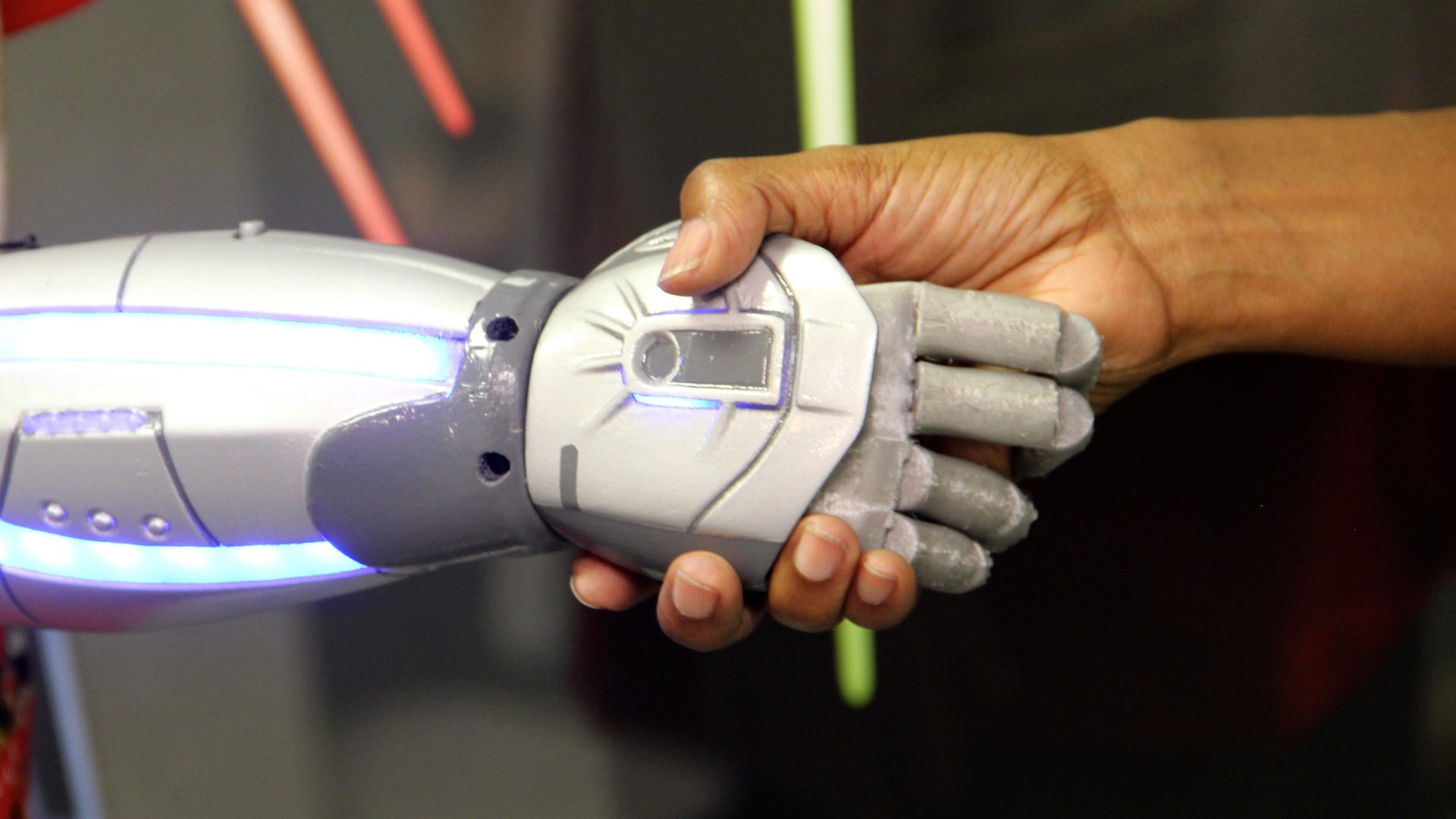
When people hear the word transhumanism, they may imagine a distant future populated by cyborgs, artificial intelligence, genetically engineered humans, and machines that allow people to live forever.
But I think it’s already here — and we are all participating in it.
Consider the technologies that have become so ordinary that we barely notice them.
Transhumanism has already arrived — we just never call it that
We use smartphones to remember appointments, navigate unfamiliar cities, communicate instantly across the world, translate languages, store photographs, monitor our health, and access enormous amounts of information. GPS allows us to overcome the limitations of our sense of direction.
The future has already been hiding in plain sight.
Contact lenses and glasses correct the limitations of our eyesight.
Pacemakers alter the functioning of the human heart. Prosthetic limbs can replace lost physical abilities. Antidepressants can alter aspects of our emotional and psychological experience. Wearable devices can continuously monitor our heart rate, sleep, exercise, and other bodily functions.
None of these technologies necessarily makes someone a “cyborg” in the science-fiction sense.
Yet they all have something in common: they allow human beings to overcome, compensate for, or modify the limitations of their biological bodies and minds.
We tend to imagine transhumanism as a future in which humans become something else. But perhaps transhumanism is simply the continuation of something humans have always done: using technology to become more than our biology allows.
Even the Pope is talking about transhumanism
Interestingly, transhumanism has also started attracting attention from some rather unexpected places.
In November 2026, Pope Leo XIV addressed the subject in a post on X, warning about the growing promises of transhumanism and posthumanism. He questioned the idea that technology could eventually eliminate disease, pain, ageing and even death.
He also raised an important question about inequality, arguing that scientific progress should not become a privilege reserved for wealthy people seeking immortality while millions of others continue to suffer from poverty and oppression.
One of his most striking observations was that “a limitation is not a manufacturing defect, but rather the very condition of human grandeur.”
It’s an interesting perspective because it challenges one of the fundamental assumptions behind transhumanism: that human limitations are things we should continually try to overcome.
And perhaps this is where the debate becomes more complicated. Is our desire to overcome biological limitations simply part of human progress, or are there aspects of being human that we should be reluctant to change?
We’ve become so accustomed to using technology to make our lives easier, healthier and longer that we rarely stop to question the direction we’re heading in.
How we learned to transcend ourselves
And this doesn’t stop with technology that we use on or inside our bodies. We have built machines that allow us to overcome limitations that are fundamental to being human.
We cannot fly, so we built aeroplanes. We cannot travel hundreds of miles in a few hours on our own, so we built trains and cars.
We cannot cross oceans without spending weeks at sea, so we built ships and aeroplanes that can take us across the world in hours.
We also cannot naturally see into space, so we built telescopes. We cannot remember everything, so we created books, computers and smartphones to store information for us.
We rarely think of these things as “enhancing” human beings. We simply call them technology.
But perhaps that’s because we have become so accustomed to extending our abilities that we no longer notice how extraordinary it is.
A human being can sit inside an aeroplane and travel at hundreds of miles per hour, something the human body could never achieve on its own.
We can cross continents by train, communicate instantly with someone on the other side of the world, and access more information in seconds than a person could have encountered in an entire lifetime.
Technology has allowed us to become faster, further-reaching, more connected and more capable than our biology alone would allow.
And perhaps that is where the idea of transhumanism begins.
When does improving ourselves become changing ourselves?
But if we’ve always used technology to overcome our limitations, what makes the next stage any different?
Perhaps the difference is that, until recently, most of our inventions existed outside of us.
We built machines to help us travel, tools to help us work, and devices to help us communicate. They extended our capabilities without necessarily changing our biological makeup.
Now, however, technology is beginning to move much closer to the human body itself.
Brain-computer interfaces, genetic engineering, advanced prosthetics and neural implants are pushing the boundaries of what we consider possible.
Researchers are exploring ways to connect the human brain directly to computers, potentially allowing people to control devices through their thoughts.
Genetic technologies are opening up possibilities for changing the way we treat inherited diseases.
Instead of simply building something that helps us overcome a limitation, we are beginning to explore whether we can remove that limitation altogether.
And this raises an interesting question: where do we draw the line between improving ourselves and fundamentally changing what it means to be human?
We generally have no problem with technology that restores something we’ve lost.
Glasses help us see, prosthetic limbs restore mobility, and pacemakers help regulate the heart. These technologies are widely accepted because they bring the body closer to what we consider normal.
But what if technology goes beyond restoring something and starts giving us abilities we never naturally possessed?
Imagine being able to enhance your memory with a brain implant, improve your eyesight beyond normal human vision, or increase your physical strength through artificial enhancements.
Would we see these developments in the same way as we see glasses or medication?
Perhaps the distinction between treatment and enhancement isn’t as obvious as we think.
The desire to become better
There is another interesting aspect to all of this. Humans have always had a desire to improve themselves.
We want to live longer, become healthier, look younger, become more intelligent and perform better.
We invest enormous amounts of time and money into improving our bodies and minds. We exercise, take supplements, undergo cosmetic procedures, use medication and increasingly rely on technology to monitor and optimise our lives.
In many ways, transhumanism takes this desire to its logical extreme.
What happens when the things we currently consider impossible become achievable? What happens when we can influence not just how long we live, but how well we age?
When we can potentially improve our memory, alter our physical capabilities or reduce our susceptibility to certain diseases?
Would we eventually reach a point where we are satisfied with ourselves?
Or would every improvement simply create a new standard to aspire to?
There is something slightly unsettling about the possibility that being human, as we currently are, might eventually be considered insufficient.
If technology allows us to become stronger, smarter, healthier and longer-lived, will choosing not to enhance ourselves still be a genuine choice?
Imagine a future where cognitive enhancements give students a significant advantage in education or where certain physical enhancements become expected in particular professions.
What begins as an optional improvement could gradually become a social expectation.
And, of course, there is the question of who gets access to these technologies. If enhancements are expensive, could we end up creating a society where the wealthy can purchase biological advantages that others cannot afford?
We could move beyond a world where inequality is measured by wealth and opportunity, towards one where it is reflected in our physical and cognitive abilities.
These are questions that we should probably be thinking about now, rather than waiting until the technology becomes commonplace.
So, what actually makes us human?
Perhaps the most interesting thing about transhumanism is that it forces us to reconsider something we rarely question: what does it actually mean to be human?
For centuries, we’ve accepted that our bodies and minds have certain limitations.
We get older, we become ill, our memories fade, our senses deteriorate and eventually we die. These things have always been part of the human experience.
But what if they didn’t have to be?
What if ageing became something we could significantly slow down?
What if we could replace failing organs with artificial ones? What if our memories could be stored externally, or our brains could communicate directly with machines?
Would we still consider ourselves entirely human?
I don’t think there is necessarily a straightforward answer. Perhaps being human has never been about remaining biologically unchanged.
After all, we have spent thousands of years adapting our environment, developing tools and finding ways to make life easier and longer.
Maybe our ability to use technology to transform ourselves is actually one of the most human things about us.
We tend to think of transhumanism as a dramatic departure from humanity, but perhaps it is simply another chapter in our long relationship with technology.
We have already extended our movement, our senses, our memories and our physical abilities. We have found ways to overcome limitations that once seemed permanent.
The next step may simply be a continuation of that process, only this time the technology might become part of us rather than something we carry around.
Perhaps we aren’t waiting for the transhumanist future to arrive.
Perhaps we’ve been building it all along.



Reader comments
Subscribers can join the conversationSign in to join the conversation. Comments are open to everyone with a free account.
Sign in or create accountLoading comments…