
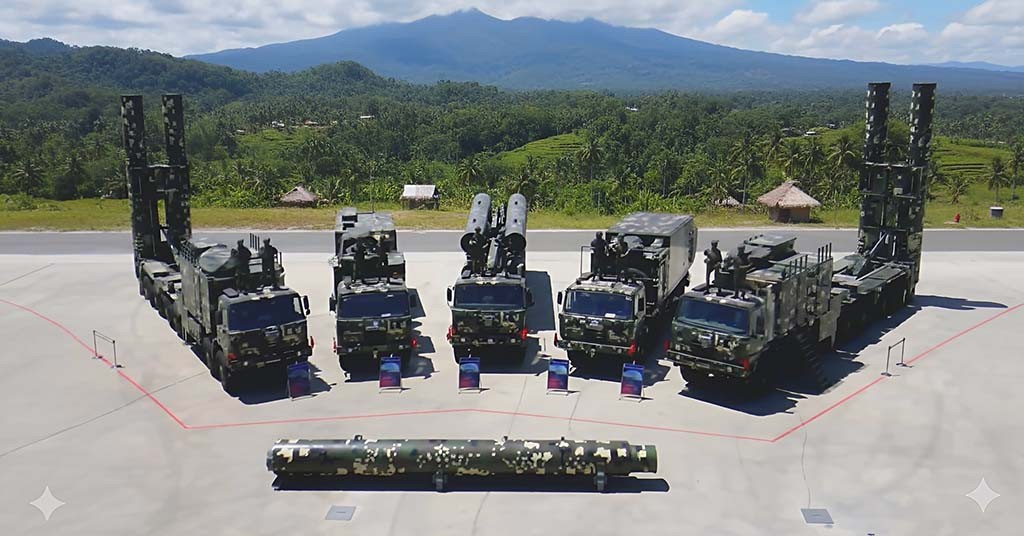
On the sidelines of the BRICS summit in New Delhi, a single confirmation redraws a strategic map. Malaysian Prime Minister Anwar Ibrahim, speaking to India's NDTV after his bilateral meeting with Prime Minister Narendra Modi, confirmed that Malaysia is exploring the acquisition of India's supersonic BrahMos cruise missile. No contract was signed, no budget approved, no delivery date promised. Yet the statement matters, for the first time, a weapon that could hold Chinese warships at risk in the South China Sea has moved from exhibition halls to prime-ministerial talks and Malaysia has just become the fourth potential link in a missile ring tightening around Beijing's most contested waters.
What Anwar Actually Said
Anwar confirmed that BrahMos was discussed with Modi but stressed that no decision has been reached. The Royal Malaysian Air Force (RMAF), he said, must determine whether the weapon meets operational, technical and financial requirements, framing his support in terms of trust between the two nations. The distinction is critical, this is political openness, not a procurement programme. Malaysia has no contract, quantity, or agreed configuration and the RMAF has not yet accepted the extensive airframe modifications the missile demands.
The Capability Shift
The relevant variant is the air-launched BrahMos-A, a roughly 2,500-kg supersonic cruise missile designed around India's Su-30 fighters. Malaysia's 18 Su-30MKM jets are the natural but technically demanding platform. If integrated, the weapon would transform the fleet's reach, an export-configured range near 290 km, combined with the Su-30's 1,300-km combat radius and tanker support, would let Malaysian crews threaten naval targets from beyond most shipborne air-defence envelopes. Sustained Mach 3 cruise compresses a defender's response to seconds and the missile substantially exceeds the RMAF's existing arsenal in range, warhead mass and velocity. In plain terms, Malaysia would hold a stand-off maritime-strike capability it has never possessed.
How the Balance Shifts
Military balance is not a tally of ships, it is a question of who can hold whom at risk, at what cost and from where. BrahMos changes that calculus in three ways. Stand-off geometry pushes Malaysian strike coverage across the Malacca Strait approaches and the southern Spratlys where China's claimed James Shoal lies barely 80 km off Borneo and where Beijing's militarized outposts are fixed targets inside a growing engagement zone. Compressed interception timelines force Chinese planners to assume higher attrition and higher alert levels, and the cost exchange is stark, a roughly US$3.5-million missile traded against a warship worth hundreds of millions inverts the economics of coercion. This is anti-access warfare in its purest form even a modest inventory of credible weapons makes aggression expensive enough to change behaviour.
The BrahMos Belt Encircles China
Malaysia's interest is the latest stitch in what analysts call the "BrahMos Belt" India's expanding network of missile partnerships with South China Sea littoral states. The Philippines signed first, in a US$375 million deal that gave Manila its first credible answer to grey-zone pressure. Vietnam's purchase was quietly concluded by May 2026. Indonesia finalized its agreement during Modi's July 2026 Jakarta visit. With Malaysia now exploring, every major ASEAN claimant except Brunei could field the same missile family.
For Beijing, the significance is cumulative. Philippine batteries cover the northern Spratlys, Vietnamese systems the west, Indonesian and possibly Malaysian systems the south and the Malacca approach Chinese surface forces would transit multiple overlapping engagement zones. The missile's credibility was cemented by its reported battlefield performance against Chinese-supplied air defences during Operation Sindoor, transforming its export appeal from theoretical to demonstrated. And claimant states now build denial capability through New Delhi rather than relying solely on Washington, diluting Beijing's ability to pressure them one by one. China's state media has already flagged the belt as encirclement, and counter-moves — hardened island defences, expanded submarine patrols, economic pressure on Kuala Lumpur — are expected.
The Limits
The shift is real but bounded. China retains overwhelming superiority in fleet size, submarines and island infrastructure. Malaysia's hedging is deliberate, Anwar met Putin on the same trip to fast-track Russian deals, while preserving deep economic ties with Beijing. And Beijing can accelerate its own counters faster than ASEAN states can buy missiles.
Malaysia's move, then, does not create parity. It raises the price of coercion in the southern South China Sea and signals that Chinese assertiveness now generates armed neighbours a slow, cumulative rebalancing, launched by a single diplomatic sentence in New Delhi.

Reader comments
Subscribers can join the conversationSign in to join the conversation. Comments are open to everyone with a free account.
Sign in or create accountLoading comments…